Semiconductor Startups in India 2026: Top Chip Companies to Watch
Table of Contents
Toggle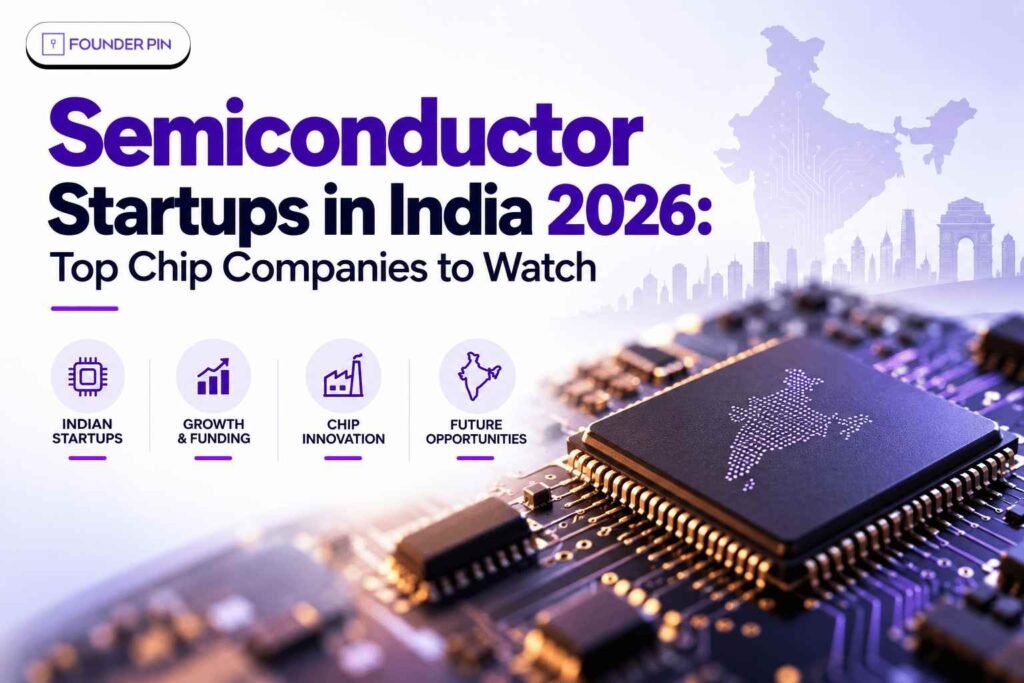
India’s semiconductor story is moving beyond policy announcements and into actual chip design, tape-outs, customer trials, and commercial production.
The government says 105 startups and MSMEs have received access to industry-standard EDA tools, while 24 semiconductor design projects have been approved for financial support. Semicon 2.0, approved in July 2026, also puts greater emphasis on chip design, materials, manufacturing, packaging, R&D and talent.
That creates an interesting opportunity for Semiconductor Startups in India. The companies below are worth watching because they are working on actual silicon, semiconductor IP, advanced materials or specialized chip architectures. If you want to understand the wider technology ecosystem first, explore FounderPin’s guide to Top 10 Deep Tech Startups in India to Watch in 2026.
Note: This is not a ranking. The companies are grouped by their technology focus and publicly documented progress.
Key Points
- India is building capabilities across chip design, packaging, fabrication and semiconductor materials.
- Mindgrove is developing RISC-V-based SoCs for IoT and embedded applications.
- Netrasemi has moved its AI chip into customer trials.
- Vervesemi focuses on analog and mixed-signal semiconductor products.
- AGNIT Semiconductors is building GaN technology for RF and power applications.
- Morphing Machines is developing adaptive computing silicon.
- FermionIC Design works on RF and high-speed mixed-signal chipsets.
- Signalchip has developed indigenous 4G/5G communication chips.
- InCore Semiconductors is building RISC-V processor IP and SoC-generation technology.
Why Semiconductor Startups in India Matter in 2026
India does not need to build only semiconductor fabs to become relevant in chips. The ecosystem also needs companies that design processors, develop intellectual property, create specialized accelerators, build RF components and develop advanced materials.
The government’s Semicon 2.0 framework specifically identifies design, machines and materials, fabs, ATMP/OSAT, R&D and talent development as six pillars of India’s semiconductor strategy.
This matters for startups because semiconductor development is a long game. A company can spend years developing IP and silicon before meaningful commercial revenue appears.
The opportunity is therefore much broader than simply asking, “Who is building a chip factory?”
For founders exploring adjacent technology opportunities, our guide to 20 Tech Startup Ideas for 2026 covers areas such as deep tech, AI, robotics, drones and other emerging technology businesses.
1. Mindgrove Technologies — RISC-V and Secure IoT Chips
Mindgrove is focused on fabless semiconductor design, with RISC-V-based SoCs targeting connected devices and edge applications.
- Founded: 2021
- Base: Chennai
- Focus: RISC-V, IoT, embedded systems, and edge computing
- Key product: Secure IoT S2401
- DLI support: ₹15 crore for Vision SoC
The company taped out its Secure IoT chip at 28nm and has been moving toward commercial production. Its chip targets products such as smart meters, locks, access-control systems and other connected electronics.
The company is also developing a Vision SoC for applications including cameras, ADAS and edge computing.
That combination of indigenous chip design and practical mass-market applications makes Mindgrove an important company to monitor as India’s fabless ecosystem matures.
2. Netrasemi — AI Chips for the Intelligent Edge
Netrasemi is developing AI semiconductor technology for edge applications such as cameras, robotics and automotive systems.
- Base: Kerala
- Focus: AI SoCs and edge computing
- Key chip: A2000
- Process: 12nm
- Backing: Zoho
In 2026, Netrasemi announced that its A2000 AI chip had reached production-ready status and entered customer trials.
The company has been testing the chip with customers in areas including surveillance and automotive applications, with commercial availability targeted for 2027.
The important point here is the shift from chip development to customer validation. For semiconductor startups, getting silicon into real-world trials is a major milestone.
3. Vervesemi Microelectronics — Analog and Mixed-Signal Silicon
Vervesemi is building machine-learning-enabled analog signal-chain ICs for industrial, energy, automotive, space and other applications.
- Founded: 2017
- Model: Fabless semiconductor company
- Focus: Analog and mixed-signal ICs
- 2026 funding: $10 million Series A
- Technology: ML-enabled analog signal-chain IP
The company raised $10 million in Series A funding in February 2026 to commercialize its semiconductor portfolio, productize existing silicon and expand R&D and engineering capabilities.
The company has also worked on motor-controller chips for applications such as BLDC fans, EVs and drones, alongside data-acquisition chips for avionics and space applications.
Its story illustrates another important part of India’s semiconductor opportunity: specialized chips can create value without competing directly with the world’s largest CPU or GPU manufacturers.
4. AGNIT Semiconductors — India’s GaN Bet
AGNIT Semiconductors is developing gallium nitride (GaN) technology for RF and power electronics.
- Founded: 2019
- Base: Bengaluru
- Origin: IISc ecosystem
- Technology: Gallium Nitride
- Applications: Defence, telecom and power electronics
GaN can offer advantages in high-frequency and high-power applications, making it relevant to areas such as radar, telecommunications and power electronics.
AGNIT raised $2.6 million in a 2026 funding round and said it aims to scale production significantly over the following two years.
The company is also evaluating the possibility of a GaN fabrication facility under India’s evolving semiconductor policy framework.
5. Morphing Machines — Reconfigurable Computing
Morphing Machines is developing adaptive computing technology designed to dynamically organize computing resources around workloads.
- Base: Bengaluru
- Core technology: REDEFINE
- Focus: Adaptive and reconfigurable computing
- Applications: AI inference, automotive, avionics and other compute-intensive workloads
The company reported in 2026 that its MuDRA chip had been taped out and returned from fabrication.
Its technology attempts to combine the flexibility associated with reconfigurable computing with the performance characteristics of specialized silicon.
The company also raised $4.38 million in 2026, adding to previous funding rounds.
For India’s semiconductor ecosystem, companies working on new computing architectures could become particularly relevant as AI workloads move from centralized cloud infrastructure toward edge devices.
6. FermionIC Design — RF and High-Speed Connectivity
FermionIC Design develops RF and mixed-signal semiconductor solutions for communications and high-performance systems.
- Founded: 2020
- Base: Bengaluru
- Focus: RF, mixed-signal and high-speed interfaces
- Applications: Radar, satellite communications, 5G and phased arrays
The company says its IP portfolio includes a 32Gbps NRZ SERDES designed for applications such as PCIe 5.0, USB4 and DisplayPort 2.0.
It is also working on RF chipsets for radar, satellite communications and 5G phased-array applications.
This is a less visible but strategically important part of semiconductor development: connectivity depends on specialized RF and high-speed interface silicon, not just processors.
7. Signalchip — Indigenous 4G and 5G Silicon
Signalchip is one of India’s established fabless semiconductor companies focused on wireless communication chips.
- Founded: 2010
- Base: Bengaluru
- Focus: 4G, 5G, RF and baseband
- Key technologies: LTE, 5G-NR, Wi-Fi and SDR
The company unveiled its 4G/LTE and 5G-NR modem chips in 2019. Its portfolio includes RF transceivers, LTE baseband platforms and integrated communication SoCs.
The company’s technology has also been used in communication systems developed with its sister company Signaltron.
Signalchip is worth watching because wireless infrastructure is a strategic semiconductor market where India can potentially build differentiated domestic IP rather than simply assemble imported components.
8. InCore Semiconductors — RISC-V Processor IP
InCore Semiconductors is focused on RISC-V processor IP and tools for developing custom SoCs.
- Focus: RISC-V
- Core offering: Processor IP and SoC-generation platform
- Application: Custom chip development
InCore’s approach is different from a startup selling one finished consumer chip. It provides processor IP and technology that other companies can use when building their own semiconductor products.
In 2026, the company highlighted taped-out silicon from partners using its IP, demonstrating the role of reusable processor technology in India’s growing fabless ecosystem.
As more Indian companies move from prototypes toward custom silicon, this type of semiconductor infrastructure could become increasingly important.
What Comes Next for India’s Semiconductor Startups?
The next phase will be less about announcing another chip and more about proving that chips can become sustainable products.
Three milestones matter:
1. From tape-out to volume production
A successful tape-out proves that a design works in silicon. Commercial volume production proves that the business can scale.
2. From government support to customers
Government programs can reduce the enormous cost of semiconductor R&D. But long-term success depends on OEMs, automotive companies, telecom operators, defence customers and electronics manufacturers adopting Indian-designed silicon.
3. From chip design to the full ecosystem
India will need more than fabless companies. It needs semiconductor materials, equipment, packaging, testing, design tools, IP, fabrication capacity and specialized talent.
The government’s 2026 Semicon 2.0 program explicitly recognizes this broader requirement.
FounderPin Perspective
The most interesting development in India’s semiconductor sector is not one particular company. It is the growing depth of the ecosystem.
India now has startups working across RISC-V processors, AI accelerators, analog chips, RF systems, GaN semiconductors, adaptive computing and semiconductor IP.
The hard part starts now: turning promising silicon into reliable products, repeat customers and sustainable businesses.
For founders and investors, that is where India’s semiconductor story gets much more interesting — and much less theoretical.
Build the Next Big Startup in India
India’s semiconductor ecosystem is expanding fast — but turning a technology idea into a scalable business takes the right strategy, funding plan, and execution.
FounderPin helps entrepreneurs with startup strategy, mentorship, fundraising, pitch decks, and growth support.
Ready to build your startup? Explore FounderPin’s programs or contact our team to get started.
FAQs About Semiconductor Startups in India
1. How many semiconductor startups are there in India?
India has more than 100 startups and MSMEs working on semiconductor design. The government reported that 105 startups/MSMEs had received access to industry-standard EDA tools, while 24 semiconductor design projects had received financial support under the Design Linked Incentive framework.
2. Which are the top semiconductor startups in India in 2026?
Some semiconductor startups and chip-design companies to watch in 2026 include Mindgrove Technologies, Netrasemi, Vervesemi Microelectronics, AGNIT Semiconductors, Morphing Machines, FermionIC Design, Signalchip, and InCore Semiconductors. They work across RISC-V, AI chips, analog and mixed-signal ICs, GaN, RF, adaptive computing and semiconductor IP.
3. What types of chips are Indian semiconductor startups developing?
Indian semiconductor startups are developing several types of silicon, including AI processors, RISC-V SoCs, IoT chips, RF components, analog and mixed-signal ICs, GaN devices, communication chips and semiconductor IP. Government-supported projects cover applications ranging from AI and telecom to drones, satellite communications, surveillance and smart meters.
4. Is India manufacturing semiconductor chips in 2026?
Yes. India’s semiconductor ecosystem has moved beyond chip design into manufacturing and packaging. The government reported that 12 semiconductor manufacturing-related units had been approved, including a silicon fab, a silicon-carbide fab, a gallium-nitride facility and nine packaging units. It also reported commercial production at facilities operated by Micron, Kaynes and CG Semi.
5. What government support is available for semiconductor startups in India?
Indian semiconductor startups can benefit from programmes such as the Design Linked Incentive (DLI) Scheme and Chips to Startup (C2S) Programme. Support can include financial assistance, access to EDA tools, semiconductor IP resources, fabrication or MPW support, prototyping and technical mentoring, depending on the programme and eligibility.
SHARE