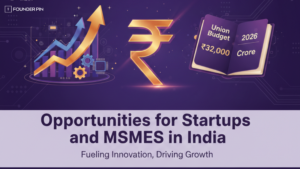
February 15, 2026 – India’s Union Budget 2026, unveiled by Finance Minister Nirmala Sitharaman on February 1, throws open the doors for startups and MSMEs like never before. The government has put aside ₹32,000 crore just for small businesses and new ventures. If you’re an entrepreneur, this budget brought unparalleled opportunities for entrepreneurs like you.
Understanding Budget 2026’s Strategy
The budget follows three main “Kartavyas,” or duties: boost economic growth with smart reforms, make the financial sector more resilient, and drive inclusive development using the latest tech. With the government aiming for around 7% GDP growth and planning to spend ₹12.2 lakh crore on capital expenditure—six times what was spent in 2015—the government wants infrastructure-led growth to lead the way.
Major Funding Schemes for Startups and MSMEs
This year, four major funding programs stand out:
Fund of Funds for Startups (₹10,000 Crore)
SIDBI will channel these funds into SEBI-registered venture capital. If a startup is DPIIT-recognized and has a scalable business model, the chances of finding the right investor become better.
SME Growth Fund (₹10,000 Crore)
Unlike regular loans, this fund offers risk capital to MSMEs with proper Udyam registration and clear GST records. The goal is to build “champion SMEs” that can compete on the global stage and help the companies weather disruptions in world trade.
Biopharma SHAKTI Initiative (₹10,000 Crore over 5 Years)
This program aims to supercharge India’s biologics and biosimilars manufacturing. It’ll set up 1,000+ clinical trial sites and speed up drug approvals. Pharmaceutical services, clinical research and biomanufacturing startups can utilise the growing ecosystem.
Self-Reliant India Fund Top-up (₹2,000 Crore)
Designed for micro-enterprises and emerging businesses, this extra funding gives risk capital and helps to expand when traditional banks refuse.
Seven Priority Manufacturing Sectors
The budget singles out seven manufacturing areas for special support.
| Sector | Allocation | Key Opportunity Areas |
| Electronics & Semiconductors | ₹40,000 crore | Precision parts, micro-tooling, component manufacturing |
| Biopharma | ₹10,000 crore | API production, biosimilars, clinical trial services |
| Rare Earth Materials | State partnerships | Filtration media, storage solutions, processing equipment |
| Chemicals | 3 dedicated parks | Industrial solvents, specialty chemicals, import substitution |
| Textiles | Multiple components | Technical textiles, engineered fabrics, export manufacturing |
| Containers | ₹10,000 crore | Shipping container parts, modular storage systems |
| Construction Equipment | Sector support | Component manufacturing, maintenance services |
If your startup works in or supplies to these sectors, you get priority in government contracts and can tap into sector-specific incentives.
Game-Changing Structural Reforms
TReDS Mandate for Working Capital
The Trade Receivables Discounting System (TReDS) becomes mandatory for all Central Public Sector Enterprises (CPSEs) purchasing from MSMEs. This reform addresses the chronic cash flow problem where businesses wait 60-90 days for payments.
The government now requires all Central Public Sector Enterprises to use the Trade Receivables Discounting System (TReDS) when buying from MSMEs. This eliminates the 60-90 days of waiting for payments.
Key benefits include:
- Immediate liquidity through invoice discounting
- Credit guarantees via CGTMSE
- Integration with Government e-Marketplace (GeM)
- Secondary market trading of receivables
You can turn invoices into cash in days, not months. Key benefits include instant liquidity, credit guarantees, integration with the Government e-Marketplace (GeM) and secondary trading of receivables.
Transfer Pricing Safe Harbor for IT/ITeS
The safe harbor margin jumps to 15.5%, with a new threshold of ₹2,000 crore (up from ₹300 crore), and a five-year lock-in. Startups planning to expand globally now get more certainty and less compliance headaches.
Data Center Tax Holiday
If you’re building data centers in India—whether you’re a local or foreign company—you get a 100% tax exemption until 2047. That’s a 21-year holiday. For SaaS and tech startups, this means better, faster and much cheaper hosting.
Tax Reforms Impacting Startups
New Income Tax Act 2025
Starting April 1, 2026, the new Income Tax Act kicks in, replacing the old 1961 law. It’s simpler, with fewer sections. Startups need to take a close look at their tax strategies under this new framework.
Buyback Taxation Changes
Share buybacks now get capital gains treatment rather than being taxed as dividends.
| Investor Type | STCG | LTCG | Additional Tax (Promoters) |
| Non-Promoter | 20% | 12.5% | None |
| Domestic Promoter | 22% | 22% | +2-9.5% |
| Foreign Promoter | 30% | 30% | +10-17.5% |
ESOP holders and angel investors stand to gain the most.
GST Export Benefits
Intermediary service exports are now zero-rated—no IGST, and you can claim full input tax credit. This is a big win for service exporters.

Digital Infrastructure and Skill Development
The government is boosting skill development spending by 62%, jumping from ₹6,100 crore to ₹9,886 crore. This includes:
- ITI modernization with ₹6,140 crore
- AVGC (Animation, VFX, Gaming, Comics) labs in 15,000 schools and 500 colleges
- National Institute of Hospitality for tourism training
These steps are shaping a much stronger talent pool for startups over the next few years.
Clean Energy Opportunities
With ₹32,915 crore set aside for renewables and another ₹20,000 crore for Carbon Capture Utilization and Storage (CCUS) over five years, cleantech startups have a lot to look forward in to:
- Battery manufacturing (with duty exemptions on raw materials)
- Solar and renewable energy systems
- CCUS equipment and services
- Energy storage solutions
Export-First Strategy
Budget 2026 is all about getting startups ready to export from day one. There’s more flexibility in SEZs, better logistics corridors, and easier compliance. Startups that focus on exports right from the start end up with stronger pricing power, more mature processes, and operations they can repeat and scale. Investors notice, too, so scaling up becomes a real possibility.
What’s Missing in Budget 2026
Even with all this support, some important things are still left out. Tax benefits under Section 80-IAC haven’t been extended beyond startups older than 10 years. There’s still no reform on ESOP tax deferral. The patent box regime is missing, and labor law codes are still waiting for implementation.
Action Plan for Entrepreneurs
Immediate Steps (0-3 Months):
- Check if you have DPIIT recognition—if not, get it.
- Make sure your Udyam and GST registrations are up to date.
- Review how your business lines up with the government’s priority sectors.
- Start assembling documents you’ll need to apply for government schemes.
Medium-Term Actions (3-6 Months):
- Work up detailed proposals for the most relevant schemes.
- Get digital compliance systems in place.
- Fine-tune your tax plan to fit new rules.
- Start building relationships with institutional investors.
Long-Term Strategy (6-12 Months):
- Develop export-ready quality standards.
- Scale up in sectors the government is backing.
- Use TReDS to keep your cash flow healthy.
- Invest in technical skills and certifications.
Conclusion
Union Budget 2026 is more than just numbers on a page—it’s a blueprint for growing startups and MSMEs. With ₹32,000 crore in direct funding, big reforms like TReDS, focused support for seven manufacturing sectors, and simpler compliance, the stage is set. If you’re prepared, you can really thrive.
To succeed, you need to dig into these provisions, align your business with national priorities, stay compliant, and move fast when opportunity knocks. Whether you’re starting something new or trying to take your MSME global, Budget 2026 brings the capital, infrastructure, and regulatory push you need to build something world-class. The real question isn’t whether the chances are there—it’s whether you’re ready to grab them.
Frequently Asked Questions (FAQs)
Q1: How do I access the ₹10,000 crore Fund of Funds for my startup?
First, make sure your startup is recognized by DPIIT. Then, reach out to SEBI-registered venture capital funds that get their funds from SIDBI. These funds look for scalability, innovation, and compliance when they decide where to invest.
Q2: What’s required to qualify for the SME Growth Fund?
You’ll need a valid Udyam registration, solid GST compliance, audited financials, and proof you can compete in markets—especially those hit by trade issues.
Q3: How does TReDS improve cash flow?
With TReDS, you upload invoices from CPSE buyers and get them discounted right away, instead of waiting months for payment. The platform also gives credit guarantees and works with GeM to speed up financing.
Q4: Which manufacturing sector has the best opportunities for new startups?
Electronics and semiconductors (with a ₹40,000 crore budget) and specialty chemicals (three new parks) offer the best mix of opportunity and low competition. Still, pick a sector based on your own strengths and market access—not just on the size of the allocation.
Pingback: Ultimate Guide to Startup Fundraising in India 2026 - Founder Pin