A Practical Founder’s Guide to Avoid Costly Mistakes
Introduction: Why Startup Idea Validation Matters More Than Ever
Every founder starts with an idea. But statistics consistently show that most startups fail not because of poor execution—but because they build something nobody truly needs.
In today’s competitive startup ecosystem, validating your idea before investing time, money, and energy is no longer optional—it’s essential. Whether you’re a first-time entrepreneur or a serial founder, startup idea validation helps you reduce risk, gain clarity, and build with confidence.
In this guide, we’ll break down a step-by-step, founder-tested approach to validating your startup idea—before you write a single line of code or hire a team.
What Is Startup Idea Validation?
Startup idea validation is the process of testing whether a real market exists for your idea. It helps answer three critical questions:
- Is this a real problem?
- Do people care enough to pay for a solution?
- Can this become a scalable business?
Validation is not about guessing or asking friends for opinions. It’s about collecting evidence from real users in real-world conditions.
Why Most Startup Ideas Fail
Before diving into the process, it’s important to understand why startups fail in the first place. According to industry research, the top reasons include:
- No market need
- Poor product-market fit
- Misunderstanding customer pain points
- Building too much, too early
- The common thread? Skipping validation.
Founders often fall in love with solutions instead of problems. Validation forces you to reverse that mindset.
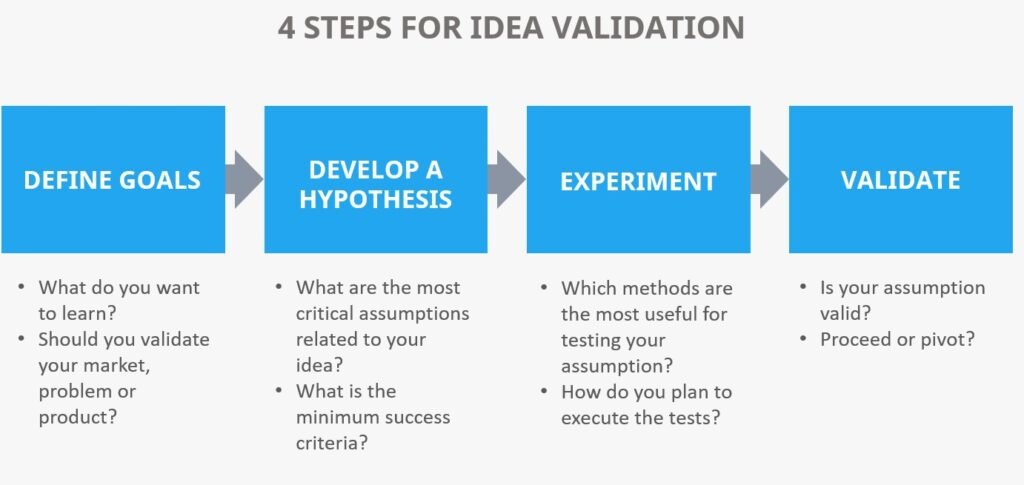
Step 1: Clearly Define the Problem (Not the Solution)
Great startups begin with painful problems, not flashy ideas. Instead of saying: “I want to build an AI app for productivity.” Ask: “Who struggles with productivity, and why?”
Action Steps:
- Write the problem in one clear sentence
- Identify who experiences this problem daily
- Understand how they currently solve it (or don’t)
If the problem feels vague or “nice to have,” that’s a red flag.
Step 2 : Identify Your Ideal Customer Persona
You can’t validate an idea without knowing who you’re validating it with. Create a simple customer persona:
- Age / role
- Industry
- Daily challenges
- Existing tools they use
- Budget constraints Avoid targeting “everyone.” Strong startups begin with a narrow, clearly defined audience.
Step 3 : Conduct Customer Discovery Interviews
Customer interviews are one of the most powerful validation tools—when done correctly.
How to Do It Right:
- Speak to at least 10–20 potential users
- Ask about their problems, not your idea
- Avoid pitching during interviews
- Look for repeated patterns
Questions to Ask:
- What’s the hardest part of your day related to this problem?
- How do you solve it today?
- What happens if this problem isn’t solved?
If people are emotionally invested in the problem, you’re onto something.
Step 4 : Validate Demand Using Simple Experiments
Validation doesn’t require a full product. In fact, the best validation methods are lightweight and fast.
Proven Validation Methods:
- Landing page with a clear value proposition
- Email waitlist signups
- Pre-orders or early access offers
- Manual or no-code MVPs
The goal is to test real intent, not just interest.
Step 5 : Measure the Right Validation Signals
Not all feedback is equal.
Strong Validation Signals:
- People ask when they can use it
- Users are willing to pay or commit time
- Organic referrals or word-of-mouth
- Clear, repeatable use cases
Weak Signals:
- “Sounds cool”
- Likes without action
- Friends and family enthusiasm
Validation is about behavior, not compliments.
Common Startup Idea Validation Mistakes
Even experienced founders make these mistakes:
- Asking leading questions
- Validating with the wrong audience
- Overbuilding before testing
- Ignoring negative feedback
- Relying only on surveys
Remember: bad news early is good news. It saves time and money.
How Validation Connects to Building an MVP
Once your idea is validated, you’re ready to move toward an MVP (Minimum Viable Product). A validated idea ensures:
- Faster product-market fit
- Better investor conversations
- Higher user retention
- Lower burn rate
How Founderpin Helps Founders Validate Smarter
Founderpin exists to support founders at every stage—from idea to scale. By combining:
- Founder-focused resources
- Practical startup tools
- Community-driven insights
Founderpin helps entrepreneurs avoid common early-stage mistakes and move forward with clarity and confidence.
Final Thoughts : Validate Before You Build
Startup success doesn’t come from working harder—it comes from working smarter. Validating your startup idea:
- Reduces risk
- Saves capital
- Increases confidence
- Improves long-term outcomes
Before you build, pitch, or raise—validate first.