
*Note: Fee and revenue figures are approximate; actual values vary by location and model.
1. Amul Scooping Parlour (Ice Cream & Dairy)
Quick Answer: Amul parlours allow entrepreneurs to sell ice-creams and dairy products under India’s largest dairy brand. Startup capital (~₹3–6 lakh) covers shop fit-out; there’s no franchise fee or royalty. Expected monthly sales are around ₹3–6 lakh, with franchisee margins up to ~50% on ice-cream items.
Details: Amul’s co-operative GCMMF has ~9774 Cr turnover and thousands of parlours nationwide. A small Amul outlet (100–150 sqft) costs ~₹3 L to set up. Franchisees pay no fee or revenue share; the model relies on wholesale supply at set prices. Margins vary: pouch milk ~2–3%, milk products ~9%, ice-cream scoops ~20% of sales. In high-traffic locations, monthly revenue can reach ₹6 lakh.
Tip: Negotiate a high-visibility spot (railway stations, malls) to hit sales ~₹50–60k daily. Stock only Amul products to get brand trust and margins.
2. Tea Time (Tea & Beverages)
Quick Answer: Tea Time is a fast-growing tea chain with 4,000+ outlets. It requires about ₹5 lakh upfront, which includes all equipment (fridge, stove, freezer). Profit margins are very high (40–80%) and the average payback is 5–10 months.
Details: Tea Time sells masala tea, shakes and snacks at Rs.15–99 price points. Franchisees get a complete setup kit for ₹5 lakh and earn 40–80% gross margin. Such margins come from low ingredient costs. For example, a ₹20 cup of tea might cost only ₹4 to make. Brand support (recipe training, marketing) and a loyal customer base help boost daily sales. Its 4000+ outlets across India attest to the concept’s popularity.
Typical monthly revenue varies by location. In tier-1 areas, a unit can do ₹50–100k sales daily (₹15–30L/month). With 40–80% margins, that means ₹6–12L gross profit monthly. The website also notes average payback in 5–10 months – one of the fastest among budget franchises.
Tip: Focus on volume and upsell (add snacks). Busy transit hubs or college campuses work best. With limited ₹5L investment, you’ll recoup costs quickly thanks to high customer frequency and minimal input costs.
3. SALADO (Healthy Salad & Wrap Franchise)
Quick Answer: SALADO offers a healthy food kiosk/cloud kitchen franchise for just ₹3–5 lakh. Monthly revenue is modest (₹1–4 lakh, depending on model) but profit margins are large (30–50%). It targets growing demand for salads and protein bowls.
Details: SALADO’s model is for 100–300 sqft: either a mall/kiosk or a small cloud kitchen. Investment is low: kiosks need ~₹5L, cloud kitchens as little as ₹2–3L. They provide training and marketing support. Because they serve healthy food, costs are mostly fresh produce – still margins run 30–50%. The website claims a break-even in 12–18 months. A high-traffic franchise can see ₹1.5–3L revenue monthly (kiosk), or ₹1–1.5L for delivery-only setups.
The niche positioning (salads, protein bowls) means lower competition than fast food. But it also means customer education is needed. The brand promises “0 food wastage” (everything is cooked per order).
Tip: Use food delivery apps aggressively. With modest volume (Rs.50k/day) and 40%+ margins, even a ₹4L setup can turn a profit after a year. Keep overhead low by focusing on takeaway/delivery.
4. T Café (Premium Tea & Snacks)
Quick Answer: T Café is a boutique tea-and-snacks franchise. Initial investment is only ₹2–5 lakh, with a brand fee of ₹1 lakh. Franchise India lists its ROI at ~40% and payback 1–2 years. Space needed is 150–200 sqft (mall or high street kiosk).
Details: Launched in 2020, T Café sells teas (masala, green, herbal) and fresh snacks. The concept emphasizes high-quality, “celebratory” tea. Franchise India notes the small investment (₹2–5L) and modest fees. The limited menu and small format keep costs low. Because each unit requires little staff, margins remain healthy (~40%).
T Café is newer (only a few outlets) but aims at urban markets (South India). The “expected ROI 40%” suggests a successful unit might turn ₹40k profit on ₹100k sales per month. Payback in 1–2 years is typical for café franchises in this segment.
Tip: Leverage social media (Instagram) to highlight “artisanal tea”. Staff training is provided, but hire friendly employees to create repeat customers. With just 2–3 staff, you keep margins high and break even faster.
5. Patanjali Store (Ayurvedic/FMCG Retail)
Quick Answer: Patanjali Ayurved’s small-store franchise costs about ₹5 lakh to start. These outlets sell Patanjali-branded FMCG products. There’s usually a small security deposit but no high royalty. With a known brand, profits can be good if footfall is steady.
Details: Owned by Baba Ramdev, Patanjali has built a huge presence (47,000+ retail counters nationwide). A basic Patanjali store (“Gramodhyog Nyas” scheme) can start at ₹5 lakh. That includes shop fittings and initial stock. The brand’s FMCG margins vary (some items have 20–30% margin). For example, personal-care items and spices yield ~20% margin, while proprietary medicines can be higher.
No official payback data is published. However, traditional retail franchises in India often break even in 12–24 months, depending on location. Advantages include Patanjali’s strong brand and a loyal customer base. Disadvantages: competition from other grocery chains and the ₹5L upfront risk.
Tip: Use in-store offers to attract customers. For instance, bundle popular Patanjali oils or supplements. Since Patanjali often requires franchisees to buy a minimum stock regularly, negotiate credit terms with distributors if possible to ease cash flow.
6. DTDC Courier (Logistics Partner)
Quick Answer: DTDC is a well-known courier network. Its channel partner program is very affordable – franchise models start around ₹50,000 for a basic outlet (plus working capital). There is no royalty fee; income comes from commission on deliveries. A partner can earn ₹30k–70k per month (depending on volume).
Details: DTDC has 16,500+ partners across India, showing its wide reach. It offers several models (office outlet, delivery partner, etc.). The low-end “Flex” partner can begin with ~₹50,000 capital, focusing on drop-off and pick-up services. This simplicity (often just a small office with computer) reduces costs. Revenues come from parcel charges – e.g. Rs.100 per domestic courier. Typically, a small DTDC outlet does 200–300 shipments/day. At ~₹40 profit each (after paying DTDC), that’s ~₹8–12k daily, or ₹2.5–4L per month. After rent/expenses, take-home ₹30–70k is realistic.
Because there’s no royalty (unlike many franchises), all revenue above expenses is yours. The trade-off is modest earnings and competition from other couriers.
Tip: Partner with local e-commerce sellers and MSMEs – they can send parcels in bulk. Use DTDC’s tech (live tracking app) to streamline operations. Meeting DTDC’s quality standards (timely pickup) can earn you higher rebates.
7. Delhivery Delivery Service (Logistics Partner)
Quick Answer: Delhivery, a major express logistics company, offers franchise/agent roles. Initial investment is typically ₹50,000–2 lakh for a booking center model (no royalty). Earnings come per pickup/delivery. In major cities, a small Delhivery center can net ₹40–80k/month.
Details: Delhivery has grown rapidly due to India’s e-commerce boom. Franchisees operate booking or delivery outlets, taking a fixed fee per parcel. Unlike DTDC, Delhivery often needs a bit more setup (e.g. pickup van, basic staff). However, their brand and tech platform attract high volumes. No official numbers are public, but anecdotal reports suggest modest fixed income: e.g. 200 shipments @Rs.50 profit each yields ₹10k/day gross. After running costs, net ~₹1–2L per month in good markets. Break-even can be ~6–12 months once operations stabilize.
Caveats: Courier competition is stiff; one must ensure reliable service.
Tip: Focus on B2B clients (shops sending returns). Delhivery offers training and integration; use them to streamline billing. Keeping overhead low (partner with existing retail space) will speed up payback.
8. Mobile Store (Electronics Retail)
Quick Answer: A branded mobile phone/accessory shop can be started for ~₹3–5 lakh (stock + rent). Franchise schemes (e.g. Oppo, Samsung) sometimes have no fee but require store fit-out. Monthly revenue can be ₹1–2 lakh with ~10–15% gross margins. Payback is usually 12–24 months.
Details: While not a single “brand name” franchise, many mobile brands support retail partners. For ₹5 lakh, you can lease ~150 sqft, furnish counters, and stock phones/accessories. If monthly sales hit ₹1.5L (60 phones+accessories), a 12% margin yields ₹18k gross. Overheads (rent, staff, telecom) are high, so net profit might be ~₹5–8k/month. Clearly, payback is slower here. The advantage is steady demand for repair/charging/accessories.
Tip: Combine phone sales with repair services (higher margin). Localize by offering preloaded accessories (cables, earphones). If tied to a telecom company franchise (e.g. Airtel), you might get franchise fees waived but earn a commission on plans.
9. Bakery Counter (Food Retail)
Quick Answer: A small bakery or patisserie counter can get started for around ₹3–5 lakh for a compact shop or kiosk. Products like bread and cookies typically run 50–60% gross margins, and monthly revenue usually lands somewhere between ₹1–2 lakh — which could mean ₹20–40k in profit. Payback tends to fall around 12–18 months.
Details: Brands like BreadTalk, along with some smaller local bakery names, occasionally offer lower-investment kiosk models in the ₹3–5 lakh range. The oven and display fridge end up being your biggest costs. Say daily sales hit ₹5k — at a 55% margin, that’s roughly ₹2.75k gross. Once ingredients and overhead are factored in, you’re left with about ₹1k net per day, which works out to around ₹30k a month. At that pace, a ₹4 lakh investment pays itself back in roughly 14 months.
Trade-offs: Fresh goods spoil quickly, so getting demand forecasting right matters a lot here. There’s not much room for inventory waste before it eats into margins.
Tip: Set up in a busy market or office area if you can. A few signature items — cookies, cupcakes, whatever becomes your thing — help build repeat customers. And baking some items in-house, where possible, keeps costs down further.
10. Water Purifier Dealer (Home Appliances)
Quick Answer: Becoming a local dealer for an RO water brand (e.g. Kent, Aquaguard) can start around ₹2–4 lakh for machines and setup. Sales are ₹50–80k/month in a mid-sized area, with 20–30% margins. Payback is generally 12–24 months.
Details: Franchises aren’t mandatory; distributors supply machines to small dealers. The investment buys demo models and service equipment. With one or two technicians, dealers install 10–20 units/month @₹10k each. Profit ~₹2–3k per unit. At 15 installs/month, that’s ~₹40k profit. These units often continue yielding service revenue (filters replacement).
Pros: Non-food, essentials; works in any market. Cons: Requires tech know-how for service.
Tip: Offer doorstep installation and subscription for filters. Build a network of plumbers for installations. The recurring filter-sales business can double profits over time.
7 Key Facts and Insights
- Minimal Fees: Major franchises like Amul and Tea Time charge no recurring royalty. You primarily pay your initial investment.
- High Margins: Dessert/tea chains often see 40–70% gross margins on products.
- Rapid ROI: Many food/cafe franchises under ₹5L break even in 6–12 months. For example, Tea Time cites a 5–10 month payback.
- Monthly Sales: A well-placed Amul parlour can sell ₹3–6 lakh per month. A small tea/coffee kiosk may do ₹5–10k per day.
- No Expertise Needed: Franchisors provide training. T Café and SALADO emphasize full startup support and recipes.
- Hidden Costs: Always ask for total setup cost. TBWX warns a ₹2L franchise can need ₹5L when adding equipment.
- Growing Demand: Logistics franchises (DTDC/Delhivery) ride e-commerce growth. DTDC boasts 16,500+ partners nationwide, showing market scale.
How Should You Choose the Best Franchise Under ₹5 Lakh?
Don’t pick a franchise just because you recognize the brand name. Sit down and compare the full economics before you sign anything.
Here’s a checklist worth working through:
1. Add up the total investment
Not just the franchise fee — factor in interiors, equipment, deposit, stock, rent, staff, and working capital too. All of it adds up fast. This same principle applies when evaluating any new business: start with the total economics rather than focusing only on the advertised investment. FounderPin’s guide to Best Startup Business Ideas in India for 2026 With Low Investment and High Profit also explains how to assess investment, demand and profitability before getting started.
2. Look closely at the royalty
A low upfront cost can turn expensive quickly if the franchisor’s taking a hefty ongoing royalty on top of it.
3. Study the location carefully
For a lot of these businesses, location ends up mattering more than the brand itself.
4. Talk to existing franchisees
Reach out to people already running this franchise. Ask about actual sales, real costs, how much support they’re getting, and what’s been genuinely hard about it.
5. Actually read the agreement
Go through territory rights, renewal terms, termination clauses, supply restrictions, and payment obligations before you commit to anything.
6. Keep some money aside
Don’t pour your entire ₹5 lakh into setup. If the franchise eats up all your capital on day one, you might struggle just to keep things running through the first few months.
What Does ₹5 Lakh Actually Cover?
A ₹5 lakh franchise budget should include more than the franchise fee. Your real startup requirement may be higher after adding rent, deposits and working capital.
Before investing, calculate:
Franchise Fee + Interiors + Equipment + Initial Inventory + Rent Deposit + Licences + Staff + Marketing + Working Capital = Total Startup Cost
This distinction is extremely important. If you’re considering a business outside the franchise model, you can also compare the capital requirements of different lean business models in our guide on How to Start a Business with Zero Investment in India.
For example, a franchise may advertise a ₹3 lakh setup, but your actual cash requirement could be higher if the quoted amount excludes property costs, rent deposit or working capital.
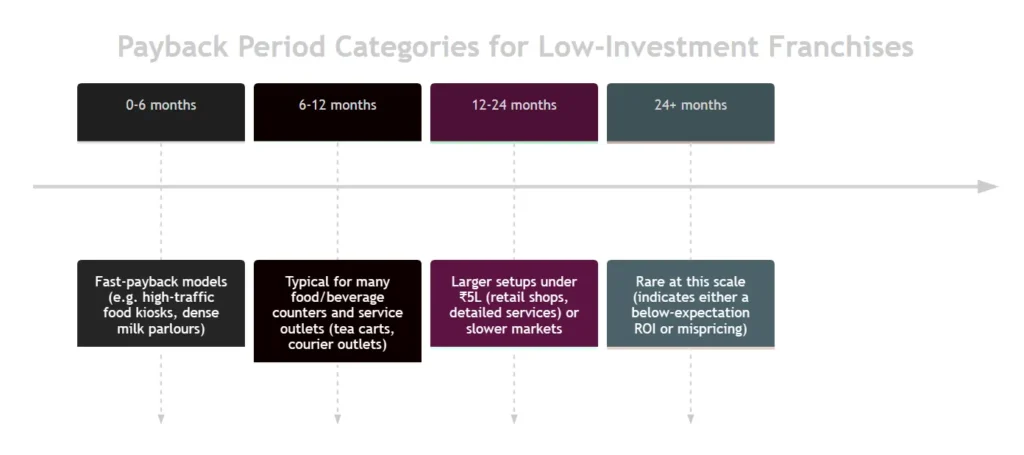
Mermaid Timeline: Payback Period Categories
Which Is the Best Franchise Under ₹5 Lakh?
For a strong established-brand option, Amul is worth considering. For a tea-focused business, Tea Time is one of the clearest ₹5 lakh options based on its published franchise information.
If you prefer healthy food, SALADO offers smaller-format models. Entrepreneurs who want to avoid food operations can instead investigate logistics partnerships such as DTDC.
Your decision should not be based only on the lowest franchise fee.
Consider:
- Total investment
- Working capital requirement
- Location and rent
- Franchise or partner fee
- Royalty and recurring charges
- Product margins
- Brand support
- Training
- Territory protection
- Inventory requirements
- Break-even assumptions
- Exit and renewal conditions
Final Thoughts
The best franchise businesses under ₹5 lakh in India are not necessarily the ones with the lowest advertised investment. The better opportunity is the one whose complete economics make sense after accounting for rent, inventory, staff, working capital and local demand.
Amul and Tea Time stand out because they publish relatively clear low-investment formats. SALADO and T Café may appeal to entrepreneurs looking for smaller food concepts, while DTDC and other logistics partnerships offer a different route for people who prefer service businesses.
Before signing anything, verify the latest investment amount, franchise agreement, royalty structure, territory rights and operating costs directly with the company.
A ₹5 lakh budget can get you into the franchise market—but smart due diligence determines whether it gets you a business or just a bill.
Thinking through which low-investment franchise actually fits your city and budget? FounderPin helps first-time entrepreneurs evaluate business models before they commit — reach out for a consultation.
Frequently Asked Questions
Which is the best franchise under ₹5 lakh in India?
There is no single best franchise for everyone. Amul and Tea Time are among the better-known options that publish low-investment formats, while SALADO and T Café offer smaller food and beverage models. Your location, skills and available working capital should determine the final choice.
Can I start a franchise business with ₹5 lakh?
Yes, some franchise and partner models can fit within or around ₹5 lakh. However, you should keep additional funds available for rent deposits, working capital, licences, staff and unexpected expenses.
Which franchise has the lowest investment in India?
Low-investment opportunities vary by business model. Courier and service partnerships can require less upfront capital than physical food outlets, but their commercial terms differ by location and partner model.
Is a ₹5 lakh franchise profitable?
It can be, but profitability is not guaranteed. Sales, gross margin, rent, staff expenses, working capital and local demand determine the actual return.
Is a franchise better than starting an independent business?
A franchise can provide an established brand, operating processes, training and marketing support. An independent business offers greater control but requires you to build the brand, processes and customer base yourself.