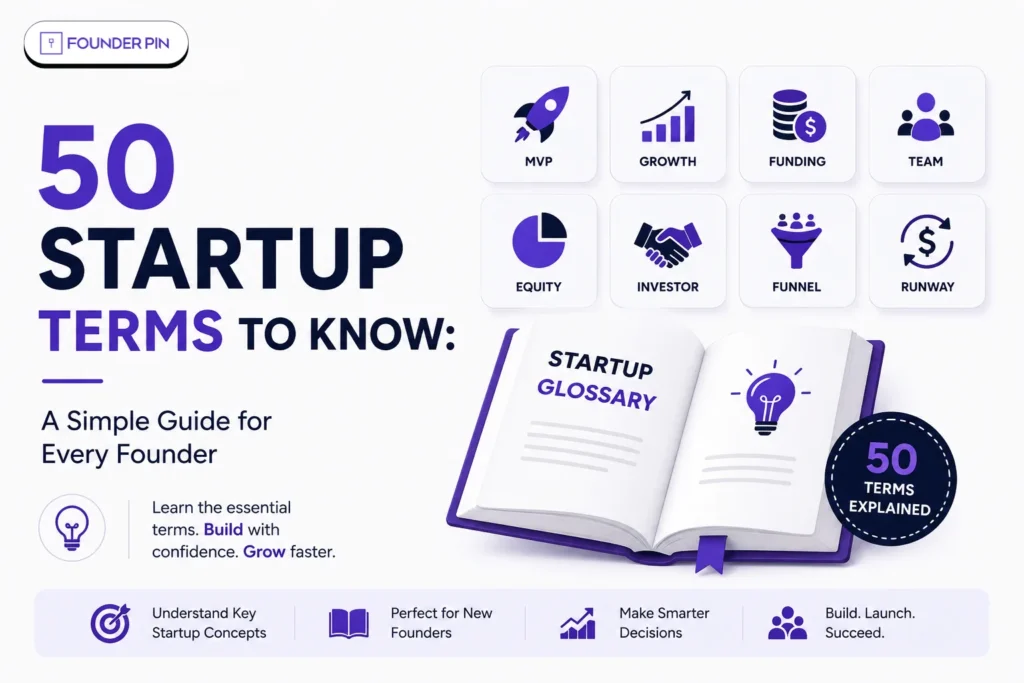
Startup terms are the language founders use to discuss products, funding, ownership, financial health and growth.
Words such as valuation, dilution, runway, CAC, LTV, SAFE and cap table can sound complicated when you first encounter them. But once you understand what each term means—and how it affects your company—the conversations become much easier.
This guide explains 50 common startup terms in plain English, with simple examples where they are useful.
Important: These are simplified educational definitions. Legal, tax and accounting treatment can vary by country and company structure. Indian founders should get professional advice before signing investment, equity, ESOP or financing documents.
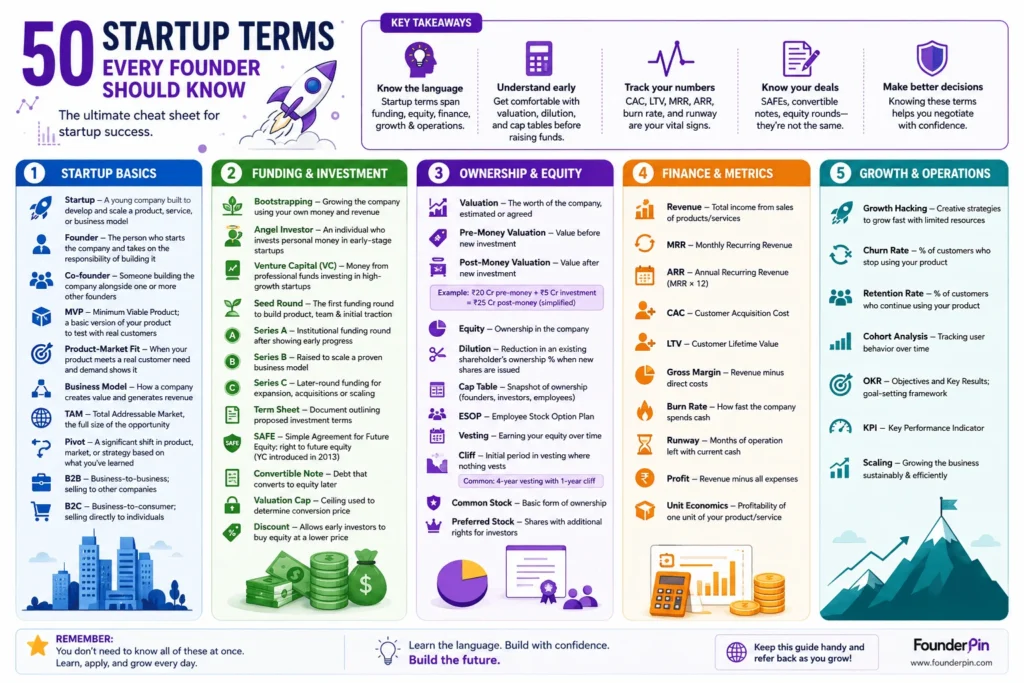
Key Takeaways
- Startup terminology covers a lot of ground — fundraising, ownership, finance, growth, day-to-day operations
- Before raising any money, get genuinely comfortable with valuation, dilution, and cap tables
- Numbers like CAC, LTV, MRR, ARR, burn rate, and runway are basically your business’s vital signs
- SAFEs, convertible notes, equity rounds — they’re not interchangeable, and the differences actually matter
- Once these terms click, decisions get easier and negotiations get a lot less intimidating
1. What Are the Essential Startup Terms Every Founder Should Know?
The easiest way to actually learn this stuff is to group similar ideas together rather than memorizing terms one by one. Here are 50 words founders tend to run into as their companies grow — starting with the basics.
Startup Basics
- Startup —A startup is a company designed to solve a problem and develop a business model with the potential to grow significantly.
Not every new business is a startup. A local shop can be a new business without having the same scalability objective.
- Founder — The person who starts the company and takes on the responsibility of building it. These financial terms also connect closely with the legal side of building a company. Before signing investment or founder documents, founders should understand the legal documents required for startups in India.
- Co-founder — A co-founder is someone who starts and builds a company alongside one or more other founders.
- MVP —MVP stands for Minimum Viable Product.
It is an early version of a product containing enough functionality to test an important assumption with real users.
Why it matters: An MVP should help you learn, not simply be a smaller version of the final product.
- Product-Market Fit – describes a stage where a product consistently solves an important customer problem and shows strong evidence of sustained demand, retention or willingness to pay.
There is no single universal metric that proves PMF.
- Business Model —A business model explains how a company creates value for customers and generates revenue.
Examples include subscriptions, marketplaces, transaction fees, advertising and direct sales.
- TAM —
TAM means Total Addressable Market.
It represents the total potential market demand for a product or service if the entire relevant market were served.
A related distinction:
- TAM: Total potential market
- SAM: Portion your business can target
- SOM: Portion you realistically expect to capture
- Pivot — A meaningful shift in a startup’s product, target market, or overall strategy, usually driven by something the founders learned along the way
- B2B — Business-to-business — you’re selling to other companies, not individual people
- B2C — Business-to-consumer — here, you’re selling directly to individual customers
2. Which Startup Funding Terms Should Founders Understand?
Funding conversations get confusing fast, and for good reason — there’s a lot riding on knowing exactly what you’re offering an investor and exactly what they get in return.
Funding & Investment
- Bootstrapping — Growing the company mostly on your own money and whatever revenue comes in, rather than taking outside investment
- Angel Investor — Someone investing their own personal money, usually into a company at its earliest stage. For founders raising their first outside capital, understanding how angel investors evaluate startups can be just as important as knowing the terminology. You can also explore our guide to angel investors in India.
- Venture Capital (VC) — Money from professional investment funds, going into startups they believe could grow significantly
- Seed Round — An early-stage financing round used to fund product development, hiring, customer acquisition and other steps toward proving and scaling the business.
If you’re still figuring out where your next round might come from, our guide to early-stage VC funds in India can help you understand the funding landscape before approaching investors.
- Series A — A priced equity financing round typically used by startups that have demonstrated meaningful early traction and need capital to build a repeatable growth engine.
- Series B — A later financing round generally used to scale a business that has established significant traction.
- Series C — A later-stage financing round that may fund expansion, acquisitions, new markets or continued scaling.
- Term Sheet — The document laying out the proposed terms of an investment before anything’s finalized — things like valuation, board structure, and investor protections
- SAFE — Simple Agreement for Future Equity. It gives an investor the right to future equity once certain conditions are met. Y Combinator introduced the SAFE in 2013, and its official documentation explains how different SAFE structures, valuation caps and ownership calculations work. Y Combinator SAFE Financing Documents
- Convertible Note — In India, convertible-note fundraising is subject to specific regulatory requirements, so founders should check whether their company and proposed transaction qualify before using one
- Valuation Cap — An estimate or agreed value assigned to a company, often used when determining the price investors pay for equity in a financing round.
- Discount — Lets an early investor buy equity at a lower price than what later investors pay in a future round
3. What Do Startup Valuation and Equity Terms Mean?
Equity decisions stick with you for years, so it’s worth actually understanding these terms before you sign anything.
Ownership & Equity
- Valuation — What the company’s worth, whether estimated or formally agreed upon
- Pre-Money Valuation — What the company was worth right before new money came in
- Post-Money Valuation — What it’s worth after that new investment gets added
Here’s a quick way to picture it: A ₹20 crore pre-money valuation plus a ₹5 crore investment gives a ₹25 crore post-money valuation. In this simplified example, the new investor owns 20% immediately after the investment.
- Equity — Ownership in the company, plain and simple. Founders, investors, employees — all of them can hold it
- Dilution — A reduction in an existing shareholder’s percentage ownership when a company issues additional shares. Your number of shares may stay the same while your percentage ownership falls.
- Cap Table — A snapshot showing who owns what percentage of the company, founders and investors and employees included
- ESOP — A plan that gives eligible employees the right to acquire shares later, usually after meeting vesting and other conditions. An option is not the same as owning shares immediately.
- Vesting — The process through which a founder or employee earns the right to shares or options over time or after meeting specified conditions.
- Cliff — The early stretch of a vesting schedule where nothing vests yet
A four-year vesting schedule with a one-year cliff is a common startup arrangement, but actual terms vary by company, jurisdiction and agreement
- Common Stock — Ordinary shares, generally the most basic form of ownership
- Preferred Stock — Shares that often come with extra rights investors get, beyond what common shareholders have
- Liquidation Preference — Determines who gets paid first, and how much, if the company gets sold or liquidated
4. Which Startup Metrics Should Founders Track?
Revenue alone doesn’t tell the whole story. Founders also need metrics that show how efficiently the company acquires customers, generates recurring revenue and manages cash.
Financial & Growth Metrics
35. Revenue — Income recognized from selling goods or services before operating expenses and other costs are deducted. Revenue is not necessarily the same as cash collected.
36. MRR — Monthly Recurring Revenue: the recurring revenue a business expects from active subscriptions or contracts in a mont.
37. ARR — Annual Recurring Revenue: an annualized view of recurring revenue, usually calculated as MRR × 12 for subscription businesses.
“MRR and ARR are operating metrics, not necessarily the same as accounting revenue reported in financial statements.”
38. CAC —(Customer Acquisition Cost)-The average sales and marketing cost required to acquire a new customer over a defined period. What you include in CAC should be consistent with the formula you use.
39. LTV —(Customer Lifetime Value) — An estimate of the value a customer generates over the expected relationship with the business. For unit economics, founders often calculate LTV using gross profit or contribution margin rather than revenue alone.
40. Churn — The rate at which customers or recurring revenue leave the business.
41. Burn Rate — The rate at which a startup uses cash to fund its operations.
42. Runway — The estimated amount of time a startup can continue operating before it runs out of cash.
A simple calculation is:
Runway = Available Cash ÷ Monthly Net Burn
This is a rough estimate assuming the burn rate remains reasonably stable
43. Gross Margin — The percentage of revenue remaining after direct costs associated with delivering a product or service.
44. Unit Economics — The financial performance of an individual unit, such as one customer, order or transaction.
5. What Growth and Strategy Terms Should Founders Know?
Once a startup moves beyond the idea stage, founders need to understand how growth actually happens—and whether it can continue efficiently.
Growth & Strategy
45. Traction — Evidence that customers want the product and that the company is making measurable progress.
46. Burn Multiple — A metric comparing cash burned with the amount of new revenue generated.
47. Growth Rate — The percentage increase in a business metric over a specific period.
48. Go-to-Market Strategy — A plan for reaching customers, positioning the product, setting pricing and generating sales.
49. Exit — A transaction or event that allows founders or investors to realize some or all of the value of their ownership, such as an acquisition, merger, secondary sale or IPO.
50. IPO — (Initial Public Offering) — The first public offering of a company’s shares to investors, after which the company’s shares can trade on a public market, subject to the applicable listing and securities rules.
Why Should Founders Learn These 50 Startup Terms?
Startup terminology isn’t about sounding impressive in front of investors. It helps founders understand what is happening to their business.
For example, a founder who understands a cap table can see how a new funding round affects ownership. A founder who understands CAC and LTV can judge whether customer acquisition makes economic sense.
A founder should become particularly comfortable with:
- Funding: Seed round, Series A, SAFE and convertible note
- Ownership: Equity, dilution and cap table
- Employee equity: ESOP, vesting and cliff
- Financial health: Revenue, burn, runway and gross margin
- Growth: CAC, LTV, churn and traction
- Strategy: MVP, product-market fit and go-to-market
- Long-term outcomes: Exit and IPO
A cap table, for example, becomes increasingly important as a startup adds investors, employee options and different types of securities.
Likewise, founders should not assume that a SAFE automatically means “free money.” Its terms can determine how much ownership investors eventually receive, so founders should model potential dilution before signing. Y Combinator specifically highlights the importance of understanding ownership and dilution when using post-money SAFEs.
How Should Founders Actually Use This List?
Don’t try to memorise all 50 terms at once — instead, learn the ones relevant to whatever stage you’re actually at right now, and revisit this list as you approach each new milestone. A founder raising a seed round needs terms 1–12 fluently; a founder approaching acquisition needs 41–50 far more urgently.
The real test of understanding any of these terms isn’t reciting the definition — it’s being able to explain what changes for you personally if that term applies to your specific deal.
Final Takeaway
These 50 Startup Terms to Know cover the vocabulary founders encounter from launching an MVP to raising capital, hiring employees and eventually exiting or going public.
The goal isn’t to memorize every definition overnight.
Instead, understand the terms that directly affect your money, ownership, customers and growth. And whenever an investor or advisor uses a term you don’t understand, stop and ask.
In startups, asking a “basic” question can sometimes save you from making a very expensive mistake.
Building your startup and want an outside perspective on your next funding round or key decision? Contact FounderPin today for a consultation, and let’s map out the right path for your business.