7 Shark Tank India Rejected Startups That Became Massive Successes
Table of Contents
Toggle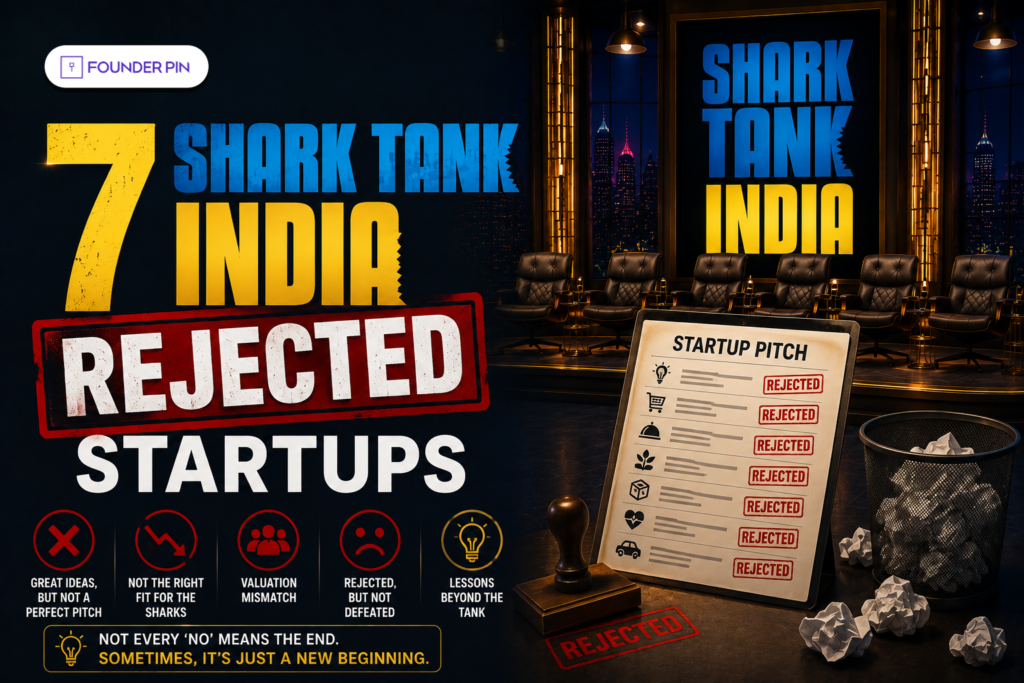
At FounderPin, we believe that rejection is often the beginning of a stronger entrepreneurial journey. Some of the most memorable Shark Tank India rejected startups left the show without a deal, only to build thriving brands and win the market on their own terms.
These stories are powerful reminders that investors can pass on a business for many reasons, including valuation concerns, category unfamiliarity, or differences in vision. However, customer demand and consistent execution ultimately determine a startup’s success.
In this article, we highlight seven genuine Shark Tank India rejected startups that did not secure investment from the Sharks but went on to grow into respected and successful businesses.
Why Some Rejected Startups Succeed Anyway
Not every great business aligns with an investor’s preferences at a specific moment.
Startups may be rejected because of:
- High valuations
- Limited traction at the time
- Category unfamiliarity
- Concerns about scalability
- Negotiation differences
Many founders use the Sharks’ feedback to strengthen their products, operations, and branding.
1. Moonshine
| COMPANY NAME | MOONSHINE |
|---|---|
| Founded | 2016 |
| Valuation | INR 160 Crores |
Rohan Rehani and Nitin Vishwas established Moonshine, the first meadery in Asia and India, in 2016. The oldest alcoholic beverage, mead, is made without artificial tastes or colours by fermenting honey with fruits and spices. The founders asked for INR 80 lakhs in exchange for 0.5% of the company when they appeared on Shark Tank India with a valuation of INR 160 crores. The sale was rejected because the founders did not find the counteroffer compelling, despite the fact that all the sharks showed interest.
2. Urban Monkey
| COMPANY NAME | URBAN MONKEY |
|---|---|
| Founded | 2013 |
| Valuation | INR 100 Crores |
Yash Gangwal launched the streetwear apparel company Urban Monkey in Mumbai in 2013. The brand, which was valued at INR 100 crores and targeted young Indians, made an appearance on Shark Tank India.
Celebrities like Rannvijay Singha and Raftaar have praised its product collection, which includes caps, sunglasses, belts, bags, clothes and more. Despite the brand’s success, the sharks turned down Yash’s request for an INR 1 crore investment in exchange for 1% stake.
3. Morriko Foods
| COMPANY NAME | MORIKKO FOODS |
|---|---|
| Founded | 2017 |
| Valuation | INR 33.33 Crores |
Morriko Foods is a Gujarat-based company that focuses on solar-dehydrated fruit and vegetable powders. Bipin Shah originally founded the business in 2002 under the name Kamdhenu Foods. Later, Tanmay Shah and Kalyani Shah joined the company, and the founders rebranded it as Morriko in 2017. The company mainly promotes healthy snacking through nutritious and natural food products.
The brand sells mango chunks, guava chunks, drumstick powder, herbal drinks, and several other healthy products. In addition, Morriko uses solar dehydration technology to preserve nutrients naturally and improve shelf life. Later, the company appeared on Shark Tank India with a valuation of INR 33.33 crores. The founders asked for an investment of INR 1 crore in exchange for 3% equity. However, they decided not to accept the counteroffers from the Sharks.
Also Read | 5 Shark Tank India Success Stories That Crossed ₹100 Crore Revenue
4. ExperientialEtc
| COMPANY NAME | EXPERIENTIALETC |
|---|---|
| Founded | 2017 |
| Valuation | INR 50 Crores |
Another prosperous company is ExperientialEtc, a premier experiential marketing firm that crafts remarkable experiences. The Mumbai-based firm, which was founded in 2017 by Karan Bhardwaj and Prashant Pandey, is worth INR 50 crores.
ExperientialEtc uses magical LEDs, life-size kinetic sculptures, projection mappings, and 3D holographic projections to improve communication. For digital needs, the business additionally makes use of interactive films and machine language.
In return for 4% of the company, the founders demanded two crores of Indian rupees. The sharks rejected the transaction even though they were impressed by the concept.
5. Agri Tourism
| COMPANY NAME | AGRI TOURISM |
|---|---|
| Founded | 2003 |
| Valuation | INR 400 Crores |
An immersive tourism experience in agriculture is provided by the novel startup Agri Tourism. This Maharashtra-based firm, founded in 2003 by Pandurang Taware, has a net worth of INR 40 crores. It creates a mutually beneficial experience by putting tourists and farmers in direct contact.
When tourists visit rural villages, the startup offers them excellent meals and amenities. Agri-tourism is well-positioned for success since it is becoming more and more popular in India. In return for 5% equity, Pandurang requested INR 50 lakhs. The sharks refused to invest despite the company’s potential.
6. Torch-it
| COMPANY NAME | TORCH-IT |
|---|---|
| Founded | 2016 |
| Valuation | INR 75 Crores |
A firm called Torch-It develops assistive technology for people with disabilities in order to promote a sustainable and inclusive ecosystem. The company was formed in 2016 by Mohit Chelani and Hunny Bhagchandani and is valued at 75 crores Indian rupees. The startup’s products help visually impaired people navigate by using ultrasonic sensors to display the proximity of objects. Despite investors’ enthusiasm for the concept, the founders’ request for 75 lakhs INR in exchange for 1% equity was turned down.
7. Shades of Spring
| COMPANY NAME | SHADES OF SPRING |
|---|---|
| Founded | 2018 |
| Valuation | INR 300 Crores |
Nidhi Gupta and Anju Bhagat started Shades of Spring, a Bengaluru-based company that specialises in floral gifts, in 2018. With more than 500 kinds grown by Indian farmers, the business provides farm-fresh flowers for special occasions and through subscription subscriptions. They provide hand-tied bouquets, luxury bouquets, weekly and monthly flower subscriptions, and more.
The founders valued the brand at 300 crores INR and demanded 3 crores INR in exchange for 1% of the business. The deal was turned down by the sharks despite its popularity prior to its appearance on the show.
Conclusion: Rejection Can Become a Competitive Advantage
These Shark Tank India rejected startups show that a “no” from investors does not mean a business lacks potential. In many cases, rejection becomes the motivation that pushes founders to build even stronger companies.
The best entrepreneurs treat feedback as fuel and continue executing until the market proves their vision right.
Ready to Build a Brand Investors Cannot Ignore?
At FounderPin, we help entrepreneurs strengthen their personal brands, refine their startup narratives, and prepare for high-stakes investor opportunities.
Contact us for a consultation and position your startup for long-term success.