Qwen3.8 Max: Alibaba's Most Advanced AI Model Yet
Table of Contents
Toggle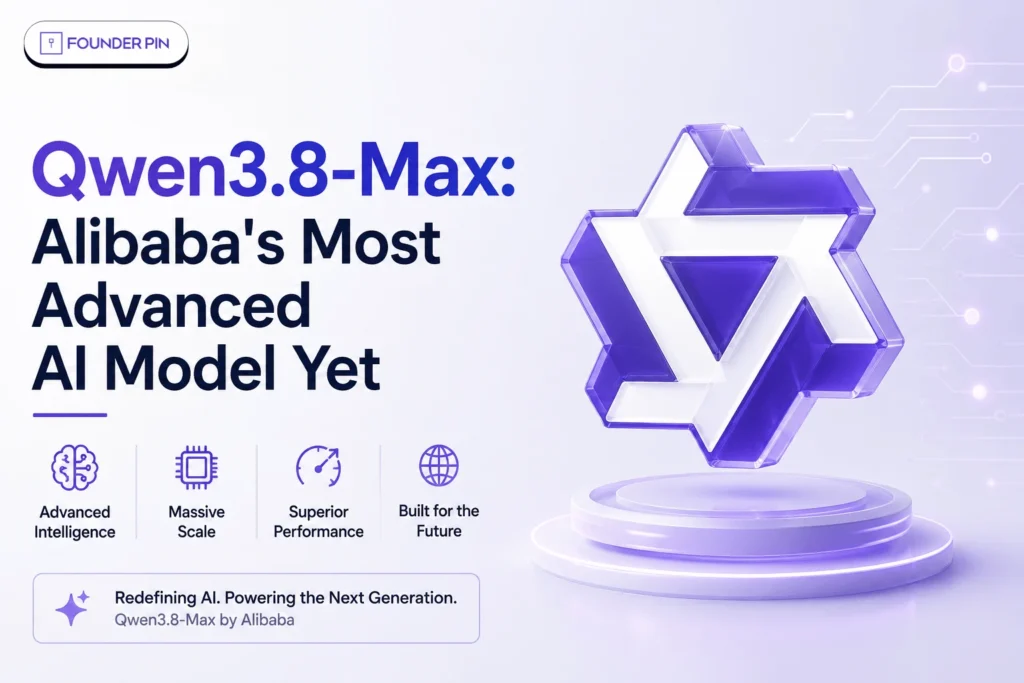
Key Takeaways
- Qwen3.8-Max has 2.4 trillion parameters, making it Alibaba’s largest AI model so far.
- It uses a Mixture-of-Experts (MoE) architecture, with around 95 billion parameters activated per request.
- The model supports text, images and video and can process up to 1 million tokens in one context.
- Alibaba says its initial tests put the model near the top of frontier AI systems, but those performance claims should be treated as company-reported until independently replicated.
- Alibaba plans to make Qwen3.8-Max available as an open-weight model, reinforcing its broader strategy of making AI technology accessible to developers.
Qwen 3.8-Max vs Qwen 3.7-Max
Here’s a quick comparison of the key differences between Qwen 3.7-Max and Qwen 3.8-Max, based on the information disclosed so far. Read Alibaba’s official Qwen3.8-Max announcement for the technical details and benchmark results
| Factor | Qwen 3.7-Max | Qwen 3.8-Max |
|---|---|---|
| Announcement Date | May 19, 2026 | Previewed July 19, 2026; launched August 3, 2026 |
| Total Parameters | Not disclosed | 2.4 trillion, using a sparse MoE architecture |
| Active Parameters | Not disclosed | Around 95B per token |
| Supported Modalities | Text only | Text plus confirmed visual input; the full range is still unclear |
| Context Window | 1 million tokens | 1 million tokens |
| Availability | Available with published pricing | Available with published pricing |
| Open Weights | No — remains closed | Yes, expected within days, including a 27B variant |
| Benchmark Data | Published and verified by third parties | Only internal claims have been disclosed so far |
What Is Qwen3.8-Max?
Alibaba released Qwen3.8-Max on August 3, 2026, making it the company’s newest and most capable AI model. It runs on 2.4 trillion total parameters. That makes it the largest model Alibaba has ever shipped.
Alibaba calls this a return to open-sourcing its flagship models. In recent years, the company kept several top-tier releases proprietary instead. However, open weights are scheduled to follow next week.
Alibaba first previewed the model at the World Artificial Intelligence Conference in Shanghai last month. Back then, it carried the name Qwen3.8-Max-Preview and included no benchmark data. Monday’s release changed that, adding full technical documentation and a benchmark table.
What makes the Qwen3.8-Max AI model different?
The biggest difference is the combination of scale, multimodal input, long context and selective computation. Qwen3.8-Max is not simply a bigger chatbot; Alibaba is positioning it as a foundation for complex AI workflows.
1. 2.4 trillion parameters
The model’s enormous parameter count gives Alibaba a flagship architecture designed for highly demanding workloads.
2. Mixture-of-Experts architecture
The MoE approach allows the system to activate a smaller portion of the overall model for each request.
3. Multimodal capabilities
Qwen3.8-Max can work with text, images and video, allowing it to process information beyond plain written prompts. This evolution is part of a much larger shift toward AI systems that can reason, execute tasks and work across multiple types of data. For a broader look at India’s AI landscape, explore the top AI companies in India and the technologies they are building.
4. One-million-token context
The model can process up to 1 million tokens at a time.
That is useful for workloads involving:
- Large software repositories
- Long research documents
- Legal files
- Business reports
- Large collections of documentation
- Extended multimodal inputs
A million-token context window is especially valuable for AI agents that need to retain information across long workflows.
What Can Qwen3.8-Max Actually Do?
Qwen3.8-Max is built for real-world, multi-step work — not just chat responses. Alibaba says it can handle long-horizon tasks that require sustained, autonomous execution over extended periods.
Reported capabilities include:
- Reviewing legal documents and conducting financial research
- Architectural 3D modelling
- Autonomous software engineering — in one internal test, the model spent 16 days independently writing, testing, and refining a coding tool with no human input. The move from AI assistants toward systems that can independently execute multi-step workflows is also driving interest in agentic AI. Founders can learn more about this shift in our guide to Agentic AI for Founders.
- Multimodal processing across text, images, and video, including building searchable knowledge bases from long documents or livestreams
How Big Is Qwen3.8-Max’s Context Window?
Qwen3.8-Max supports a context window of up to 1 million tokens — roughly equivalent to 750,000 words in a single query. That’s large enough to process an entire codebase or a stack of legal contracts in one pass.
For comparison, most consumer-facing AI chat tools still cap out well below that, which makes this genuinely useful for enterprise document-heavy workflows rather than just longer conversations.
How Does the Qwen3.8-Max AI Model Compare to Rivals?
Alibaba claims Qwen3.8-Max performs comparably to Anthropic’s Fable 5 and OpenAI’s GPT5.6-Sol on several benchmarks — a bold claim for an open-weight model. Independent leaderboard data partially backs this up.
On Arena.AI’s crowdsourced leaderboards:
- Qwen3.8-Max ranks second globally on the Vision Arena, behind a Claude Fable 5 variant
- It ranks fifth on the Text Arena, behind Fable 5 and several Anthropic Opus variants
- It placed fourth on the Frontend Code Arena, with a score of 1,668
It’s also being compared directly to Moonshot AI’s Kimi K3, a 2.8-trillion-parameter model released last month that currently holds the record as the largest open-source AI model by parameter count. Qwen3.8-Max is the second-largest.
For startups, however, the bigger question is not simply which model tops a leaderboard. It is how founders can turn rapidly improving AI capabilities into defensible businesses. Our startup pitch deck guide explains how founders can communicate their technology, market opportunity and competitive advantage to investors.
Is Qwen3.8-Max open source?
Although “open weight” and “open source” are not usually synonymous, Alibaba is shifting Qwen3.8-Max toward an open-weight model strategy.
In keeping with its larger commitment to open AI development, Alibaba announced that the model would become open weight.
Unlike many closed commercial models, open-weight models let developers to access the learnt model parameters and even modify or deploy them, according to Reuters.
This distinction matters for businesses.
Open-weight models can provide developers more authority over:
- Deployment
- Customisation
- Fine-tuning
- Infrastructure
- Data governance
- Model experimentation
However, developers should always check the final license, usage restrictions and model documentation before deploying a model commercially.
How Much Does Qwen3.8-Max Cost to Use?
Alibaba priced API access to Qwen3.8-Max well below Anthropic’s flagship pricing — a clear signal this is a cost-competition play, not just a capability one.
Specifically, in international markets:
- Input tokens are priced at roughly 40% of Claude Opus 5’s rate
- Output tokens are priced at roughly 24% of Claude Opus 5’s rate
- Cache hits bring costs down substantially further
That pricing gap matters more than the benchmark scores for most businesses actually deciding which model to build on.
What should developers consider before adopting Qwen3.8-Max?
A powerful model still needs to fit the actual business problem. Developers should evaluate cost, latency, reliability, licensing and performance on their own workloads before migrating production systems.
Before adopting Qwen3.8-Max, teams should assess:
- Benchmark performance on relevant tasks.
- Inference costs at expected usage levels.
- Latency for real-time applications.
- Context requirements for long-document workloads.
- Multimodal performance if images or video matter.
- Licensing terms for commercial deployment.
- Data governance and privacy requirements.
- Infrastructure requirements for self-hosted deployments.
This prevents a common AI mistake: choosing a model because the headline number looks enormous.
Why Does This Matter Beyond Alibaba?
Qwen3.8-Max is part of a broader pattern: Chinese AI labs releasing increasingly large, increasingly capable open-weight models at a pace that’s visibly narrowing the gap with US labs. Alibaba’s stock rose roughly 4.5–4.8% in premarket trading and 7% in Hong Kong following the announcement — investors clearly read this as a meaningful competitive move, not just another incremental release.
Alibaba has also committed more than 380 billion yuan (about $53 billion) to AI and cloud infrastructure over the next three years, which suggests Qwen3.8-Max is a checkpoint in a much longer roadmap, not a one-off flagship launch.
This competition is also creating new opportunities for entrepreneurs building AI-first companies. If you’re looking for potential business opportunities around emerging technologies, see these 20 profitable startup ideas for India in 2026.
What is the future of Alibaba Qwen3.8-Max?
Qwen3.8-Max is part of Alibaba’s larger strategy to build a complete AI ecosystem rather than compete only at the model layer.
Alibaba Cloud is developing infrastructure for AI agents, inference optimisation, developer tools and hardware alongside Qwen models. Its WAIC announcements included the Agent-Native Cloud suite and T-Head’s SAIL software stack.
That strategy could become important as AI moves from chatbots toward autonomous agents.
The future competition may not simply be:
“Whose model is smartest?”
It could become:
“Whose models, infrastructure, tools and developer ecosystem can solve the most real-world problems at the lowest sustainable cost?”
Qwen3.8-Max gives Alibaba a strong entry in that competition.
FounderPin Perspective
Qwen3.8-Max is a reminder that the AI race is becoming an ecosystem race.
For founders, the biggest opportunity may not be building another general-purpose chatbot. It may be taking powerful foundation models and applying them to specific industries where proprietary data, workflows and distribution create genuine differentiation.
Alibaba’s latest model shows how quickly frontier AI is evolving. With 2.4 trillion total parameters, a 1-million-token context window, multimodal capabilities and an MoE architecture, Qwen3.8-Max is clearly designed for ambitious workloads.
But founders should avoid being distracted by parameter-count headlines.
The better question is:
Can this model make your product faster, cheaper, smarter or harder to replace?
If the answer is yes, Qwen3.8-Max could become a valuable building block. If not, 2.4 trillion parameters are just a very impressive number.
Final Takeaway
Qwen3.8-Max is Alibaba’s most ambitious Qwen model yet — and another marker in just how fast the global AI race is moving.
Under the hood, it’s packing a 2.4-trillion-parameter architecture, a 95-billion-parameter active MoE design, multimodal capabilities, and a 1-million-token context window. That’s the kind of technical muscle advanced AI applications actually need.
But here’s what really stands out: Alibaba isn’t just shipping a model. It’s pairing Qwen3.8-Max with a whole ecosystem — AI agents, cloud infrastructure, developer tools, open-weight technology. In the long run, that ecosystem play could matter more than any single leaderboard ranking.
The broader industry is racing past impressive chatbots now, moving toward long-context reasoning, multimodal systems, and autonomous agents. Qwen3.8-Max makes it pretty clear Alibaba wants a serious seat at that table, across the board.
For developers and founders, the takeaway is simple: the frontier keeps getting more capable, more competitive, and more open, all at once. And that cuts both ways — it’s a challenge, sure, but it’s also a real opportunity.
Building an AI-powered product and weighing which model or infrastructure to bet on? Contact FounderPin today for a consultation, and let’s map out the right path for your startup.
Frequently Asked Questions
What is Qwen3.8-Max?
Qwen3.8-Max is Alibaba’s latest flagship AI model. It has 2.4 trillion parameters and supports text, image and video inputs with a context window of up to 1 million tokens.
How many parameters does Qwen3.8-Max have?
The model has 2.4 trillion total parameters. Its Mixture-of-Experts design activates about 95 billion parameters per request, according to Reuters.
Is Qwen3.8-Max better than ChatGPT?
There is no universal answer. Model performance depends on the task, benchmark, version and deployment. Alibaba reports strong frontier-level performance, but users should evaluate the model on their own workloads rather than assume one model is best at everything.
What is the context window of Qwen3.8-Max?
Qwen3.8-Max supports up to 1 million tokens of context, making it suitable for very long documents, large codebases and extended AI workflows.
Is Qwen3.8-Max open source?
Alibaba has announced an open-weight release strategy for Qwen3.8-Max. Developers should check the final model license and deployment terms before commercial use.
SHARE