
Quick Commerce Trends in India 2026: Key Market Trends and Insights
Table of Contents
Toggle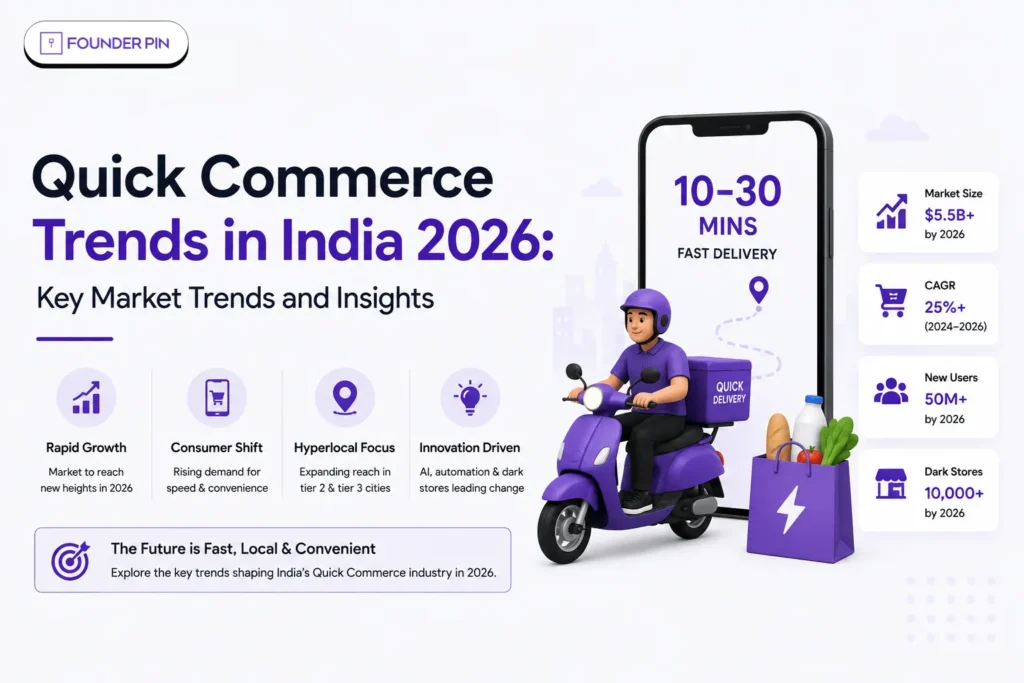
India’s quick commerce market is entering a more mature phase in 2026. This isn’t just about delivering groceries fast anymore. Instead, the story has shifted toward category expansion, dark-store productivity, how often customers come back, actual profitability, and competition that’s now spreading well beyond the metros.
The latest numbers show just how fast things are moving. Redseer estimates Indian quick commerce generated roughly ₹11,000 crore in GMV in January 2026. Order volumes were up nearly 95% year over year. That same data also pointed to around 6,280 dark stores in operation and about 5.2 crore monthly transacting users.
Put together, that makes Quick Commerce Trends one of the most important stories in India’s retail and startup world this year.
Key Takeaways
- India’s quick commerce market is shifting from a speed-first model toward one focused on scale and profitability
- Non-grocery categories like fashion, electronics, and mobiles are becoming increasingly important to the mix
- Dark-store networks keep expanding, but productivity and utilization now matter more than just adding new locations
- Quick commerce is pushing well past the traditional metros, with Tier 2 and smaller cities emerging as the next growth frontier
- Regulation, rider safety, food safety, and profitability will all shape where the industry heads next
How Big Is India’s Quick Commerce Market in 2026?
India’s quick commerce sector has grown from a pandemic-era niche into a genuinely structural part of the country’s retail economy, though exactly how big depends on which report you read. That inconsistency itself is one of the more interesting quick commerce trends India 2026 is producing.
Here’s what different credible sources actually say:
- IBEF pegs the segment at $7–8 billion in FY25, growing at a blistering 110–130% CAGR between 2021–25, and projects it will reach $65–70 billion by 2030
- Statista projects 2026 revenue at $5.58 billion, growing to $10.2 billion by 2031
- Mordor Intelligence estimates a narrower $3.65 billion for 2026, reaching $6.64 billion by 2031
- Equirus, in a July 2026 brokerage report, sized India’s quick commerce market at ₹1.08 lakh crore (roughly $13 billion) for 2026, growing 40% year-on-year — more than twice the pace of overall digital commerce
Why Do Market-Size Estimates Vary So Much?
The gap comes down to methodology — what counts as “quick commerce” differs by firm, and GMV, revenue, and gross order value get measured inconsistently across reports. Rather than picking one number and presenting it as gospel, the more useful signal is the consistent growth direction every single source agrees on: quick commerce is growing 2–4x faster than broader ecommerce, no matter how you measure it.
What Are the Biggest Quick Commerce Trends India 2026 Is Seeing?
Five clear shifts are shaping the sector this year, and they’re consistent across independent market reports rather than isolated to one platform’s messaging.
1. Dark-store networks are expanding fast, and consolidating around fewer players. The combined dark-store count across Blinkit, Instamart, and Zepto hit 5,026 locations by May 2026, up from 3,405 a year earlier — a 48% jump in just twelve months.
2. Private label is becoming a real margin strategy, not a side experiment. Blinkit, now holding close to 50% market share following its integration with parent Eternal, has pivoted toward an inventory-led model specifically to support private-label expansion and improve store-level contribution margins.
3. Category depth is expanding well beyond groceries. Platforms are actively widening assortment to capture larger basket sizes — seasonal data from Equirus shows ice cream, beverages, and face-care products as the strongest recent category gainers, a sign quick commerce is eating into categories once dominated by traditional retail and pharmacy.
4. Tier-II and Tier-III cities are the next real growth frontier. Both IBEF and Equirus flag rising incomes and digital adoption in smaller cities as a key driver, even as platforms shift from pure hyper-expansion toward profitable density in their existing core catchments first.
5. New, well-funded entrants are scaling up competitive pressure. Amazon announced plans in April 2026 to expand Amazon Now to 100 cities, backed by a $300 million investment, while JioMart and BigBasket continue scaling their own competitive entry into the space.
The competitive environment also shows why founders need to understand where capital is flowing across India’s startup ecosystem. FounderPin’s coverage of Indian startup funding trends provides broader context on the sectors attracting investor attention.
Who’s Leading India’s Quick Commerce Market Right Now?
Blinkit, Swiggy Instamart, and Zepto still run the show here — no surprise there. What’s more interesting is how differently each one’s playing the game. This isn’t really a speed war anymore. If you’re looking at this space as an investor, a brand, or a founder, understanding that split matters more than the headline numbers.
- Blinkit’s out front with something like 50% market share, built on an inventory-led model that leans hard into private labels
- Swiggy Instamart is riding on Swiggy’s existing food-delivery user base — gross order value grew strongly year-on-year in fiscal 2026, and the company keeps pouring money into dark stores and promotions
- Zepto spent 2025 expanding its footprint and branching into new categories, backed by fresh funding that kept its city-level density push going into late 2025
What Risks Are Quick Commerce Platforms Facing in 2026?
Not every trend here points upward — FMCG volume growth across the category may stay capped at just 3–4% in the near term, largely due to rainfall deficit and food-inflation pressure. That’s a real headwind worth flagging honestly, since most coverage of this sector skews toward pure hype.
A few other pressure points worth watching:
- Profitability still lags growth for most platforms outside their core metro catchments
- Intensifying competition from Amazon, JioMart, and BigBasket could compress margins across the board
- Expansion into Tier-II and Tier-III cities carries thinner unit economics than dense metro operations.
Unit economics become especially important when a company moves from an early growth phase into expansion. Founders can also explore FounderPin’s analysis of startup unit economics and CAC to understand why customer acquisition costs and contribution margins matter when scaling a business.
This is a particularly useful contextual link because you’re already discussing profitability, margins and expansion economics.
What does the future of quick commerce in India look like?
India’s quick-commerce market is likely to become bigger, broader and more disciplined—but also more competitive.
A SEBI-filed prospectus cited the Indian quick-commerce market at approximately ₹0.53 trillion ($6.2 billion) in FY2025 and projected a 50–62% CAGR between FY2025 and FY2030.
Different research firms use different methodologies and market definitions, so individual market-size estimates should not be treated as perfectly interchangeable.
Still, the direction is clear.
The next phase will likely revolve around:
- Higher store productivity
- More non-grocery categories
- Expansion into new cities
- Better contribution margins
- Greater use of private labels
- More advertising and brand monetization
- Safer delivery practices
- Stronger food-safety compliance
- More sophisticated inventory management
In other words, India’s quick-commerce story is moving from a race for speed toward a race for scale, efficiency and customer loyalty.
What do the Quick Commerce Trends mean for Indian startups?
For startups, quick commerce is creating opportunities far beyond delivery platforms themselves.
The ecosystem needs technology and services for inventory forecasting, cold-chain logistics, warehouse automation, route optimization, retail analytics, payments and brand marketing.
It also creates opportunities for consumer startups that can build products specifically suited to fast, app-driven purchasing.
Founders looking for more ideas can explore FounderPin’s collection of profitable startup ideas in India for 2026, particularly those connected to technology, consumer businesses and emerging market opportunities.
The key lesson is simple:
Don’t build a startup merely because quick commerce is growing. Build something that makes the ecosystem better, cheaper, faster or more valuable.
FounderPin Perspective
The most interesting Quick Commerce Trends in India 2026 aren’t actually about shaving another two minutes from delivery.
They are about what happens after speed becomes normal.
When almost every major player can deliver quickly, speed stops being the only differentiator. Product availability, pricing, assortment, reliability, customer experience and profitability start doing the heavy lifting.
For brands, this could make quick commerce one of India’s most important retail channels.
For startups, it creates a huge ecosystem of problems waiting to be solved.
And for investors, the question is becoming much more sophisticated:
Who can turn India’s obsession with convenience into a profitable, durable business?
That is the real quick-commerce race to watch.
Final Word
Quick commerce trends in India for 2026 point toward a sector maturing from hyper-growth chaos into a genuinely structural retail channel — dark stores consolidating, private label rising, and competition intensifying from every direction, including Amazon’s renewed push. Whatever the exact market-size number turns out to be, the direction is unambiguous, and it’s moving fast.
Building a consumer brand and figuring out your quick commerce distribution strategy? Contact FounderPin today for a consultation.
Frequently Asked Questions
What are the biggest Quick Commerce Trends in India 2026?
The biggest trends include non-grocery expansion, dark-store productivity, Tier 2 expansion, stronger competition, profitability-focused operations and greater regulatory scrutiny.
How big is India’s quick-commerce market?
Market estimates vary by methodology. A SEBI-filed prospectus put the market at around ₹0.53 trillion ($6.2 billion) in FY2025, while other 2026 industry estimates use broader market definitions and produce higher figures.
Which categories are growing fastest in quick commerce?
Non-grocery categories are growing quickly. Redseer reported that non-grocery grew around 1.6 times faster than grocery in January 2026, with fashion and mobiles among the fastest-growing categories from smaller bases.
Are quick-commerce companies still promising 10-minute delivery?
Major platforms removed prominent 10-minute delivery claims after the Indian government’s intervention over gig-worker safety. Fast delivery remains part of the model, but the marketing emphasis has shifted.
Is quick commerce profitable in India?
Profitability remains one of the industry’s biggest challenges. Platforms are increasingly focusing on store utilization, contribution margins, higher-value categories and operational efficiency rather than growth through expansion alone
SHARE