Flipkart vs Swiggy vs Zomato: Food Delivery Comparison 2026
Table of Contents
Toggle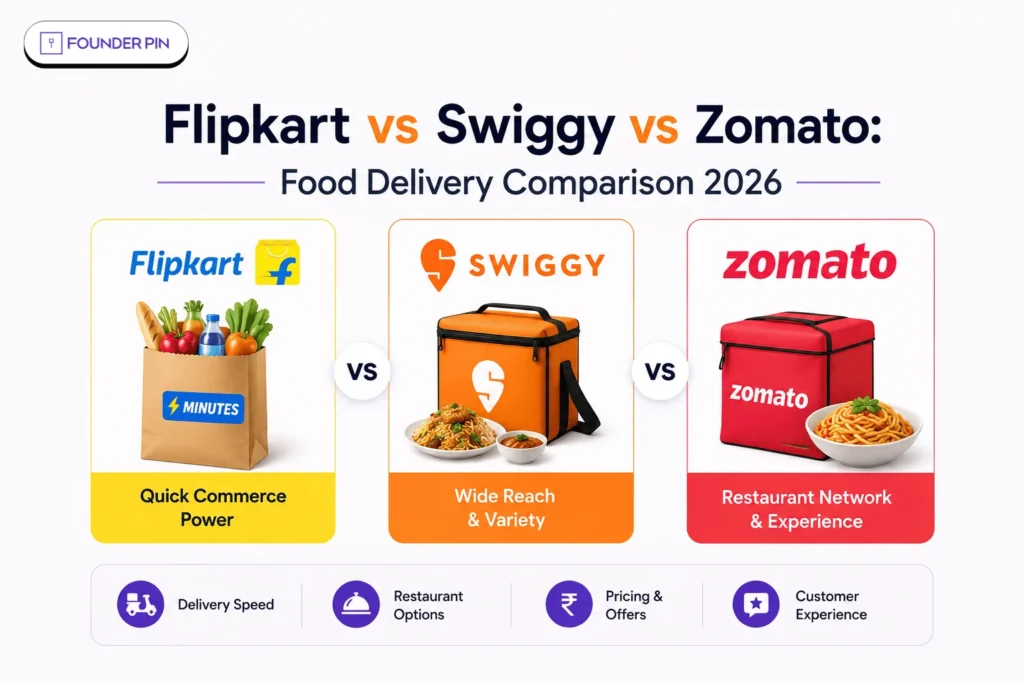
India’s food-delivery market is about to get a serious new challenger. Swiggy and Zomato have owned this space for years, but now Flipkart’s gearing up to move in — and it’s bringing a much bigger e-commerce and quick-commerce ecosystem along with it.
So the Flipkart vs Swiggy vs Zomato comparison isn’t really just about who delivers faster. It comes down to restaurant network, customer reach, logistics, pricing, profitability, and how strong each company’s broader ecosystem actually is — any of those could decide who wins the next round.
The timing here is worth noting too. By June 2026, Flipkart Minutes had already crossed 1,000 micro-fulfilment centres, spread across 130+ cities and more than 8,000 PIN codes. That’s a genuinely substantial hyperlocal infrastructure to build on.
How Does Flipkart’s Commission Model Compare to Swiggy and Zomato?
Flipkart is targeting a roughly 10% commission from restaurants, compared to the 16–30% typically charged by Zomato and Swiggy. That gap alone is the single biggest competitive lever Flipkart has going into this launch.
A few specifics worth knowing:
| Feature / Metric | Zomato (Eternal) | Swiggy | Flipkart (Upcoming Pilot) |
|---|---|---|---|
| Market Share | Leads the pack at roughly 60% | Trails behind at about 40%, the clear #2 | Zero, for now — the pilot hasn't gone live |
| Recent Order Value Growth | Net Order Value up 18.8% YoY in Q4 FY26 | Actually outpaced Zomato here, up 22.6% YoY in Q4 FY26 | Nothing to report yet; early days will likely prioritize reliability over growth |
| Merchant Commission | Somewhere in the 16%–30% range, closer to 25%–35% once fees pile on | Nearly identical to Zomato — 16%–30%, effectively 25%–35% after fees | Reportedly eyeing ~10%, a much cheaper deal for restaurants if it holds |
| Platform Fee | Went up to ₹17.58/order in March 2026 | Matched that exact move — also ₹17.58/order in March 2026 | No standalone fee expected; likely folded into the broader Flipkart ecosystem |
| Budget Food Strategy | Leans on Bistro by Blinkit, with a supply chain built in-house | Runs a separate play called Toing, aimed squarely at cheap meals | Probably ONDC-based, alongside its own app |
| Ecosystem Advantage | Backed by Blinkit (~46% of quick-commerce) plus Gold perks | Backed by Instamart (~24% of quick-commerce) plus One membership | Brings Flipkart Minutes into the mix, riding on 85M daily active users |
Why Is Flipkart’s Timing Especially Disruptive?
Flipkart’s Bengaluru launch coincides almost exactly with a threatened restaurant boycott against Swiggy and Zomato, also starting August 15, 2026, over high commission rates. That’s either a remarkable coincidence or a very deliberate entry point — and either way, it hands Flipkart an unusually receptive audience of restaurants already frustrated with the incumbents.
The market reaction was immediate and telling: Swiggy’s shares fell as much as 7%, and Zomato parent company Eternal dropped over 3%, on July 24, 2026 — purely on the news that Flipkart planned to enter “in the coming weeks,” before any pilot had even launched.
Who Currently Has the Strongest Food-Delivery Business?
Swiggy and Zomato have a real head start here — food delivery’s already core to how both businesses run.
Swiggy’s advantage becomes even clearer when its food-delivery network is viewed alongside Instamart. FounderPin’s How Swiggy Is Winning the Quick Commerce Game in India examines how that existing ecosystem has helped Swiggy build a second growth engine.
Swiggy pulled in ₹9,005 crore in quarterly food-delivery GOV for Q4 FY2026, up 22.6% year over year, with food-delivery MTUs hitting 18.3 million. The company also said food delivery crossed ₹1,000 crore in annual adjusted EBITDA during FY2026 — a sign the economics are steadily improving.
Zomato’s parent, Eternal, tells a similar story. In Q1 FY27, its food-delivery arm recorded ₹10,769 crore in NOV, up 20.1% year over year, while average monthly transacting customers climbed to 27.2 million.
Flipkart, on the other hand, was still just gearing up to launch food delivery in 2026. Reports from July suggested the company expected to enter the market within weeks.
Verdict: Swiggy and Zomato currently lead on food-delivery maturity, and it’s not particularly close.
Which Company Has the Better Profitability Position?
Right now, Zomato holds the stronger position on reported food-delivery profitability, though Swiggy’s made real progress too.
Eternal’s food-delivery arm generated ₹606 crore in adjusted EBITDA in Q1 FY27, working out to a 5.6% adjusted EBITDA margin on NOV. Swiggy, meanwhile, crossed ₹1,000 crore in annual adjusted EBITDA for its food-delivery business in FY2026.
Flipkart’s a different story entirely — its food-delivery business is simply too new for any meaningful profitability comparison yet.
That gap matters more than it might seem, especially for investors and founders watching this space. A new entrant can afford to spend aggressively chasing market share before profitability even enters the conversation, while established players are already past that stage and focused on squeezing more margin out of what they’ve built.
The bigger lesson is that scale alone isn’t enough anymore. FounderPin’s analysis of startup unit economics and CAC explains why growth only becomes valuable when customer acquisition costs, margins and lifetime value work together.
What Does the Flipkart vs Swiggy vs Zomato Comparison Mean for Restaurants?
Restaurants could benefit from having another major platform competing for their orders.
A new player could create more distribution opportunities and potentially increase competition among food-delivery platforms.
Restaurants may gain:
- Another customer acquisition channel
- Additional order volume
- More marketing options
- Greater platform competition
- Potentially different commercial terms
But managing multiple platforms also creates operational complexity.
Restaurants need to keep menus, pricing, inventory and promotions synchronized across platforms.
That means Flipkart’s entry could benefit restaurants, but execution will matter.
Who Wins the Flipkart vs Swiggy vs Zomato Comparison?
There are different winners depending on the category.
| Category | Winner |
|---|---|
| Food-delivery maturity | Swiggy / Zomato |
| Food-focused ecosystem | Zomato |
| Established food expertise | Swiggy |
| Quick-commerce integration | Zomato / Swiggy |
| E-commerce ecosystem | Flipkart |
| Hyperlocal expansion potential | Flipkart |
| Current food-delivery profitability | Zomato |
| New challenger potential | Flipkart |
Best established food-delivery players: Swiggy and Zomato
Both have substantial restaurant networks, customer bases and operational experience.
Strongest food + quick-commerce combination: Zomato/Eternal
Zomato and Blinkit give Eternal a powerful combination of food and instant commerce.
Most interesting challenger: Flipkart
Flipkart’s biggest opportunity is connecting food with its existing e-commerce, grocery, quick-commerce and loyalty ecosystem.
Final Verdict: Flipkart vs Swiggy vs Zomato
Swiggy and Zomato lead India’s food-delivery market today. Flipkart, however, could become a serious challenger if it successfully combines food with its wider commerce ecosystem.
Swiggy brings deep food-delivery expertise and Instamart.
Zomato combines food discovery and delivery with Blinkit.
Flipkart brings a massive e-commerce ecosystem and a rapidly expanding Minutes network.
So the next phase of the competition may not simply be about who delivers food fastest.
It may be about who can become the most useful everyday consumer platform.
For India’s startup ecosystem, that convergence is worth watching closely. Founders exploring emerging business opportunities can also explore FounderPin’s startup and business insights for more market analysis.
Building or scaling a consumer platform business and thinking through competitive positioning? Contact FounderPin today for a consultation, and let’s map out the right path for your startup.
Frequently Asked Questions
Is Flipkart competing with Swiggy and Zomato?
Yes. Flipkart is entering food delivery in 2026, challenging the two established platforms.
Who is bigger in food delivery?
Both Swiggy and Zomato operate at significant scale. Zomato reported 27.2 million average monthly transacting customers in Q1 FY27, while Swiggy reported 18.3 million food-delivery MTUs in Q4 FY2026. These figures come from different reporting periods, so they should not be treated as a direct market-share comparison.
What is Flipkart’s biggest advantage?
Its biggest advantage is its broader ecosystem covering e-commerce, grocery, quick commerce, logistics and loyalty.
Is Zomato profitable in food delivery?
Yes. Eternal reported ₹606 crore in adjusted EBITDA from food delivery in Q1 FY27.
Is Swiggy profitable?
Swiggy’s food-delivery business is generating positive adjusted EBITDA, although its wider business continues to invest heavily in quick commerce.
SHARE