
Ultraviolette Funding: $82 Million Plant and How the EV Startup Plans to Scale in India
Table of Contents
Toggle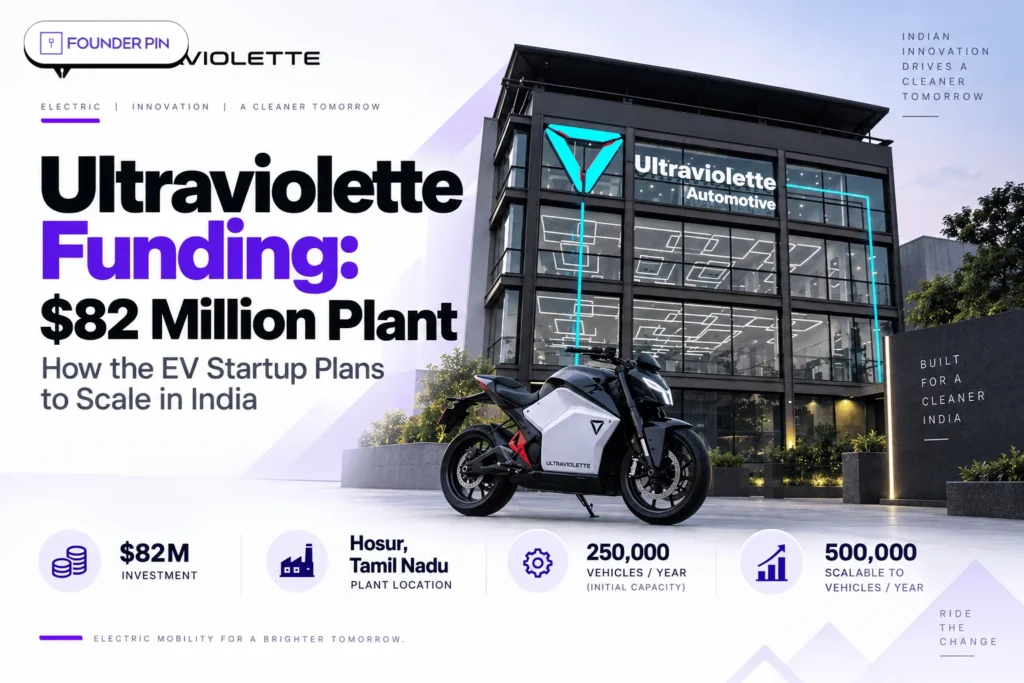
Ultraviolette funding has entered a new phase. The Bengaluru-based electric two-wheeler startup plans to invest about $82 million (₹779 crore) in a new manufacturing facility in Hosur, Tamil Nadu, as it prepares to move beyond premium electric motorcycles and target higher-volume segments.
The new BIGGA Factory is planned with an initial annual capacity of 250,000 vehicles, with infrastructure that can eventually support 500,000 units a year. The move is closely tied to Ultraviolette’s upcoming products, particularly the Tesseract electric scooter and Shockwave motorcycle.
Key Takeaways
- Ultraviolette plans to invest about $82 million (₹779 crore) in a new Hosur plant.
- The BIGGA Factory will initially support 250,000 vehicles annually.
- Infrastructure can eventually scale to 500,000 units per year.
- The Tesseract scooter is central to the company’s volume strategy.
- Ultraviolette is targeting a broader market beyond premium motorcycles.
- The company is also expanding into Europe and other international markets.
- Its disclosed funding history includes major investors such as TVS Motor, Zoho, Qualcomm Ventures, Lingotto and TDK Ventures.
Here is what the latest Ultraviolette funding and manufacturing expansion means for the company’s next stage of growth.
Ultraviolette Funding: What Happened?
The $82 million figure refers to the planned investment in a new manufacturing plant, not a newly announced $82 million funding round.
- Planned plant investment: about $82 million
- Location: Hosur, Tamil Nadu
- Initial capacity: 250,000 vehicles annually
- Potential capacity: 500,000 vehicles annually
- Investment period: about five years
- Funding sources for the plant: internal reserves, equity and future cash flows, with limited debt planned
Ultraviolette’s CTO Niraj Rajmohan told Reuters that the investment will be funded through a combination of internal reserves, equity and future cash flows.
That distinction matters. Searches for “Ultraviolette funding $82 million” can make it sound like the startup has just raised $82 million from investors. The announced $82 million is instead the planned capital expenditure for manufacturing expansion.
Ultraviolette’s Funding Journey
Ultraviolette has raised more than $100 million through multiple funding rounds, with TVS Motor, Qualcomm Ventures, Zoho, Lingotto and TDK Ventures among its notable investors.
Key disclosed rounds include:
| Year | Funding | Key investors |
|---|---|---|
| 2017 | ~$0.8M | TVS Motor |
| 2020 | ~$4.1M | TVS Motor |
| 2021 | ~$15M | TVS Motor, Zoho |
| 2022 | $10M | EXOR |
| 2022 | $24M | Qualcomm Ventures and others |
| 2025 | $21M | TDK Ventures and existing investors |
| 2025 | $45M | Zoho, Lingotto |
Funding databases differ in how they classify individual tranches and rounds. Inc42, for example, reports $135.9 million across 10 rounds through December 2025.
The company’s December 2025 $45 million round came from Zoho Corporation and Lingotto and was intended to support production scaling, existing products and new models.
For founders looking to understand the basics of startup investing, our guide on [how to invest in startups in India] explains how startup funding and equity participation work.
Why Does Ultraviolette Need an $82 Million Plant?
The main reason is simple: Ultraviolette’s existing manufacturing capacity is no longer designed for the volume the company expects from its next generation of products.
- Existing Bengaluru facility: up to 50,000 units annually
- New Hosur facility: 250,000 units initially
- Future potential: 500,000 units annually
The capacity jump is substantial. It signals a change in strategy from building relatively low-volume performance motorcycles toward serving a much larger electric two-wheeler market.
In other words, the company is moving from “premium EV startup” toward “scaled EV manufacturer.”
That transition requires more than a good motorcycle. It needs factories, supply chains, distribution, service infrastructure and products that can sell in much larger numbers.
Tesseract and Shockwave Could Change the Volume Game
Ultraviolette’s biggest scaling opportunity is its move into more accessible electric two-wheelers.
The company has historically built its reputation around performance-oriented models such as the F77 and X47. However, the upcoming Tesseract and Shockwave are aimed at broader customer segments.
According to recent reporting:
- Tesseract: expected below ₹1.5 lakh
- Shockwave: expected below ₹2 lakh
- Tesseract launch target: Q1 2027
- Expected scooter demand: potentially 10,000 units per month
Business Standard reported that Ultraviolette expects scooters and motorcycles to eventually contribute roughly equally to volumes at scale.
This is strategically important because selling thousands of premium motorcycles is very different from building a mass-market two-wheeler business.
The scooter segment can provide the volume. The performance motorcycles can continue building the brand.
How Ultraviolette Plans to Scale in India
Ultraviolette’s India strategy combines manufacturing expansion, a broader product range and a larger retail footprint.
1. Increase manufacturing capacity
The Hosur plant takes planned annual capacity from the existing Bengaluru facility’s roughly 50,000 units to an initial 250,000-unit manufacturing platform.
2. Enter higher-volume segments
The Tesseract represents an important move into electric scooters, potentially opening Ultraviolette to customers beyond the performance-bike market.
3. Expand its retail network
In 2025, the company said it planned to expand from about 20 stores in 20 Indian cities toward roughly 100 stores.
4. Build international markets
Ultraviolette is also expanding internationally. In 2025, the company had around 40 European dealers and was exploring markets in Latin America and Southeast Asia.
By 2026, the company said exports to Europe and Latin America accounted for around 15% of sales, with a goal of increasing the share to 25% within five years.
Also Read | Top 10 Indian AI Companies Leading the Tech Revolution in 2026
Why Hosur Makes Sense for Ultraviolette
Hosur gives Ultraviolette access to an established automotive ecosystem while keeping the new facility relatively close to its Bengaluru R&D operations.
The location sits within one of India’s major automotive manufacturing clusters and provides access to suppliers and manufacturing talent.
For an EV company, that ecosystem matters. Battery systems, electronics, motors, components and vehicle assembly all depend on a reliable industrial supply chain.
The decision also keeps manufacturing relatively close to Ultraviolette’s Bengaluru engineering base, according to company executives.
Ultraviolette’s Bigger EV Opportunity
The timing of the investment reflects the broader growth of electric two-wheelers in India.
Electric two-wheelers crossed 10% of overall two-wheeler sales in August 2026, while more than 1.03 million electric two-wheelers were sold in the first eight months of 2026, according to Reuters’ reporting.
McKinsey has estimated that electric two-wheelers could represent 40%–45% of India’s overall two-wheeler sales by fiscal 2030.
That does not guarantee Ultraviolette will capture a large share of the market. But it explains why the company is investing in production capacity before its new products reach full scale.
What the Ultraviolette Funding Story Means
Ultraviolette’s latest expansion shows that the company is shifting from proving its technology to proving that it can manufacture and sell at scale.
Its earlier funding helped develop products, technology and manufacturing capabilities. The latest phase is much more capital-intensive: factories, distribution, new models and international expansion all require substantial investment.
The $82 million Hosur project therefore represents more than another factory.
It is a bet that electric scooters and motorcycles can take Ultraviolette from a premium EV brand to a much larger Indian and international mobility company.
FounderPin Perspective
Ultraviolette’s story highlights an important startup lesson: product-market fit is only half the battle in hardware.
Once demand starts increasing, manufacturing capacity becomes a competitive advantage of its own. Ultraviolette is now putting serious capital behind that next challenge.
The real test will come after the BIGGA Factory begins scaling: whether the Tesseract, Shockwave and future models can convert the company’s technology and brand appeal into sustainable high-volume sales.
In short, the latest Ultraviolette funding story is not simply about raising money. It is about using capital, manufacturing and new products to build the scale needed for the next stage of India’s EV market.
Read About | Snabbit Funding News: Inside the $56 Million Raise and What It Means for Startups
Frequently Asked Questions
1. How much is Ultraviolette funding for its new plant?
Ultraviolette plans to invest around $82 million (₹779 crore) in its new BIGGA manufacturing facility in Hosur, Tamil Nadu. The investment is planned over about five years.
2. Who are the major investors in Ultraviolette?
Major investors in Ultraviolette include TVS Motor, Zoho Corporation, Qualcomm Ventures, Lingotto and TDK Ventures. The company has raised funding across multiple rounds to develop its electric vehicles, technology and manufacturing capabilities.
3. What is the production capacity of Ultraviolette’s new plant?
The BIGGA Factory in Hosur is planned to have an initial annual production capacity of 250,000 vehicles. The facility is designed with the potential to scale capacity to 500,000 vehicles per year.
4. Which new EVs will Ultraviolette manufacture?
The new facility is expected to support Ultraviolette’s upcoming products, including the Tesseract electric scooter and Shockwave electric motorcycle, along with future models across different two-wheeler categories.
5. How does Ultraviolette plan to scale in India?
Ultraviolette plans to scale through higher production capacity, new electric scooters and motorcycles, a larger retail network and expansion into international markets. The Tesseract is particularly important to its strategy because scooters can help the company reach a broader customer base.
SHARE