
Is Quick Commerce Profitable in India? The 2026 Reality
Table of Contents
Toggle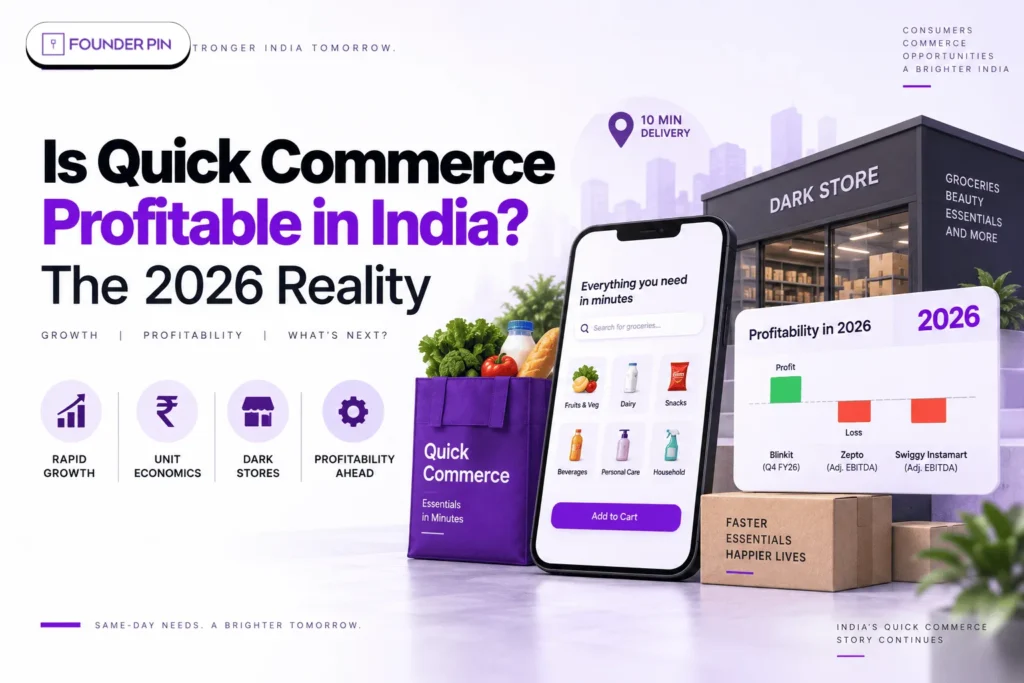
Quick commerce has transformed how Indians buy groceries, snacks, medicines, personal-care products and even electronics. But the bigger question is no longer whether consumers want 10-minute delivery. It is whether companies can make money doing it.
The short answer: Quick commerce is moving toward profitability in India, but the sector is not uniformly profitable yet. In 2026, Blinkit has shown stronger financial progress, while Swiggy Instamart has sharply improved its unit economics and Zepto continues to scale while investing heavily.
The 2026 reality is therefore less about “delivery in 10 minutes” and more about basket size, advertising, store productivity, logistics density and contribution margins.
Is Quick Commerce Profitable in India in 2026?
Quick commerce is not yet broadly profitable across the industry, but the economics are improving.
Key points
- Blinkit has reached important profitability milestones within Eternal’s broader business.
- Swiggy Instamart reduced its contribution-margin loss to just -0.2% of GOV in Q1 FY27.
- Zepto continues to expand rapidly, but profitability remains under pressure from its aggressive expansion.
- Advertising, higher-value products and larger baskets are becoming increasingly important.
- Scale matters because every additional order can spread fixed dark-store and technology costs.
The distinction between contribution profit and EBITDA profit is important. A company can earn positive contribution margin on orders while still losing money after employee costs, technology, depreciation, corporate expenses and other operating costs.
So, when asking Is Quick Commerce Profitable in India?, the answer depends on which level of profitability you mean.
Why Is Quick Commerce Growing So Fast in India?
Convenience, higher order frequency and expanding product categories are driving the sector.
Key facts
- India’s quick-commerce market reached roughly US$7–8 billion in FY25, according to IBEF industry data.
- Quick commerce accounted for around 70–75% of India’s e-grocery orders, up from about 35% in 2022.
- Redseer estimates Indian quick-commerce GMV could reach around ₹1.98 lakh crore in CY2026.
- Redseer estimates more than 50 million monthly transacting users in 2026.
The customer proposition is simple: people will pay for convenience when the alternative is walking to a store for milk, snacks or a forgotten ingredient.
The market has also expanded beyond basic groceries. Beauty, personal care, electronics accessories, packaged foods and other categories can increase basket value and improve economics.
Quick commerce is part of a much larger Indian startup ecosystem where convenience, technology and changing consumer behaviour are creating new business opportunities. Founders exploring these opportunities can also review 20 Technology Startup Ideas for 2026 for ideas beyond quick commerce.
How Does Quick Commerce Make Money?
Quick-commerce companies use several revenue streams rather than relying only on product margins.
The main revenue engines are:
- Product margins
- Seller commissions
- Delivery and platform fees
- Advertising
- Brand partnerships
- Membership or subscription programmes
- Private-label products
- Higher-margin non-grocery categories
Advertising is particularly important because brands want visibility exactly where consumers are ready to purchase.
A quick-commerce platform can therefore earn from the product sale and from the brand that wants its product placed prominently in the app.
This creates an increasingly important second business: retail media.
Understanding revenue, costs and margins is essential when evaluating any startup business model. For a broader introduction to startup economics, see FounderPin’s 50 Startup Terms Every Founder Should Know.
Why Is Quick Commerce Difficult to Make Profitable?
The biggest challenge is that speed is expensive.
Key cost pressures
- Dark-store rent and operating costs
- Delivery-partner expenses
- Inventory and wastage
- Discounts and customer incentives
- Technology infrastructure
- Marketing
- New-store expansion
- Low-value orders
A 10-minute delivery model requires inventory to sit close to customers. That means companies need many dark stores rather than a few large warehouses.
The model becomes more attractive when each store processes enough orders to keep workers and inventory productive.
In simple terms:
More orders per store → better utilisation → lower cost per order → stronger unit economics.
That is why scale is so important in this industry.
Blinkit, Instamart and Zepto: What Does 2026 Tell Us?
The three major platforms show different stages of the profitability journey.
| Company | 2026 Signal | What It Means |
|---|---|---|
| Blinkit | Strong growth and improving profitability within Eternal | Scale and store density supporting economics |
| Swiggy Instamart | Contribution margin at -0.2% of GOV in Q1 FY27 | Near contribution breakeven |
| Zepto | 2.3M+ orders per day in Q4 FY26 | Large scale; expansion continues to weigh on profitability |
Eternal reported that in FY26, 109 million Indians completed transactions worth more than US$10 billion through Blinkit, District and Zomato. In Q1 FY27, Eternal’s consolidated adjusted EBITDA reached ₹555 crore.
Swiggy’s numbers are particularly useful for understanding the economics. Instamart’s Q1 FY27 GOV reached ₹7,907 crore, up 40% year over year. Its contribution-margin loss narrowed to -0.2%, while more than 45% of its store network was contribution-margin positive.
Zepto, meanwhile, reported more than 2.3 million orders per day in Q4 FY26. Its investor-relations data shows a 119%+ order-volume CAGR between FY24 and FY26.
Business Standard reported that Zepto operated 1,139 dark stores at the end of FY26, compared with roughly 2,243 for Blinkit and 1,143 for Instamart. It also noted that profitability remained challenging as Zepto continued investing in expansion.
Quick commerce is also becoming an important part of India’s startup funding landscape. For another look at how Indian startups are raising capital to scale rapidly, read Swish Funding: $24 Million Raised to Challenge India’s Quick Commerce Giants.
Can Quick Commerce Become Profitable Without Raising Prices?
Yes, but companies need to improve the economics of every order.
The biggest levers are:
- Increase average order value
- Reduce delivery cost per order
- Increase orders per dark store
- Improve inventory turnover
- Reduce discounts
- Sell more high-margin products
- Increase advertising revenue
- Improve customer retention
Swiggy provides a useful example. Between Q4 FY25 and Q1 FY27, Instamart increased revenue per order by ₹25 while reducing cost per order by ₹3. Swiggy said the business would need roughly a 4-percentage-point contribution-margin improvement from -0.2% to around 4% for EBITDA breakeven.
That illustrates the industry’s central lesson: profitability does not necessarily require slower growth; it requires better economics underneath the growth.
What About the Future of Quick Commerce in India?
The market still has significant room to grow, but future expansion will increasingly be judged by profitability rather than order growth alone.
Redseer estimates India’s quick-commerce GMV could rise from around US$11.5 billion in CY2025 to US$25 billion in CY2026, with a potential US$60–80 billion market by 2030.
IBEF also reports that quick commerce could reach US$65–70 billion by 2030, potentially contributing nearly half of incremental e-retail growth.
But bigger does not automatically mean more profitable.
The next phase will likely focus on store productivity, customer retention, advertising revenue, larger baskets and category expansion rather than simply opening stores everywhere.
The 2026 Reality: Is Quick Commerce Profitable in India?
The answer is: partly, increasingly, but not universally.
Quick commerce has moved beyond the experimental stage. The industry now has enormous transaction volumes, millions of users and increasingly sophisticated unit economics.
However, the companies are at different stages.
Blinkit demonstrates that scale can support stronger economics. Instamart is approaching contribution-margin breakeven. Zepto has achieved enormous operating scale but continues to face profitability pressure from expansion.
The real test for Indian quick commerce is therefore no longer “Can you deliver in 10 minutes?”
It is:
“Can you deliver quickly, increase the basket, monetise brands and still make money after all costs?”
That is where the 2026 quick-commerce race is heading.
FounderPin Perspective
Quick commerce is becoming a classic scale-versus-profitability story. The winners of the next phase will not necessarily be the platforms delivering the fastest—they will be the ones that turn high order frequency into sustainable unit economics.
For startups and founders, the lesson is useful: growth gets attention, but healthy contribution margins build businesses.
Build Smarter. Grow Faster. Learn From FounderPin.
Want to turn business ideas into real opportunities? FounderPin helps founders, entrepreneurs, and aspiring business leaders build practical skills and make better-informed decisions.
Learn with FounderPin: Explore our practical courses designed to help you understand startups, business, funding, marketing, and entrepreneurship.
Get Expert Support: Need help with your business, content, SEO, branding, or growth strategy? Explore our professional services.
Talk to FounderPin: Have a question, partnership idea, or business requirement? Get in touch with our team.
Ready to take the next step?
Explore the FounderPin Course, check out our Services, or Contact FounderPin today.
SHARE