
Google AI-for-Climate Accelerator: Four Indian Startups Selected for Google’s First APAC Program
Table of Contents
Toggle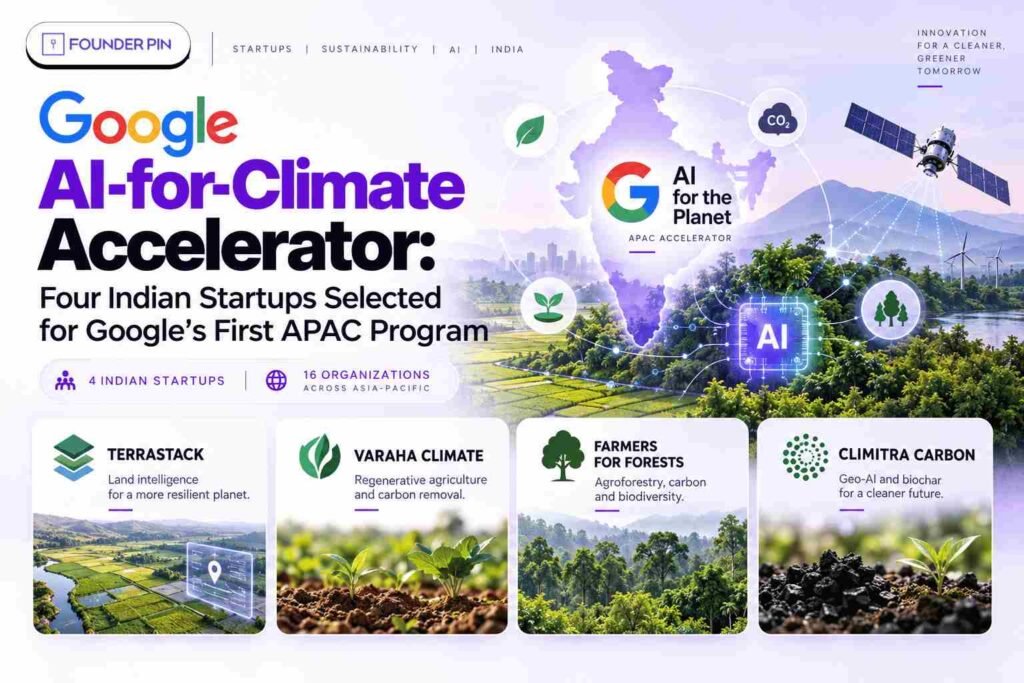
India’s climate-tech ecosystem has received a notable boost from Google DeepMind. Four Indian organizations—Terrastack, Varaha Climate, Farmers for Forests, and Climitra Carbon—have been selected for the inaugural Google DeepMind Accelerator: AI for the Planet, an Asia-Pacific program focused on using artificial intelligence to address environmental challenges.
The four Indian participants are part of a 16-organization APAC cohort that includes startups, nonprofits, and research teams. The three-month program provides access to Google’s AI technologies, technical support, expert mentorship, and other resources.
Methodology: This article uses Google DeepMind’s official accelerator page and Google’s official India and global announcements as primary sources. Descriptions of the four Indian organizations are based primarily on Google’s published cohort information
Google AI-for-Climate Accelerator: What Is It?
Google DeepMind runs this three-month program to help APAC organizations use frontier AI for environmental problems. So what exactly does it involve?
Here are the key points:
- Officially, it’s called Google DeepMind Accelerator: AI for the Planet.
- It focuses on the Asia-Pacific region.
- The inaugural cohort includes 16 selected organizations.
- Participants range from startups to nonprofits to research teams.
- Focus areas cover climate, nature, agriculture, sustainability, and energy.
- The program takes no equity.
- Participants also get technical support and mentorship from Google experts.
Google built this program specifically for organizations where AI already drives the solution, or where AI plays a big part in the future roadmap.
So this isn’t just another startup accelerator. Instead, it centers on applying advanced AI to real problems — sustainable agriculture, biodiversity protection, carbon removal, and environmental monitoring, to name a few.
Four Indian Startups Selected by Google DeepMind
India has four organizations in the inaugural APAC cohort: Terrastack, Varaha Climate, Farmers for Forests, and Climitra Carbon.
| Indian organization | AI and climate focus |
|---|---|
| Terrastack | Plot-level land intelligence for smallholder farmers |
| Varaha Climate | Regenerative agriculture and carbon removal verification |
| Farmers for Forests | AI-powered drones for agroforestry, carbon and biodiversity |
| Climitra Carbon | Geo-AI for invasive-species removal and biochar |
Google’s announcement describes these four organizations as applying AI, satellite data, remote sensing, drones, and geospatial technologies to environmental challenges.
The use of satellite data, remote sensing, drones, and Geo-AI also shows how climate technology is increasingly overlapping with deep tech. FounderPin’s Top 10 Deep Tech Startups in India to Watch in 2026 explores this wider ecosystem.
1. Terrastack
Terrastack uses satellite and agricultural data to provide plot-level land intelligence for smallholder farmers.
The company is part of the accelerator’s sustainable agriculture focus. Its use of geospatial and agricultural information highlights how AI can help convert complex land data into information that farmers and other stakeholders can use.
This is particularly relevant in India, where agricultural decisions often depend on highly localized information about land, crops, and environmental conditions.
2. Varaha Climate
Varaha Climate uses remote sensing and AI to verify regenerative agriculture and carbon-removal activities.
Its model connects climate technology with smallholder agriculture by helping farmers participate in carbon-credit and carbon-removal systems.
The company is part of the accelerator’s climate and carbon solutions group, showing how AI can potentially improve measurement and verification in climate projects.
3. Farmers for Forests
Farmers for Forests uses AI-powered drones to scale smallholder agroforestry and make carbon and biodiversity outcomes measurable.
Agroforestry combines trees with agricultural systems, making monitoring and measurement important when projects operate across large areas.
Google has placed Farmers for Forests within the program’s climate and carbon focus, where AI-enabled monitoring can support the measurement of environmental outcomes.
4. Climitra Carbon
Climitra Carbon uses Geo-AI to verify the removal of invasive species and convert the resulting biomass into biochar.
This approach connects geospatial artificial intelligence with biomass utilization and carbon-related applications.
Its inclusion demonstrates that climate AI is not limited to renewable energy or emissions forecasting. It can also involve land management, biodiversity, biomass processing, and carbon measurement.
What Will the Indian Startups Get From Google?
The biggest benefit is access to Google’s AI ecosystem and technical expertise rather than traditional equity investment.
Participants receive:
- Access to Google’s latest AI stack and selected frontier models.
- Technical guidance from Google DeepMind and Google Research experts.
- Tailored mentorship.
- Google Cloud resources and eligible product credits.
- Opportunities to work through complex technical challenges.
- Exposure to an international network of organizations working on environmental problems.
- A program culminating in an in-person Demo Day.
Google’s accelerator programs are designed to support AI-focused organizations without taking equity. Google says its broader accelerator network has supported more than 2,000 startups and organizations across 88 countries since 2016.
That makes the climate program part of a much larger Google effort to help AI-focused organizations move from technology development toward real-world deployment.
Why AI Matters for Climate Technology
AI can help climate-tech companies process large volumes of environmental data, improve predictions, and automate monitoring.
Climate and environmental projects generate enormous amounts of information from:
- Satellites
- Drones
- Weather systems
- Agricultural sensors
- Geographic datasets
- Remote-sensing platforms
Google has already applied AI to environmental problems beyond this accelerator. Its Flood Hub technology, for example, provides river-flood forecasts covering more than 150 countries and about 2 billion people, with forecasts available up to seven days ahead in areas at risk of significant river flooding.
Google has also reported that AI-based technology can support climate mitigation, adaptation, and more sustainable decision-making. A Google and Boston Consulting Group report estimated that AI could potentially help mitigate 5–10% of global greenhouse-gas emissions by 2030, although this is a potential-impact estimate rather than a guaranteed outcome
AI is increasingly moving beyond consumer applications into agriculture, environmental monitoring, and other specialized industries. For a broader look at India’s AI ecosystem, explore FounderPin’s Top 10 Indian AI Companies in 2026
Why the Google AI-for-Climate Accelerator Matters for India
The program puts Indian climate-tech companies inside a wider APAC ecosystem focused on AI-powered environmental solutions.
India faces challenges across agriculture, water, biodiversity, land use, energy, and climate resilience. AI can potentially help address some of these problems by making environmental information faster to collect, analyze, and act upon.
Google is also expanding its broader climate-technology work in India. In February 2026, Google announced the Google Center for Climate Technology in collaboration with the Office of the Principal Scientific Adviser to the Government of India.
In September, Google said the Center had received 77 applications and selected three inaugural projects focused on green workforce training and low-carbon construction materials, while announcing additional focus areas around water stewardship and waste and circularity.
This creates a broader picture: India’s AI ecosystem is increasingly intersecting with climate research, agriculture, carbon markets, biodiversity, and sustainability.
The intersection of AI, satellite data, and environmental intelligence is particularly interesting in India’s expanding technology ecosystem. Our guide to Top 10 Space Startups in India to Watch in 2026 looks at companies building technologies around Earth observation, satellites, propulsion, and other space applications.
What Happens Next?
The AI for the Planet program runs through December 2026, with a Demo Day scheduled for December 10 in Singapore.
The program began with a bootcamp in Singapore from September 7–11, 2026, followed by tailored virtual support from September through December.
The selected organizations will work with Google’s AI technologies and experts during the program before presenting their progress at Demo Day.
For India’s four participants, the important question is not simply how much AI they can use. It is whether that technology can help turn climate solutions into products and systems that work reliably at scale.
FounderPin Perspective
The Google AI-for-Climate Accelerator highlights an important shift in India’s startup ecosystem: AI is moving beyond consumer applications and enterprise software into agriculture, carbon removal, biodiversity, and environmental monitoring.
Terrastack, Varaha Climate, Farmers for Forests, and Climitra Carbon are tackling different problems, but they share a common approach—using data, AI, and technology to make environmental action more measurable and scalable.
The accelerator does not guarantee commercial success or environmental impact. But it gives these organizations access to technical expertise and AI infrastructure that could help them test, improve, and scale their solutions.
For India’s climate-tech ecosystem, that combination of AI + geospatial data + agriculture + carbon + biodiversity is one of the more interesting technology intersections to watch through 2026 and beyond.
FAQs
1. What is the Google AI-for-Climate Accelerator?
The Google AI-for-Climate Accelerator, officially called Google DeepMind Accelerator: AI for the Planet, is a three-month APAC program that helps organizations use AI to address environmental challenges. The 2026 inaugural cohort includes 16 organizations working across agriculture, biodiversity, carbon removal, energy, and climate resilience.
2. Which Indian startups were selected for Google’s AI-for-Climate Accelerator?
Four Indian organizations were selected: Terrastack, Varaha Climate, Farmers for Forests, and Climitra Carbon. They use technologies including AI, satellite data, remote sensing, drones, and Geo-AI to work on sustainable agriculture, agroforestry, biodiversity, carbon removal, and land intelligence.
3. What does the Google AI-for-Climate Accelerator provide?
The accelerator provides selected organizations with access to Google AI technologies, technical expertise, mentorship, and support. The program includes a September 2026 bootcamp in Singapore, virtual support through December, and a Demo Day scheduled for December 10, 2026.
4. How are Indian startups using AI for climate solutions?
The selected Indian organizations apply AI in different ways. Terrastack combines satellite and agricultural data for land intelligence, while Varaha Climate uses remote sensing and AI for regenerative agriculture and carbon verification. Farmers for Forests uses AI-powered drones, while Climitra Carbon applies Geo-AI to invasive-species removal and biochar.
5. Why is Google investing in AI and climate technology in India?
Google is expanding its sustainability work in India across climate-smart agriculture, climate technology, and clean energy. The company says its initiatives aim to combine AI, digital technology, research, and partnerships to develop practical solutions for environmental challenges in India.
SHARE