

India’s construction industry is moving beyond bricks, cement and manual spreadsheets. AI, BIM, computer vision, 3D concrete printing, digital project management and technology-enabled material procurement are becoming important parts of the construction value chain.
That creates a growing opportunity for construction tech startups in India that can solve practical problems such as project delays, material procurement, quality monitoring, cost control and labour productivity.
A 2025 research paper on drone adoption in India’s construction industry found that only around 30% of surveyed construction firms were using drones, showing that digital adoption still has significant room to grow. Another 2026 study highlighted technological, financial, regulatory and organisational barriers to construction automation and robotics in India.
There is no single official ranking of Indian construction-tech startups, so this is best treated as a 2026 watchlist, not a definitive ranking.
Here are some of the Indian construction-tech companies worth watching in 2026.
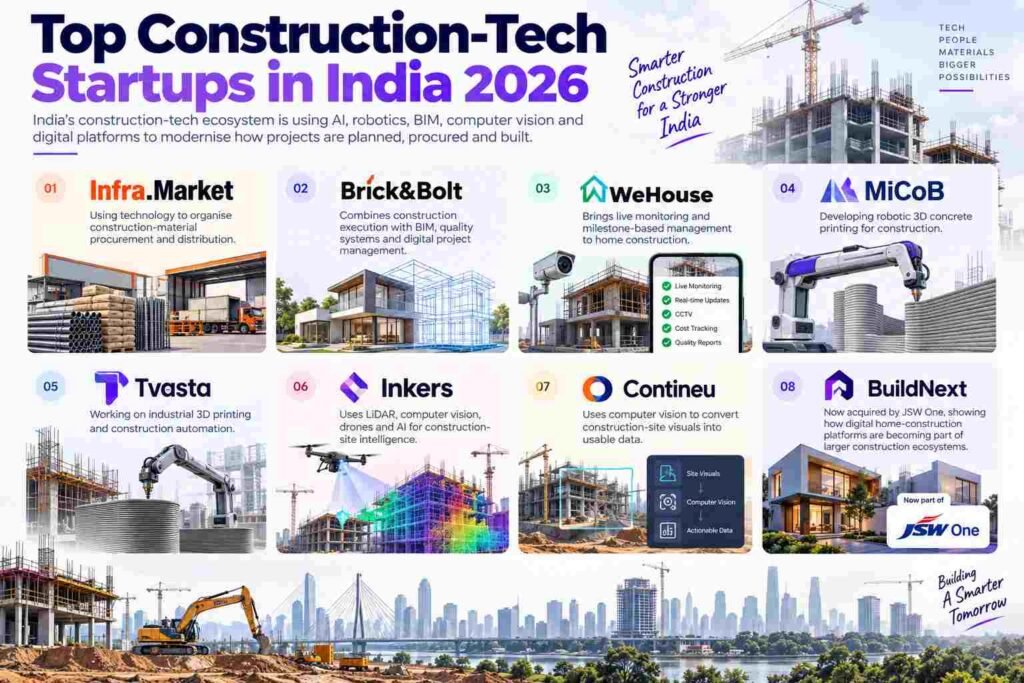
1. Infra.Market
Infra.Market is a technology-enabled construction-materials platform focused on digitising procurement, manufacturing and distribution.
- Founder: Aaditya Sharda and Souvik Sengupta
- Founded: 2016
- Location: Thane, Maharashtra
- Core technology: Digital procurement, supply-chain technology, manufacturing and distribution systems
- Products/services: Concrete, aggregates, AAC blocks, steel, pipes, tiles, paints, electrical products, modular products and other construction materials
- Funding: More than $740 million in reported total funding according to Inc42; it raised ₹1,050 crore in January 2025 and another ₹732 crore in September 2025.
- Key projects/customers: The company supplies construction materials to contractors, developers and infrastructure companies across India. Its platform serves both B2B and retail channels, with more than 283 manufacturing facilities across 22 states according to the company’s website.
- Why it is notable: Infra.Market demonstrates that construction technology is not limited to software. Digitising the material procurement and supply chain can influence cost, availability and delivery across large construction projects.
The company is also moving toward the public markets. It received SEBI approval for a proposed ₹5,000-crore IPO in January 2026.
2. Brick&Bolt
Brick&Bolt combines technology with on-ground construction execution to make residential construction more predictable and transparent.
- Founders: Jayesh Rajpurohit and Arpit Rajpurohit
- Founded: 2017; launched Brick&Bolt in January 2018
- Location: Bengaluru, Karnataka
- Core technology: BIM, digital project tracking, quality-management systems and construction workflow technology
- Products/services: End-to-end home construction, design, project management, material supply and quality monitoring
- Funding: Inc42 reports total disclosed funding of about $13.74 million across four rounds, with its latest listed round in January 2023.
- Key projects/customers: Brick&Bolt says it crossed 10,000 homes delivered across India by July 2025.
- Why it is notable: Its QASCON framework uses 470+ quality checks, while BIM is used during planning to create detailed 3D construction models. Customers can also monitor project information digitally.
The company is interesting because it connects software with the messy reality of physical construction. The technology has to work on an actual site, not just look good in a pitch deck.
3. WeHouse
WeHouse uses technology, project management and real-time monitoring to organise residential construction from design through execution.
- Founders: Sripad Nandiraj and Rohan Vinayak Reddy
- Founded: 2017
- Location: Hyderabad, Telangana
- Core technology: Digital project monitoring, CCTV, material tracking, milestone management and quality monitoring
- Products/services: Architecture, construction, interiors and technology-enabled home construction
- Funding: The company says it has raised ₹50 crore+; it also raised ₹25 crore in Series A funding in September 2025.
- Key projects/customers: WeHouse says it has delivered 400+ projects across eight cities, covering more than 25 lakh sq. ft.
- Why it is notable: Its E-Monitoring system gives customers access to construction milestones, material deliveries, quality checkpoints and site information without requiring them to visit the site constantly.
That addresses one of residential construction’s oldest problems: the customer often has very little visibility once construction begins.
4. MiCoB
MiCoB is building a digital construction-manufacturing platform around 3D concrete printing, robotics, and automation.
- Founders: Dr. Shashank Shekhar, Dr. Ankita Sinha and Rishabh Mathur
- Founded: 2018, at IIT Gandhinagar
- Location: Ahmedabad, Gujarat
- Core technology: 3D concrete printing, robotics, automated material handling, construction software, and digital manufacturing
- What it builds: 3D-printed bunkers, buildings, dwelling units, modular structures, infrastructure components, and customised construction systems
- Funding: A ₹30 crore investment commitment, announced through the Vande Bharatam initiative in 2026
- Track record: By its own count, MiCoB has delivered 650+ 3D-printed structures across 13 states. More than 500 of those are impact- and blast-resistant bunkers. The company also works in defence, housing, hospitality, and infrastructure.
- Why it stands out: Most 3D-printing efforts stop at demonstration houses. MiCoB is aiming for a broader “Digital Construction Manufacturing” model that ties together materials, robotics, software, and project execution.
Its defence work carries extra weight. Harsh, remote environments put rapid, automated construction technology through a tougher test than most commercial projects ever will.
5. Tvasta
Tvasta is an IIT Madras-founded deep-tech company developing large-scale 3D-printing systems for construction and other industrial applications.
- Founders: Adithya V.S., Parivarthan Reddy, Santhosh Kumar and Vidyashankar C.
- Founded: 2016
- Location: Chennai, Tamil Nadu
- Core technology: Concrete 3D printing, robotics, specialised materials and digital construction software
- Products/services: Industrial 3D printers, construction printing systems, software, materials and turnkey services
- Funding: Inc42 reports more than $400,000 in disclosed funding across two rounds; funding databases can differ depending on how grants, debt and undisclosed rounds are counted.
- Key projects/customers: Tvasta built a 3D-printed house at IIT Madras and has developed construction-focused printing technology. The Ministry of Housing and Urban Affairs has also listed Tvasta’s 3D-printed house technology under the Global Housing Technology Challenge ecosystem.
- Why it is notable: Tvasta is working on the complete construction-printing stack: hardware, software, materials and printing strategy.
Its current website says its systems have produced more than 25,000 sq. ft. of 3D-printed construction and can reduce material waste substantially, although company-reported performance figures should be distinguished from independently verified industry benchmarks.
6. Inkers
Inkers is using AI, spatial computing and computer vision to turn construction-site information into structured project intelligence.
- Founders: Inkers’ founding team
- Founded: 2018
- Location: Bengaluru, Karnataka
- Core technology: AI, computer vision, LiDAR/spatial capture, BIM and construction analytics
- Products/services: Kaël, an AI project manager, and Observance, an as-built BIM and site-scanning platform
- Funding: Inkers announced a new funding round in May 2026 to expand Kaël and Observance across India; the company did not disclose the round’s amount in its announcement.
- Key projects/customers: Inkers says its systems are being expanded across residential, commercial and industrial projects, including large residential towers, technology parks and warehouses.
- Why it is notable: Instead of treating construction photographs and scans as isolated records, Inkers is trying to turn them into structured information that project teams can use for decisions.
The company’s 2026 funding announcement specifically describes a shift from early deployments with marquee builders toward broader adoption across Indian construction.
7. Contineu
Contineu uses 360-degree site capture, 3D digital twins and AI to automate construction-site visibility and quality monitoring.
- Founder: Contineu’s founding team
- Founded: 2023
- Location: Bengaluru, Karnataka
- Core technology: 360° reality capture, computer vision, 3D digital twins and machine learning
- Products/services: Site scanning, automated QA/QC, defect detection, progress tracking, digital twins and structured construction records
- Funding: The company raised a $1.2 million seed round in 2025, according to The Economic Times.
- Key projects/customers: Contineu says its technology is deployed across residential, hospitality, commercial, pharmaceutical and industrial construction, with active deployments in multiple cities.
- Why it is notable: Its platform turns a short 360° site walk into a structured digital record and uses AI to identify construction defects and track progress.
This is an important direction for construction tech: capturing what physically exists on-site and converting it into usable digital data.
8. BuildNext — Now Part of JSW One
BuildNext is worth watching because its 2026 acquisition shows how digital home-construction technology is becoming integrated with larger construction platforms.
The company developed technology around home design and project management.
In April 2026, JSW One acquired BuildNext, adding its design and project-management capabilities to JSW One Homes. The combined platform is intended to connect materials procurement, design, execution and project management.
This is an important development for the sector: construction technology does not necessarily have to remain a standalone startup. It can become part of a larger ecosystem covering materials + finance + design + execution + technology.
How Construction-Tech Is Changing India’s Construction Industry
Construction technology is not simply about replacing workers with machines. Its bigger role is to make construction more measurable, predictable, safer and resource-efficient.
Lower Construction Time
Automation and digital planning can reduce delays by identifying problems earlier and making repetitive processes more predictable.
- 3D printing can automate selected construction activities.
- BIM can identify design conflicts before construction.
- Digital site monitoring can identify progress issues earlier.
- Automated workflows can reduce repetitive reporting.
For example, 3D-printing companies such as MiCoB and Tvasta are trying to move selected construction activities from manual site work toward controlled digital manufacturing.
The time benefit depends heavily on project design, material availability, site conditions and approvals. Technology is not a magic “skip delays” button.
Cost Efficiency
Construction technology can reduce costs by improving procurement, planning, quality control and labour productivity.
- Digital procurement can improve material coordination.
- BIM can improve quantity estimation.
- Computer vision can reduce manual inspection work.
- Automated construction can reduce certain repetitive activities.
Infra.Market, for example, uses technology across procurement, manufacturing and distribution rather than operating only as a conventional materials supplier.
Reduced Material Waste
Digital manufacturing and better project planning can reduce unnecessary material consumption and rework.
3D concrete printing is particularly relevant because material is deposited according to a digital toolpath rather than being used in the same way as conventional formwork-heavy construction.
Tvasta says its 3D-printing approach can reduce construction waste by up to 80%; this should be treated as a company-reported capability, because actual savings vary by design and project conditions.
Automation
Automation is moving from factories into construction sites.
The emerging technology stack includes:
- Robotic arms
- 3D concrete printers
- AI project managers
- Computer vision
- Drones
- Digital twins
- Automated quality inspection
- BIM-based planning
IIT Madras’ launch of a ₹3.3-crore construction-robotics laboratory with Bechtel India in September 2026 is another sign that construction automation is receiving greater attention from academia and industry.
Worker Safety
Technology can reduce exposure to some hazardous, repetitive or physically demanding activities.
Robots can potentially perform selected tasks in difficult environments, while drones and remote site-capture systems can reduce the need for people to physically inspect certain areas.
However, technology does not automatically make a site safe. Proper training, operating procedures and compliance remain essential.
Sustainable Construction
Construction tech can support sustainability through better material efficiency, lower rework and more controlled production.
3D printing, digital quantity estimation, BIM and AI-based quality monitoring can help reduce unnecessary material consumption.
NITI Aayog’s 2026 buildings report also places the construction and buildings sector within India’s wider transition toward Viksit Bharat and net-zero objectives, reinforcing the importance of resource-efficient building technologies.
Challenges Faced by Construction-Tech Startups
Construction tech has enormous potential, but scaling a construction startup is considerably harder than launching another software product.
1. High Capital Requirements
Hardware-heavy construction startups need significant capital before reaching commercial scale.
Robotic systems, printers, sensors, testing equipment and manufacturing facilities can require substantial upfront investment. Unlike SaaS businesses, the startup may need to buy physical equipment before generating recurring revenue.
2. Hardware and Manufacturing Costs
Building construction hardware is only the beginning; maintaining and deploying it at different sites creates additional costs.
A construction robot or 3D printer must work in dusty, hot, humid or remote environments. Equipment also needs transportation, maintenance, calibration and trained operators.
3. Slow Industry Adoption
Construction companies often have long-established workflows, which makes technology adoption slower than in many digital industries.
A 2026 study of automation and robotics adoption in India’s construction industry identified high initial cost, organisational rigidity, interoperability, lack of competency and lack of standardisation among important barriers.
In other words, convincing a construction company to change its workflow can sometimes be harder than building the technology itself.
4. Regulations
Construction technology must work within building codes, safety requirements, approvals and project-specific regulations.
This becomes particularly important for new construction methods such as 3D printing and robotics. A technology may work technically but still require additional validation before it can be used widely on regulated projects.
5. Skilled Talent
Construction tech needs people who understand both technology and construction.
Startups need combinations of:
- Civil engineering
- Robotics
- AI and computer vision
- Materials science
- BIM
- Mechanical engineering
- Construction management
- Field operations
Finding people who can bridge these disciplines is a major scaling challenge.
6. Scaling Challenges
A technology that works on one project does not automatically work across 100 different construction sites.
Indian construction projects vary significantly in climate, labour availability, regulations, materials, site conditions and design.
That means startups need technology that is not merely impressive in a controlled demonstration but repeatable, serviceable and commercially viable in real-world construction environments.
What to Watch in 2026 and Beyond
The next phase of Indian construction tech will likely be about connecting technologies rather than selling isolated tools.
A construction company may eventually use BIM for planning, AI for scheduling, computer vision for quality inspection, drones for surveying, digital procurement for materials and robotics for selected construction tasks.
The challenge will be adoption. Construction is a physical industry, so a clever app alone cannot fix a broken process.
The startups that can connect software, hardware, construction expertise and on-site execution will have an interesting opportunity as India’s built environment becomes increasingly digital.