
Ultrahuman Funding: $70 Million Raised, Investors, Valuation, and What's Next
Table of Contents
Toggle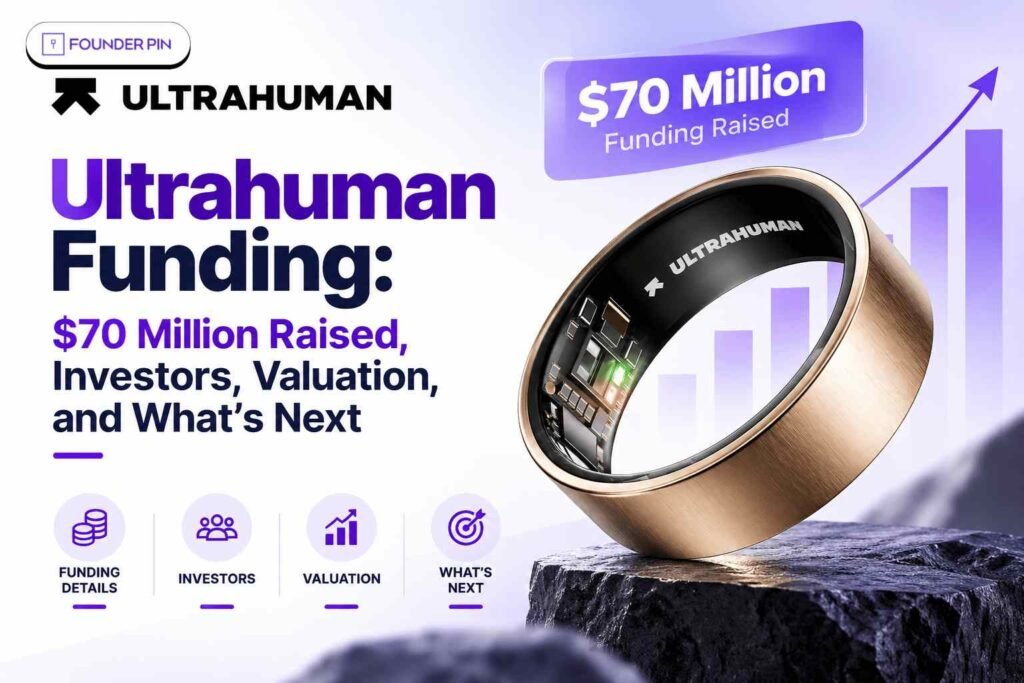
Ultrahuman funding reached a major milestone in September 2026, when the Bengaluru-based health-tech company announced a $70 million financing round involving Qualcomm Ventures, Labcorp, Alpha Wave, Blume Ventures, Nexus Venture Partners and Alteria Capital.
The round values Ultrahuman at about $365 million, according to TechCrunch, and marks a broader shift in the company’s ambitions. Ultrahuman is no longer positioning itself only as a smart-ring company. It wants to build a health intelligence and human-computer interface platform around continuous biological data.
Ultrahuman Funding: Key Facts
- Latest funding: $70 million
- Latest round announced: September 3, 2026
- Reported valuation: Approximately $365 million
- Primary equity: $65 million
- Debt component: $5 million
- Founder & CEO: Mohit Kumar
- Co-founder: Vatsal Singhal
- Headquarters: Bengaluru, India
- Key investors: Qualcomm Ventures, Labcorp, Alpha Wave, Blume Ventures, Nexus Venture Partners and Alteria Capital
- Main focus: Wearables, health intelligence, AI, sensing and biological data
Ultrahuman’s latest funding is notable because strategic investors are joining financial investors. Qualcomm brings semiconductor and computing expertise, while Labcorp adds a major diagnostics connection.
Who Invested in Ultrahuman’s $70 Million Round?
The latest Ultrahuman funding round includes Qualcomm Ventures, Labcorp, Alpha Wave, Blume Ventures, Nexus Venture Partners and Alteria Capital.
The investor mix includes:
- Qualcomm Ventures – Qualcomm’s venture investment arm
- Labcorp – U.S.-based diagnostics and laboratory services company
- Alpha Wave
- Blume Ventures
- Nexus Venture Partners
- Alteria Capital
- Other existing and participating investors
Qualcomm’s involvement is particularly interesting because Ultrahuman is exploring smart rings that can perform more computing directly on the device.
That means the ring could eventually do more than collect health data and send it to a smartphone or cloud service. The company’s longer-term vision includes AI interaction, software applications and other forms of on-device computing.
To understand terms such as equity, debt, valuation, dilution and cap tables, founders can also explore FounderPin’s guide to startup funding terminology.
What Is Ultrahuman’s Valuation?
Ultrahuman’s latest reported valuation is approximately $365 million following the September 2026 financing.
TechCrunch reported that the valuation is roughly three times the company’s reported $120 million valuation in 2023. The latest valuation reflects investor expectations around Ultrahuman’s expansion beyond smart rings into health intelligence and computing.
Valuation should not be confused with cash raised.
The $70 million represents financing, while the $365 million figure represents the company’s reported valuation following the round. They measure different things.
For investors trying to understand how startup valuation, dilution and risk fit together, this valuation guide provides useful context
Was the Entire $70 Million Equity Funding?
No. The $70 million financing included both equity and debt.
- $65 million came through primary equity
- $5 million came through debt
This distinction matters when discussing Ultrahuman funding because headlines can make the entire $70 million sound like equity investment.
The company’s own announcement describes the transaction as a $70 million financing round, while founder and CEO Mohit Kumar provided the equity-debt breakdown to TechCrunch.
Ultrahuman Funding History
The 2026 round builds on several earlier financing events as Ultrahuman moved from metabolic health technology into smart rings and a wider health platform.
Public funding databases differ in how they classify Ultrahuman’s financing, particularly around debt and more recent rounds. Inc42, for example, lists earlier rounds including Series A in 2020, a 2021 round, a 2024 Series B and venture debt in 2025.
Some reported milestones include:
| Period | Funding / development |
|---|---|
| 2020 | Series A funding reported |
| 2021 | $17.5M funding round reported |
| 2024 | $35M Series B reported by Inc42 |
| 2025 | ₹100 crore venture debt from Alteria Capital |
| 2026 | $70M involving Qualcomm Ventures and others |
Ultrahuman also reported ₹100 crore in venture debt from Alteria Capital in November 2025, aimed at market expansion, research partnerships and new product and software development.
Because databases use different definitions of “total funding,” FounderPin readers should treat individual round figures as more reliable than combining third-party database totals without checking their methodology.
How Is Ultrahuman Using the New Funding?
Ultrahuman says the new capital will support health intelligence, sensing, AI, miniaturized electronics, clinical research and international expansion.
The company is working across several areas:
- On-device computing
- Artificial intelligence
- Sensor technology
- Health algorithms
- Clinical research
- New wearable categories
- International expansion
- Human-computer interfaces
The strategy is becoming broader than selling another generation of smart rings.
Ultrahuman wants the ring to become a computing platform that understands physiological context and can potentially interact with software and AI applications.
Ultrahuman’s Business Is Already Scaling
The funding comes after strong reported growth in Ultrahuman’s existing business.
For FY2025, Ultrahuman reported:
- $64 million in operating revenue
- $8.2 million in net profit
- 8.76% EBITDA margin
- $58.4 million of revenue from smart rings
- $3.2 million from subscriptions
The company’s own figures show that smart rings still generated the overwhelming majority of FY2025 operating revenue, while software subscriptions were smaller but strategically important.
This creates an interesting hardware-to-software model.
The ring brings users into the ecosystem. Software features, PowerPlugs and additional health services can then potentially increase revenue from the installed user base.
Why Qualcomm’s Investment Matters
Qualcomm’s investment connects Ultrahuman’s health-data strategy with a much larger ambition around on-device computing.
Today, many wearable devices primarily collect data and rely on smartphones or cloud infrastructure for processing.
Ultrahuman wants future rings to perform more computation locally.
According to TechCrunch, the company is exploring uses such as AI interactions, gaming controls, pointing, car keys and third-party software. The goal is effectively to make the ring more like a small computing platform rather than just a passive tracker.
That is a significant change in positioning. Ultrahuman’s strategy also reflects a broader opportunity emerging across AI and technology startups, particularly where hardware and software increasingly overlap
What Is Next for Ultrahuman?
Ultrahuman’s next phase is likely to focus on turning its ring into a broader health and computing interface.
The company has already introduced Ring PRO, Jade AI, Blood Vision, CGM products, PowerPlugs and research initiatives such as Pulsomics.
Ring PRO adds on-device machine learning and expanded storage, while Jade connects information from areas such as Ring, Blood Vision and CGM data.
Ultrahuman is also rebuilding its U.S. business following its patent dispute with Oura. Ring PRO received clearance for U.S. entry in 2026, allowing the company to resume sales with its redesigned product.
The company is also investing in clinical science and research. Its Pulsomics initiative, for example, is designed to collect opt-in longitudinal physiological data for research and model development.
Could Ultrahuman Go Public?
An IPO is not an immediate priority, according to founder and CEO Mohit Kumar.
Kumar told TechCrunch that Ultrahuman wants to demonstrate approximately eight quarters of profitability before going public, making 2028 the earliest potential IPO window based on his comments.
That is a management target, not a confirmed IPO plan or date. The company’s future listing decision will depend on its financial performance, market conditions and strategic priorities.
FounderPin Perspective
Ultrahuman funding tells a bigger startup story than simply another $70 million raise.
The company began with metabolic health and glucose monitoring, expanded into smart rings, added blood testing and environmental sensing, and is now building an AI-powered health intelligence platform.
The latest financing suggests that investors are backing a broader thesis: the wearable could become a computing interface for the human body.
The challenge is equally clear. Ultrahuman must turn more sensors, more data and more AI into products that users actually find useful.
For founders, the lesson is worth watching: a hardware product can become much more valuable when the company builds a software, data and ecosystem layer around it.
Frequently Asked Questions About Ultrahuman Funding
1. How much funding has Ultrahuman raised?
Ultrahuman announced a $70 million financing round in September 2026, with participation from Qualcomm Ventures, Labcorp, Alpha Wave, Blume Ventures, Nexus Venture Partners and Alteria Capital. The round includes $65 million in primary equity and $5 million in debt, according to TechCrunch.
2. Who are the investors in Ultrahuman?
The latest Ultrahuman funding round includes Qualcomm Ventures, Labcorp, Alpha Wave, Blume Ventures, Nexus Venture Partners and Alteria Capital, among others. The mix combines technology, diagnostics, venture capital and debt investors as Ultrahuman expands its health intelligence and wearable technology business.
3. What is Ultrahuman’s valuation in 2026?
Ultrahuman was reportedly valued at approximately $365 million after its September 2026 financing round, according to TechCrunch. The reported valuation is about three times the company’s $120 million valuation in 2023. Valuation figures can vary depending on the financing terms and source.
4. What will Ultrahuman use its new funding for?
Ultrahuman plans to use the new capital to expand sensing technology, artificial intelligence, miniaturized electronics, health algorithms, clinical science and international operations. The company is also developing its broader health intelligence platform and exploring smart rings as human-computer interfaces.
5. Is Ultrahuman planning an IPO?
Ultrahuman has discussed a potential future public listing, but there is no confirmed IPO date. Founder and CEO Mohit Kumar has indicated that the company wants to establish a sustained period of profitability before considering an IPO. Any future listing would depend on business performance and market conditions.
Build Your Startup for the Next Funding Round
Ultrahuman’s journey shows that raising capital is only one part of building a scalable startup. The right strategy, investor-ready pitch, business model and fundraising preparation matter just as much.
At FounderPin, we help founders turn ideas into investment-ready businesses through practical guidance, startup courses, mentorship and fundraising support.
Want to prepare your startup for investors? Explore our startup courses, learn how to build a stronger fundraising strategy, or contact FounderPin for expert startup guidance.
Build smarter. Pitch better. Grow with confidence.
SHARE