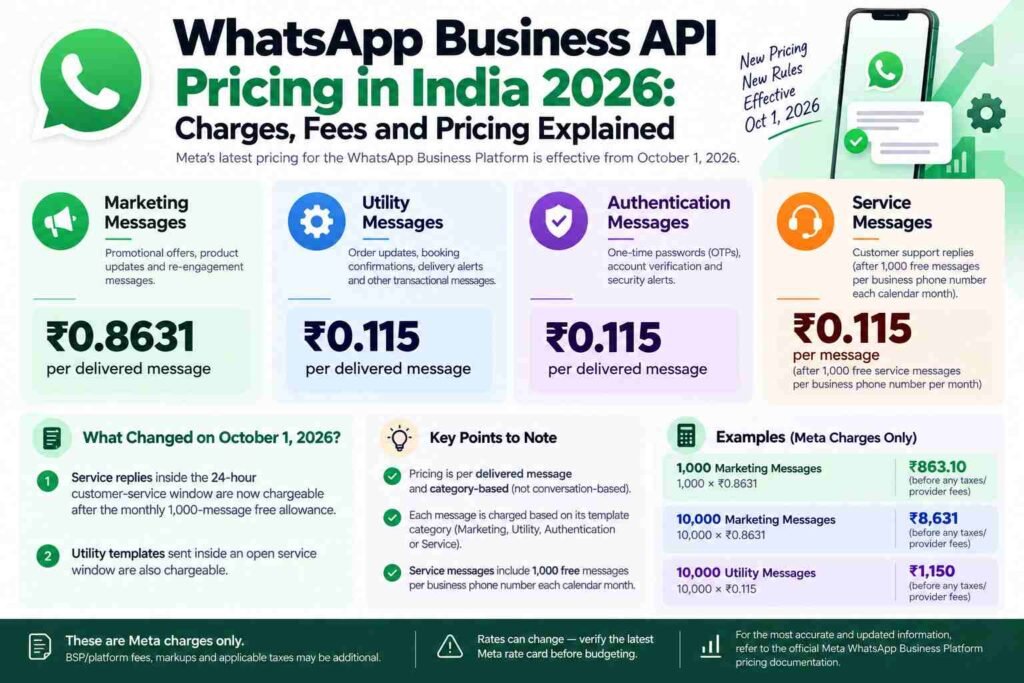
Assumptions: These are simple estimates using India list rates of ₹0.8631 for marketing and ₹0.115 for utility messages. Actual costs can be lower for eligible utility/authentication volume tiers. Service messages also have a 1,000-message monthly free allowance per business phone number from October 1, 2026.
Important: These figures exclude BSP/software fees and applicable GST. Your final WhatsApp API bill can therefore be higher.
What Are Service Messages?
Service messages are generally free-form replies sent by a business after a customer contacts it, while the customer-service window is open.
Examples include:
- Answering a customer’s product question
- Providing information requested by a customer
- Responding through a chatbot
- Handling support conversations
- Sending a normal free-form reply from an agent
From October 1, 2026, each WhatsApp Business phone number receives 1,000 free service messages per month. After that allowance, additional service messages become chargeable.
The allowance is based on messages, not customers or conversations. It also resets monthly rather than accumulating.
Are WhatsApp Business API Replies Still Free?
Not always. This is one of the most important 2026 changes.
Customer messages sent to your business remain free. However, your business’s replies can become chargeable once the monthly service-message allowance is exhausted.
There is also a separate 72-hour free entry-point window for eligible conversations originating from Click-to-WhatsApp Ads or certain Facebook call-to-action entry points. Messages covered by that window remain free for message delivery.
So the old shortcut of saying “WhatsApp replies are free within 24 hours” is now incomplete.
What Are BSP or WhatsApp Provider Fees?
Meta’s rate is only part of the calculation if you use a third-party platform.
A BSP or WhatsApp software provider may charge for:
- Monthly subscription
- Team members or agent seats
- Chatbot features
- CRM integrations
- Automation
- AI agents
- Analytics
- Per-message markup
- Setup or additional services
For example, AiSensy’s current pricing page lists plans ranging from a free tier to paid plans such as ₹1,500/month, ₹3,200/month and ₹9,100/month, with messaging charges shown separately.
Twilio uses another model: it lists its own $0.005-per-message handling fee, in addition to Meta’s applicable WhatsApp messaging charges.
This is why two businesses sending exactly the same number of WhatsApp messages can receive very different total bills.
WhatsApp API Pricing Example for an Indian Business
Suppose an online store sends in one month:
- 5,000 marketing messages
- 10,000 utility messages
- 5,000 authentication messages
- 2,000 service messages
Using the listed India rates:
Marketing: 5,000 × ₹0.8631 = ₹4,315.50
Utility: 10,000 × ₹0.115 = ₹1,150
Authentication: 5,000 × ₹0.115 = ₹575
Service: First 1,000 free; remaining 1,000 × ₹0.115 = ₹115
Estimated Meta messaging cost = ₹6,155.50
This is a calculation based on the published rates and does not include provider fees or taxes.
How to Reduce WhatsApp API Costs in India
The simplest way to control WhatsApp API pricing is to understand which messages you’re sending and why.
- Separate marketing from transactional communication.
- Avoid unnecessary duplicate messages.
- Review automated chatbot replies.
- Monitor service-message usage every month.
- Compare BSP subscription and markup structures.
- Use approved templates appropriately.
- Track delivered messages rather than simply messages attempted.
- Check the recipient’s country because Meta pricing varies by market.
Meta also emphasizes user opt-ins, message quality and limits around business messaging. Businesses using the API to initiate conversations generally need approved templates, and repeated policy violations can result in messaging restrictions.
Separating marketing from transactional communication is especially important for D2C companies. If you’re building a consumer brand, our guide to D2C Growth in India explains how digital channels, marketplaces and quick commerce are changing customer acquisition.
WhatsApp Business API vs WhatsApp Business App
These are not the same product.
The WhatsApp Business App is designed primarily for smaller businesses managing conversations directly. The WhatsApp Business Platform/API is designed for businesses that need integrations, automation, multiple agents, CRM connectivity or large-scale messaging.
The pricing discussed in this article applies to the WhatsApp Business Platform/API, not normal personal WhatsApp usage. The October 2026 pricing change does not mean ordinary WhatsApp users suddenly pay to send messages.
Final Takeaway
WhatsApp Business API Pricing in India in 2026 is primarily a per-message model, but your final cost depends on more than Meta’s rate card.
The key numbers to remember are:
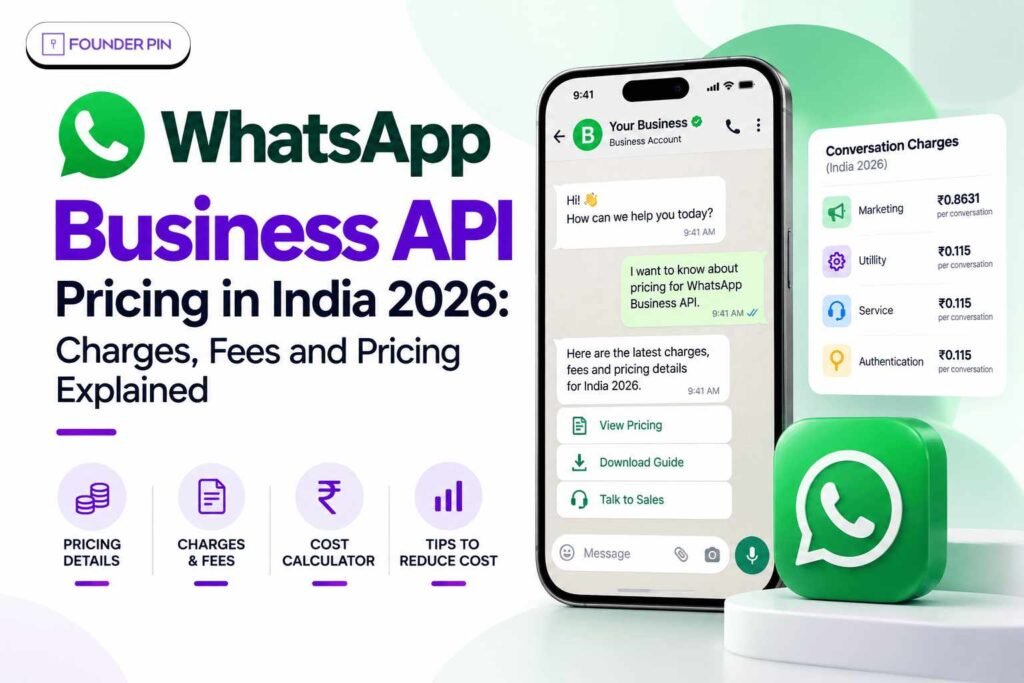
- ₹0.8631 — marketing message
- ₹0.115 — utility message
- ₹0.115 — authentication message
- 1,000 free service messages/month per business phone number
- ₹0.115 — service messages after that allowance, based on the current India rate
- BSP/software fees may come on top
Meta can revise its pricing, so businesses should check the current rate card before building a long-term messaging budget.
FAQs About WhatsApp Business API Pricing in India
Is WhatsApp Business API free in India?
No. The WhatsApp Business Platform is not completely free. Meta charges businesses for delivered messages based on their category and destination market. However, there is no separate fee to access the platform directly. Providers may charge additional software or service fees.
How much does WhatsApp API cost in India?
WhatsApp API pricing depends on the message category, volume and recipient market. Marketing messages generally cost more than utility or authentication messages. From October 2026, service messages also become chargeable after the first 1,000 free service messages per business phone number each month.
What are WhatsApp Business API message charges?
Meta charges per delivered message, with four main categories: marketing, utility, authentication and service. Rates vary by category and market, while utility and authentication messages can qualify for volume-based pricing.
Is WhatsApp Business API different from WhatsApp Business?
Yes. The WhatsApp Business app is designed mainly for smaller businesses and can be used from a device with limited integrations. The WhatsApp Business Platform/API is built for businesses that need automation, multiple integrations, customer-support systems and messaging at scale.
Does WhatsApp charge for incoming messages?
No, customers can message your business without a message delivery charge to the business. Businesses are charged based on messages they deliver, subject to Meta’s pricing rules and applicable free-entry-point or service-message provisions.
Do I need a WhatsApp API provider?
Not necessarily. Businesses with developers can access the WhatsApp Business Platform directly. If you need an inbox, chatbot, CRM integration or other ready-made tools, you can use an approved Business Solution Provider, which may charge additional fees.
What is the cheapest WhatsApp API solution in India?
There is no single cheapest option for every business. Direct access can avoid third-party software fees, while a provider may be more practical if you need automation, CRM integration or team inbox features. Compare the Meta message charges plus provider fees before choosing a solution.