Galgotias University Controversy: Branding Mistakes & Lessons
Galgotias University Controversy: In the fast-paced world of digital branding, a single viral moment can either build a legacy or break a reputation. Recently, Galgotias University found itself at the center of a PR firestorm during the India AI Impact Summit 2026. For the Founder Pin community of entrepreneurs and startups, what was meant to be a showcase of academic innovation has quickly morphed into a masterclass on the dangers of performative branding.
Galgotias University Controversy: The Incident: “Orion” vs. Reality:
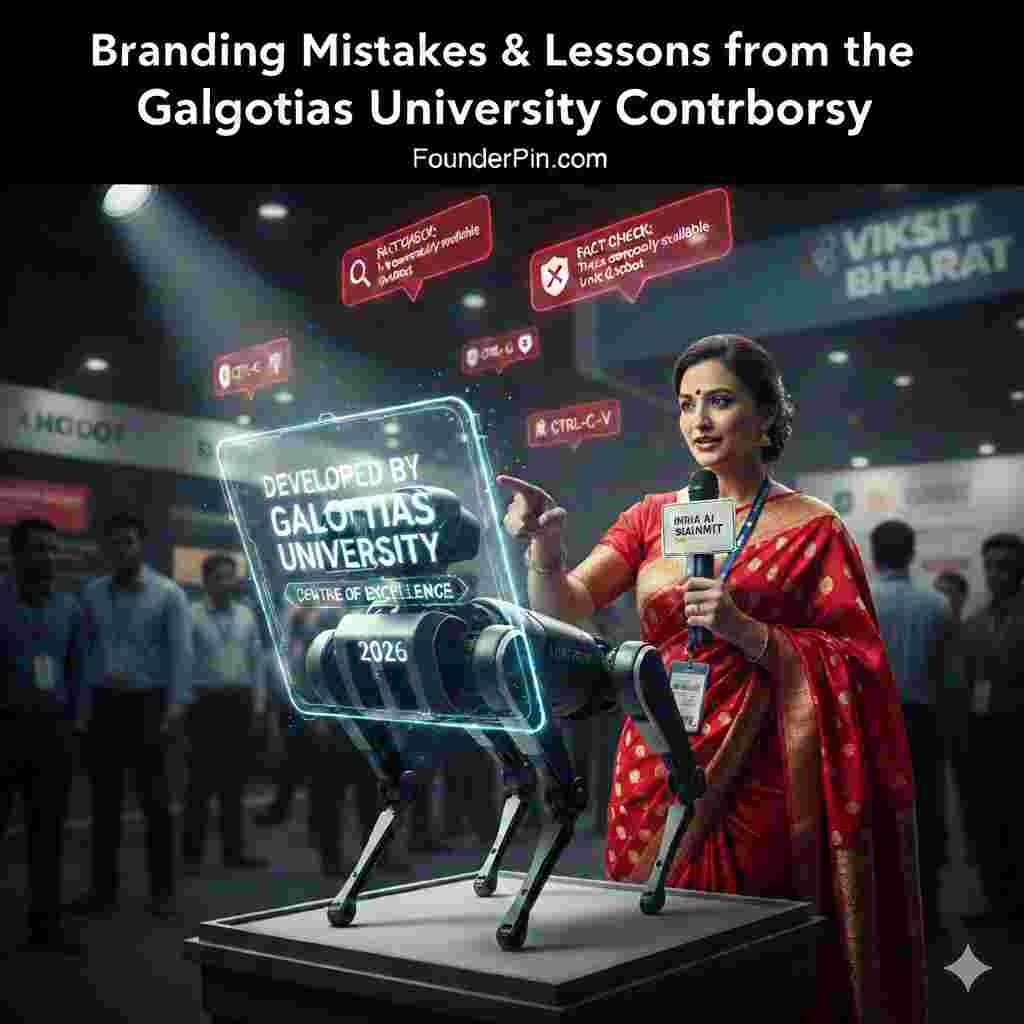
Galgotias University Controversy: The controversy began at the university’s stall at Bharat Mandapam, where a robotic dog named “Orion” was showcased. A video went viral showing a faculty member claiming the robot was “developed by the Centre of Excellence at Galgotias University” as part of a ₹350 crore AI investment.
However, tech-savvy netizens quickly identified “Orion” as the Unitree Go2, a commercially available product manufactured in China. The fallout was swift: the university was asked to vacate its stall, and social media exploded with “Ctrl-C Ctrl-V” memes.
For brands, this incident highlights a critical shift: in 2026, transparency is your only defense. Here are 10 branding mistakes to avoid, inspired by the Galgotias fiasco.
1. Over-Claiming Innovation (The “White-Label” Trap)
Galgotias University Controversy: The biggest hit to Galgotias’ credibility was the claim of “developing” an off-the-shelf product.
-
The Lesson: Be transparent about your tech stack. If you’re building an AI startup, differentiate between what you built and what you’re leveraging. As Harvard Business Review notes, consumers today judge authenticity as much as they judge quality.
2. Lack of Spokesperson Training
The university later blamed the controversy on an “ill-informed” professor.
-
The Lesson: Never let a representative speak on a national platform without a rigorous briefing. According to Forbes’ 2026 Crisis Playbook, the “Golden Hour” of PR is now a “Golden Moment” of just 15 minutes. One wrong word can go viral before you can correct it.
3. Galgotias University Controversy: The “Scapegoat” Strategy
Publicly throwing an employee under the bus—as the university did—often backfires.
-
The Lesson: Take collective responsibility. As we’ve seen in other startup case studies on Founder Pin, internal culture is your external brand.
4. Inconsistent Crisis Communication
Galgotias issued multiple statements: first calling the backlash “propaganda,” then a “misinterpretation,” and finally an “apology.”
-
The Lesson: Before hitting ‘send,’ ensure your story is solid. PRLab’s 2026 trends suggest that AI search engines will summarize your brand’s failure for months if your initial response is messy.
5. Ignoring the Power of Fact-Checkers
The university’s defense was publicly dismantled by X Community Notes.
-
The Lesson: Assume your audience is highly informed. In an era where even the Story of YourStory shows the power of citizen journalism, you cannot “spin” a video that millions have already seen.
6. Misalignment with the “Occasion”
Showcasing a Chinese-made robot at a summit focused on “Viksit Bharat” (Indigenous India) created a glaring ideological clash.
-
The Lesson: Read the room. For founders looking at how to register a startup in India, aligning your brand with national narratives requires genuine local contribution, not just a label.
7. Defensive “Propaganda” Claims
Labeling legitimate public criticism as “propaganda” often triggers the Streisand Effect, making the controversy even bigger.
-
The Lesson: Distinguish between trolls and critics. A humble, fact-based technical defense is more effective than an emotional counter-attack.
8. Neglecting Internal Alignment
The incident suggested that the PR team and the faculty weren’t on the same page.
-
The Lesson: Internal branding is key. Whether you’re learning how to start an AI company or running a university, your team must know the “True North” of your brand.
9. Using “Jargon” to Obfuscate
The university tried to explain the controversy as a “jumble of the words develop and development.”
-
The Lesson: Clarity beats cleverness. If you didn’t build it, don’t say you “developed” it. Ethical branding research proves that integrity yields higher long-term equity than short-term hype.
10. Galgotias University Controversy: Failing to Build Substance Before Display
The most sustainable branding is built on actual output—patents, research papers, and original prototypes.
-
The Lesson: Don’t let your storytelling get too far ahead of your story. As highlighted in the Rajpal Yadav legal explainers, when the “hype” falls away, only the legal and factual reality remains.
Galgotias University Controversy: Conclusion
Branding is a marathon, not a sprint. While Galgotias University’s intent may have been to showcase technology, the execution lacked the transparency required in a digital-first world. For every founder, the takeaway is simple: Be real, or be ready to be called out.
Would you like me to help you draft a PR checklist to ensure your next product launch avoids these common branding traps?
Galgotias University Robo-Dog Controversy Explained
This video captures the specific viral moment and the subsequent attempt at clarification that sparked the national branding debate.