Biotechnology Ignition Grant (BIG) Explained for Indian Startups
Table of Contents
Toggle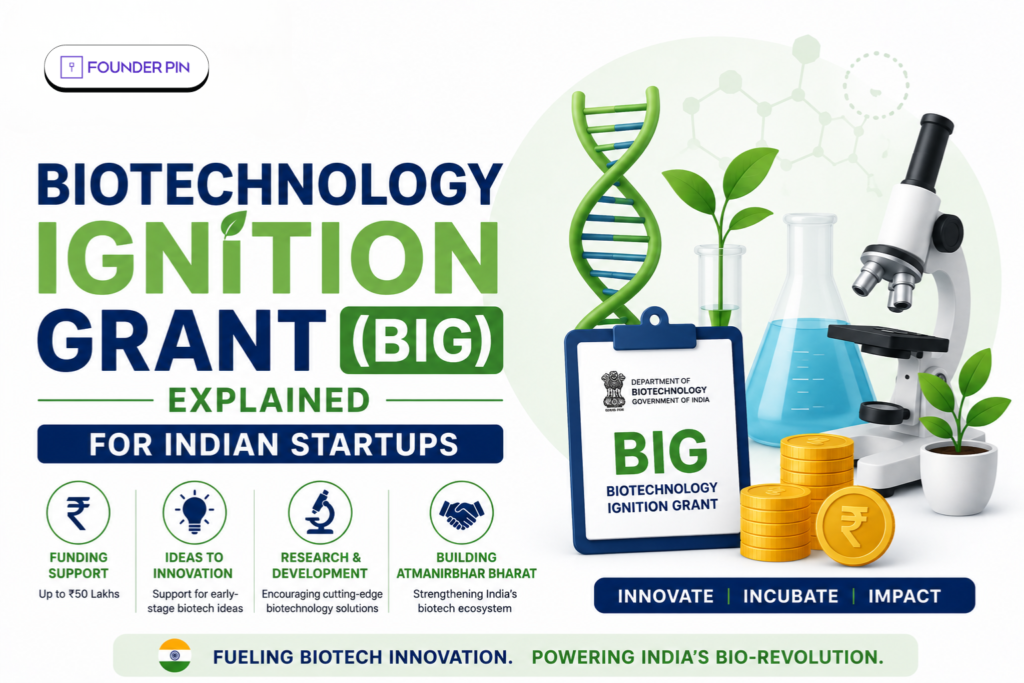
Key Takeaways
- The Biotechnology Ignition Grant (BIG) provides early-stage funding support for innovative biotechnology startups in India.
- BIG helps entrepreneurs transform research-based ideas into commercially viable products through proof-of-concept and prototype development.
- The grant offers non-dilutive funding, allowing founders to retain ownership while advancing their innovations.
- Biotech startups in healthcare, diagnostics, agriculture, industrial biotechnology, and bioinformatics can benefit from the program.
- A strong application should demonstrate innovation, technical feasibility, market potential, and a clear commercialization strategy.
- The Biotechnology Ignition Grant serves as a stepping stone for attracting investors, strategic partnerships, and future funding opportunities.
India’s biotechnology sector is rapidly emerging as one of the country’s most promising innovation-driven industries. From healthcare and diagnostics to agriculture, industrial biotechnology, and bioinformatics, startups are creating solutions that address some of society’s most pressing challenges. However, transforming a scientific breakthrough into a commercially viable product often requires substantial early-stage funding.
This is where the Biotechnology Ignition Grant (BIG) plays a crucial role. Designed specifically for biotech innovators, the Biotechnology Ignition Grant provides early-stage financial support that helps entrepreneurs validate ideas, build prototypes, and move closer to commercialization.
For aspiring biotech founders, understanding the Biotechnology Ignition Grant can be the first step toward securing critical funding and accelerating innovation.
What is the Biotechnology Ignition Grant (BIG)?
The Biotechnology Ignition Grant (BIG) is one of India’s most recognized funding programs for early-stage biotechnology innovations. The initiative aims to support entrepreneurs, startups, researchers, and innovators who possess promising biotech ideas but require financial assistance to validate their concepts and develop proof-of-concept solutions.
The program focuses on bridging the gap between scientific research and market-ready products. Many breakthrough technologies fail to reach commercialization due to limited access to seed-stage funding. BIG addresses this challenge by helping innovators de-risk their projects before approaching investors or larger funding agencies.
Why the Biotechnology Ignition Grant Matters for Startups
Biotechnology ventures typically require longer development cycles, regulatory approvals, specialized infrastructure, and extensive testing before generating revenue. These factors often make it difficult for startups to secure traditional funding during the earliest stages.
The Biotechnology Ignition Grant provides several advantages:
- Early-stage innovation funding
- Support for proof-of-concept development
- Reduced financial risk for founders
- Improved investor readiness
- Enhanced commercialization potential
- Increased credibility within the biotech ecosystem
For many startups, BIG serves as the foundation upon which larger funding rounds and strategic partnerships are built.
Also Read | MSME Innovative Scheme and Grants for Early-Stage Startups
Key Benefits of the Biotechnology Ignition Grant
Non-Dilutive Funding Support
One of the most attractive features of the Biotechnology Ignition Grant is that it provides funding without requiring founders to surrender equity. This allows entrepreneurs to retain ownership while advancing product development.
Validation of Innovative Ideas
Receiving a Biotechnology Ignition Grant acts as a strong validation signal. Investors, industry partners, and stakeholders often view grant-supported innovations as more credible due to the rigorous evaluation process.
Accelerated Product Development
Activities that can be funded include:
- Prototype development
- Laboratory testing
- Product validation
- Technology optimization
- Early-stage research activities
This significantly reduces the time required to move from concept to commercialization.
Improved Investor Confidence
Startups that successfully complete grant-funded milestones are often better positioned to attract angel investors, venture capital firms, and strategic industry partners.
Eligibility Criteria for the Biotechnology Ignition Grant (BIG)
The Biotechnology Ignition Grant (BIG) supports innovators, entrepreneurs, and biotech startups working on commercially viable biotechnology solutions. Applicants can apply either as an individual entrepreneur or through an eligible company or LLP.
Eligibility for Individual Applicants
To apply as an individual, applicants must meet the following requirements:
The applicant must be an Indian citizen.
The applicant should serve as the Project Leader and take primary responsibility for the project.
The project must be incubated or proposed for incubation at a recognized incubator. Applicants are expected to identify a preferred incubator during the application process.
A Letter of Intent (LoI) or Memorandum of Understanding (MoU) with the incubator may be required before final approval.
Applicants Associated with Academic or Research Institutions
If the applicant is employed or enrolled at an academic or research institution, they must either:
Obtain a No Objection Certificate (NOC) from the institution confirming permission to:
Receive grant funding as an individual.
Operate a separate bank account for the grant.
Execute the project through an incubator.
Establish a startup based on the innovation.
OR
Submit an undertaking confirming their intention to leave their current position and work on the project full-time if the grant is approved. Supporting documents such as resignation or relieving letters may be required before funding is released.
Applicants Employed in Private Companies or LLPs
Applicants working in a private company or LLP must:
Commit to leaving their current employment and joining the project full-time if selected for funding.
OR
Submit the application through the company or LLP instead of applying as an individual.
Restrictions
Individuals who already hold promoter or partner positions in a biotechnology company or biotech LLP are generally not eligible to apply as individuals. In such cases, applications should be submitted through the respective company or LLP if it meets the eligibility requirements.
Eligibility for Companies and LLPs
Applicants applying through a company or LLP must satisfy the following conditions:
The entity must be registered under the Companies Act, 1956 or 2013, or as a valid LLP in India.
The organization should not be more than five years old from the closing date of the relevant BIG application cycle.
At least 51% ownership and control must be held by resident Indian citizens and/or Indian-owned entities.
The application must identify a qualified Project Leader responsible for project execution.
The company or LLP should have access to adequate research and development (R&D) facilities. If such facilities are unavailable, the startup should be incubated at an approved incubator.
Additional Conditions
Companies or LLPs with promoters or partners linked to other ineligible biotechnology businesses may not qualify.
Exceptions may apply if the related business operates outside the biotechnology sector.
Important Notes
Project Leadership Requirements
Every application must designate a Project Leader responsible for both technical and managerial aspects of the project.
The Project Leader should possess the necessary technical qualifications and must have completed at least an undergraduate degree.
If shortlisted, the Project Leader will be required to present the proposal before the evaluation committee.
Upon approval, the Project Leader must sign the project agreement and, in the case of a company application, should also be a shareholder in the organization.
Funding Conditions
The proposed project must not have received funding support from another agency for the same objectives and deliverables.
BIG funding can generally be awarded only once to an individual entrepreneur or startup.
Eligible Applicants
The program welcomes applications from:
Biotechnology startups with commercialization potential.
Individual innovators and entrepreneurs with biotech-based solutions.
Scientists, researchers, faculty members, and graduates from any discipline.
Entrepreneurs currently incubated or planning to incubate at a recognized biotechnology incubator.
BIG Grant Application Process
The Biotechnology Ignition Grant (BIG) follows a structured process to identify and support innovative biotechnology startups with strong commercialization potential.
Application Process
Step 1: Funding Call Announcement
BIRAC announces BIG funding calls at least twice a year, usually in January and July. In addition, BIRAC promotes these opportunities through its website, startup networks, industry publications, and other media channels. Typically, the application window remains open for approximately six weeks.
Step 2: Submit the Application Online
Applicants must submit their proposals through the official BIRAC portal. However, BIRAC does not accept offline applications.
Step 3: Register as a BIG Applicant
Next, applicants need to create an account on the BIRAC website and register under the BIG User category.
Step 4: Complete and Submit the Proposal
After registration, eligible startups, companies, LLPs, and individual innovators can complete the application form. They must also upload all required documents before submission.
Important Application Guidelines
- Provide complete and accurate information to support a fair evaluation process.
- Review the proposal carefully before submission because BIRAC generally does not allow changes afterward.
- Avoid submitting inaccurate or misleading information, as it may lead to disqualification.
- Furthermore, applicants should coordinate with the assigned BIG Partner whenever required during the application process.
BIG Grant Selection Process
The BIG program uses a multi-stage evaluation process to assess innovation, feasibility, and commercialization potential.
Step 1: Eligibility Review
First, BIG Partners verify whether the application satisfies all eligibility requirements. They also check whether the proposal aligns with the objectives of the BIG scheme.
Step 2: Preliminary Selection Committee (PSC) Assessment
Next, the Preliminary Selection Committee reviews eligible applications based on:
- Alignment with the BIG program
- Availability of technical information
- Originality of the innovation
- Absence of plagiarism
Step 3: Expert Review
After the PSC assessment, subject matter experts review the shortlisted proposals. They evaluate the project’s technical strength, innovation level, and business potential.
Step 4: Technical Expert Panel (TEP) Presentation
Subsequently, shortlisted applicants present their ideas before the Technical Expert Panel (TEP).
The panel evaluates proposals within specific technology themes. Moreover, experts assign scores individually before calculating a final evaluation score.
Scoring Criteria
- Proposals scoring 60 or higher move to the next stage.
- Conversely, proposals scoring below 60 do not proceed further.
Step 5: Expert Selection Committee (ESC) Decision
The Expert Selection Committee reviews all qualified proposals and determines the final selection cutoff. As a result, only the highest-ranking applications advance to the due diligence stage.
Step 6: Due Diligence and Final Approval
Finally, BIG Partners conduct a comprehensive review of the selected proposals.
The due diligence process includes:
- Verification of eligibility documents
- Assessment of technical feasibility
- Review of financial viability
- Evaluation of laboratory facilities and equipment
- Validation of incubation support
- Examination of regulatory and compliance requirements
- Budget verification and justification
- Finalization of project milestones and funding schedules
Evaluation Criteria
BIG reviewers assess proposals across several important parameters.
| Evaluation Parameter | Maximum Score |
|---|---|
| Unmet Need and Problem Significance | 20 |
| Value Proposition and Differentiation | 20 |
| Technical Feasibility | 30 |
| Team Capability and Commitment | 15 |
| Business Potential and Commercialization Readiness | 15 |
In addition to these parameters, reviewers assess the startup’s market opportunity, commercialization strategy, scalability, and long-term growth potential. Therefore, applicants should clearly demonstrate both technical innovation and business viability throughout their proposals.
Also Read | Top Government Grants for Women Entrepreneurs in India
Documents Required for BIG Grant Application
Applicants must provide supporting documents at different stages of the BIG evaluation process to verify eligibility, technical feasibility, and project readiness.
Documents Required Before the Technical Expert Panel (TEP)
Prior to the TEP presentation, applicants may need to submit the following documents:
- Commitment letter from scientific advisors or mentors confirming their willingness to guide the project.
- Letters of intent from key technical team members participating in the project.
- Letter of interest or preliminary support from the selected incubator.
- Evidence demonstrating access to specialized facilities or infrastructure required for project execution.
- Proof of availability of critical samples, materials, or resources necessary for conducting the proposed work.
- Any additional supporting documents relevant to the innovation or project.
Documents Required After Expert Selection Committee (ESC) Approval
Applicants shortlisted by the Expert Selection Committee may be required to provide additional documentation, including:
- Formal acceptance letter or signed MoU with the incubator.
- Agreements or MoUs with facility providers, technology partners, vendors, or service providers involved in the project.
- Additional due diligence documents requested by BIG Partners, such as technology licensing agreements, intellectual property ownership documents, No Objection Certificates (NOCs), or regulatory clearances.
- A declaration confirming that the proposed project has not received funding from any other agency for the same objectives and deliverables.
- Any other documents requested during the final verification and approval process.
Common Challenges Faced by Biotech Startups
Despite growing opportunities, biotech entrepreneurs continue to encounter several obstacles.
Long Development Timelines
Biotech products often require years of research, validation, and regulatory approvals before reaching the market.
Capital Intensity
Research and development activities demand significant investment in infrastructure, talent, and testing.
Regulatory Complexity
Compliance requirements can create additional costs and delays for startups operating in highly regulated sectors.
Programs such as the Biotechnology Ignition Grant help address these challenges by providing critical support during the most vulnerable phase of a startup’s journey.
Strategic Tips for Securing Biotechnology Funding
Founders seeking grant support should focus on:
- Building a strong scientific foundation
- Validating market demand early
- Creating realistic commercialization plans
- Protecting intellectual property
- Developing measurable project milestones
- Presenting a compelling impact narrative
The combination of scientific innovation and business viability significantly improves funding prospects.
Conclusion
The Biotechnology Ignition Grant has become one of India’s most valuable funding opportunities for biotechnology innovators and early-stage startups. By providing non-dilutive financial support, validation, and commercialization assistance, the program helps bridge the critical gap between research and market adoption.
For biotech entrepreneurs developing transformative solutions in healthcare, agriculture, industrial biotechnology, and related sectors, the Biotechnology Ignition Grant can serve as a powerful launchpad for growth and long-term success.
Contact FounderPin for Expert Funding Guidance
Identifying suitable grant opportunities and preparing winning applications requires strategic planning and expert support. At FounderPin, we help startups navigate government funding programs, startup registrations, grant applications, and growth strategies.
Contact us for a consultation today and discover how your startup can leverage the Biotechnology Ignition Grant and other funding opportunities to accelerate innovation and business growth.