How to Write a Winning Grant Proposal for Startups
Table of Contents
Toggle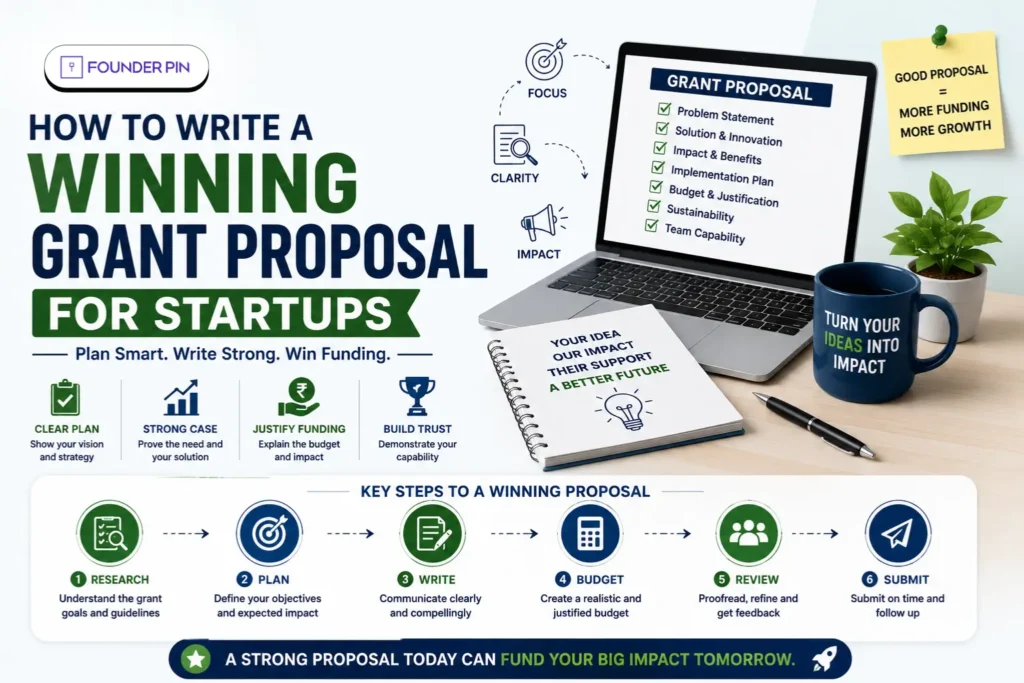
Key Takeaways
- A winning grant proposal clearly explains the problem, solution, market opportunity, funding requirements, and expected impact.
- Funding agencies prioritize startups that demonstrate innovation, scalability, feasibility, and measurable outcomes.
- Strong proposals use data, market research, customer validation, and realistic financial projections to build credibility.
- A strong executive summary can raise the likelihood of approval and greatly enhance reviewer engagement.
- Clear, concise writing is more effective than overly technical or complex explanations.
- Highlighting your team’s expertise, industry experience, and execution capability can strengthen your application.
- Understanding How to Write a Winning Grant Proposal can help startups secure non-dilutive funding and accelerate business growth.
Introduction
For many startups, government grants and innovation funding programs offer a valuable opportunity to secure capital without giving up equity. However, competition for grants is often intense, and even promising startups can struggle to secure funding if their proposal fails to communicate the value of their idea effectively.
A well-crafted grant proposal does more than describe a business concept. It demonstrates innovation, market potential, financial viability, and measurable impact. Funding agencies want evidence that their investment will create economic, technological, or social value.
At FounderPin, we assist entrepreneurs in locating financing sources and crafting strong proposals. In this guide, you’ll learn How to Write a Winning Grant Proposal, avoid common mistakes, and improve your chances of securing startup funding.
Why a Strong Grant Proposal Matters
Many founders believe that a great product alone is enough to win funding. In reality, grant evaluators assess not only the innovation but also the startup’s ability to execute and deliver results.
A strong proposal helps:
- Build credibility
- Demonstrate innovation
- Showcase market demand
- Explain funding utilization
- Highlight long-term impact
- Improve approval chances
Even highly innovative startups can lose funding opportunities if their proposal lacks clarity or structure.
Understanding What Grant Evaluators Look For
Before writing a proposal, it is important to understand the evaluation criteria commonly used by funding agencies.
Innovation
Funders want to support ideas that solve real problems in unique ways. Clearly explain what differentiates your solution from existing alternatives.
Market Potential
A startup must demonstrate that there is sufficient demand for the product or service.
Include:
- Market size
- Target customers
- Industry trends
- Growth opportunities
Scalability
Most funding organizations prioritize businesses capable of achieving significant economic or social impact.
Feasibility
Your proposal should convince reviewers that the project can realistically be executed within the proposed timeline and budget.
Also Read | Top Agriculture Startup Grants in India 2026 Explained
How to Write a Successful Grant Proposal for Indian Startups
Securing government grants requires more than a strong idea. A successful proposal should clearly demonstrate innovation, market potential, and alignment with the objectives of the funding program. Startups should focus on presenting their solution in a simple, structured, and results-oriented manner while highlighting the impact of the requested funding.
1. Build a Strong Foundation Before Applying
Before preparing your proposal, make sure your startup meets the basic eligibility requirements of the target scheme.
Obtain DPIIT Recognition
Register your startup under the Startup India initiative and secure DPIIT recognition. Many government grant programs require this as a mandatory qualification criterion.
Choose the Right Funding Program
Select a scheme that matches your startup’s stage and sector. For example:
Startup India Seed Fund Scheme (SISFS) offers grants of up to ₹20 lakh for prototype development and validation.
BIRAC supports biotech and healthcare innovations.
MeitY programs focus on technology-driven startups and digital innovation.
2. Structure Your Proposal Effectively
Most government funding programs follow a similar evaluation framework. Therefore, your proposal should include the following sections:
Executive Summary
Provide a concise overview of:
The problem you are solving
Your proposed solution
Market opportunity
Funding requirement
Although it appears first, this section is often easier to write after completing the rest of the proposal.
Problem Statement
Clearly explain the challenge or market gap your startup addresses. Use relevant statistics, industry insights, and evidence to demonstrate the significance of the problem.
Solution and Unique Value Proposition
Describe your product, prototype, or MVP in detail. Highlight what makes your solution different from existing alternatives, including any proprietary technology, innovation, or intellectual property.
Commercialization and Impact
Explain how your solution will reach customers and generate value. Additionally, outline the economic, social, environmental, or industry impact your startup can create.
Team and Expertise
Showcase the qualifications and experience of your founders and key team members. Emphasize why your team is capable of successfully executing the project.
3. Present a Realistic Budget and Milestone Plan
Grant reviewers look for practical and achievable plans.
Define Clear Milestones
Break the project into measurable stages such as:
Prototype development
Product testing
Pilot deployment
Market launch
Connect each milestone to specific funding requirements.
Explain Project Costs
Provide a transparent breakdown of expenses, including:
Equipment and machinery
Software and technology tools
Raw materials
Salaries and operational costs
Highlight Co-Funding Sources
If the scheme requires matching contributions, clearly mention how the remaining funds will be sourced, such as founder investment, angel funding, or other financing options.
4. Best Practices to Improve Approval Chances
Verify Eligibility Carefully
Review all scheme requirements before applying. Many grants target specific sectors such as agritech, clean-tech, healthcare, or women-led startups.
Use Simple and Clear Language
Avoid excessive technical jargon. Instead, explain complex ideas in a way that reviewers can easily understand. Use bullet points and concise paragraphs to improve readability.
Follow Application Guidelines Exactly
Carefully read the scheme handbook and comply with all submission requirements. Missing documents, incorrect formatting, or exceeding page limits can result in immediate rejection regardless of the quality of the proposal.
By combining a strong business case, realistic financial planning, and a well-structured application, startups can significantly improve their chances of securing government grant funding.
How to Make Your Proposal Stand Out
Use Data and Evidence
Strong proposals rely on facts rather than assumptions.
Support claims with:
- Market research
- Industry reports
- Customer feedback
- Pilot project results
Data helps evaluators trust your projections.
Tell a Compelling Story
Every successful startup has an issue that needs to be resolved.
Use storytelling to explain:
- Why the problem matters
- Why your solution is different
- Why your team is capable of success
Human-centered narratives often improve engagement.
Highlight Team Expertise
Funding agencies invest in founders as much as ideas.
Showcase:
- Industry experience
- Technical expertise
- Previous achievements
- Key partnerships
A strong team can increase evaluator confidence.
Common Grant Proposal Mistakes
Ignoring Eligibility Requirements
Applying for grants that don’t align with your startup’s stage or sector wastes time and resources.
Always review eligibility criteria carefully.
Weak Financial Planning
Unrealistic budgets can damage credibility.
Ensure funding requests align with project goals and milestones.
Overcomplicating the Proposal
Many founders include unnecessary technical details.
Grant reviewers may not have specialized knowledge, so simplicity and clarity are essential.
Failing to Demonstrate Impact
Innovation alone is rarely enough.
Show how the funding will generate measurable business, economic, or social outcomes.
Grant Proposal Checklist for Startups
Before submitting your application, verify that you have:
| Checklist Item | What to Verify |
|---|---|
| Clear Business Problem | Clearly defined the problem and identified the market need. |
| Strong Solution | Explained the innovation, unique value proposition, and competitive advantage. |
| Market Validation | Included evidence of customer demand, pilot results, or market research. |
| Realistic Budget | Provided a detailed breakdown of how the grant funds will be utilized. |
| Measurable Outcomes | Defined clear goals, milestones, and expected impact. |
| Supporting Documents | Attached all required registrations, financial records, certifications, and compliance documents. |
Conclusion
Learning How to Write a Winning Grant Proposal is one of the most valuable skills a startup founder can develop. A strong proposal not only increases funding approval chances but also helps clarify business goals, market opportunities, and growth strategies.
By focusing on innovation, market validation, measurable impact, and clear communication, startups can significantly improve their chances of securing grants and accelerating growth.
Contact FounderPin for Expert Grant Proposal Support
Preparing a successful grant application requires strategy, research, and attention to detail. At FounderPin, we help startups identify funding opportunities, prepare compelling grant proposals, and maximize approval chances.
Contact us for a consultation today and let our experts help you create a winning grant proposal for your startup.
Frequently Asked Questions (FAQs)
1. What is a grant proposal for a startup?
A grant proposal is a formal document submitted to a government agency, incubator, or funding organization to request financial support. It outlines the startup’s business idea, innovation, market opportunity, funding requirements, and expected impact, helping evaluators determine whether the venture deserves funding.
2. How do you write a winning grant proposal for a startup?
To write a winning grant proposal, clearly define the problem, explain your solution, demonstrate market demand, provide a realistic budget, and highlight measurable outcomes. Strong proposals combine data, innovation, and a clear execution strategy to convince funders of the startup’s potential.
3. What are the most important sections of a grant proposal?
The key sections include an executive summary, problem statement, proposed solution, market opportunity, funding request, implementation plan, and expected impact. Each section should be concise, evidence-based, and aligned with the funding organization’s objectives and evaluation criteria.
4. Why do startup grant proposals get rejected?
Startup grant proposals are often rejected due to incomplete documentation, weak market validation, unrealistic financial projections, lack of innovation, or failure to meet eligibility requirements. A well-structured proposal with clear objectives and measurable outcomes can significantly improve approval chances.
5. Can startups apply for multiple government grants at the same time?
Yes, startups can often apply for multiple grant programs simultaneously, provided they meet the eligibility requirements of each scheme. However, founders should carefully review funding conditions and ensure that the proposed use of funds does not create conflicts between programs.
SHARE