
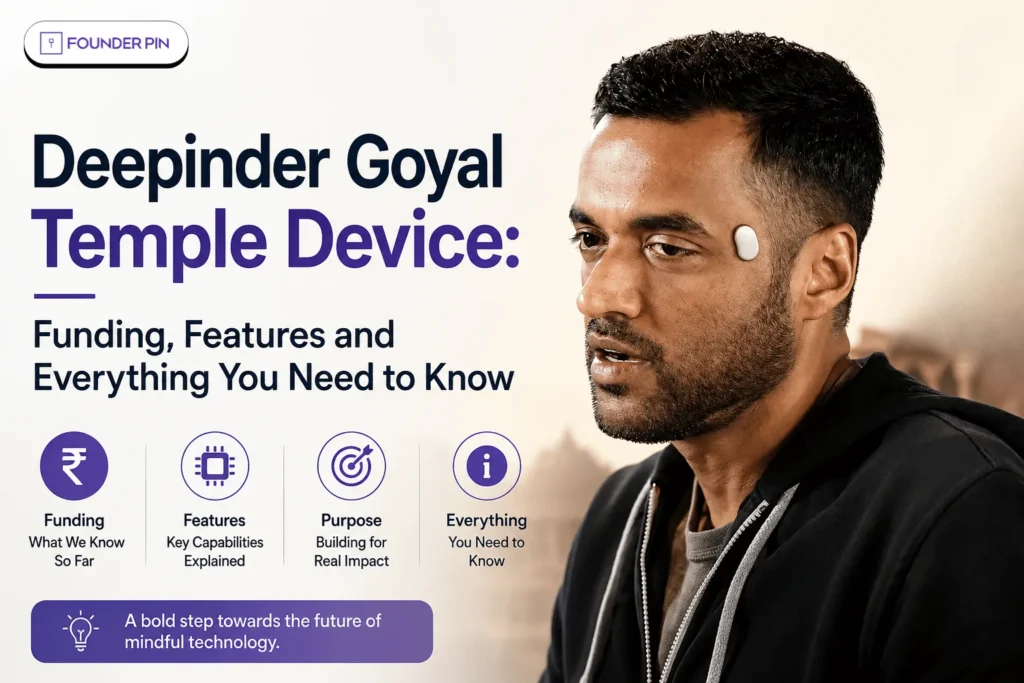
The Deepinder Goyal Temple Device is a wearable health-tech product that’s turning heads — literally. Instead of the usual wrist-based tracker, it captures physiological signals from the temple area of the head. That’s exactly what’s made people pay attention.
Deepinder Goyal, the founder behind Eternal (formerly Zomato), is the person behind Temple too. So far, the company has pulled in $54 million in seed funding. Back in February 2026, investors valued it at around $190 million. Fast forward to July 2026, and Moneycontrol reported the valuation had jumped to $375 million. Goyal himself said investors were now circling a $500 million valuation.
Here’s what we know so far about the device, its funding, the tech behind it, and where the business is headed. For more information about the product and early-access updates, readers can visit Temple’s official website.
What is the Deepinder Goyal Temple Device?
Temple is a small wearable designed to sit on the side of the head and continuously collect physiological data. The product is positioned as a wellness and performance device rather than a medical diagnostic tool.
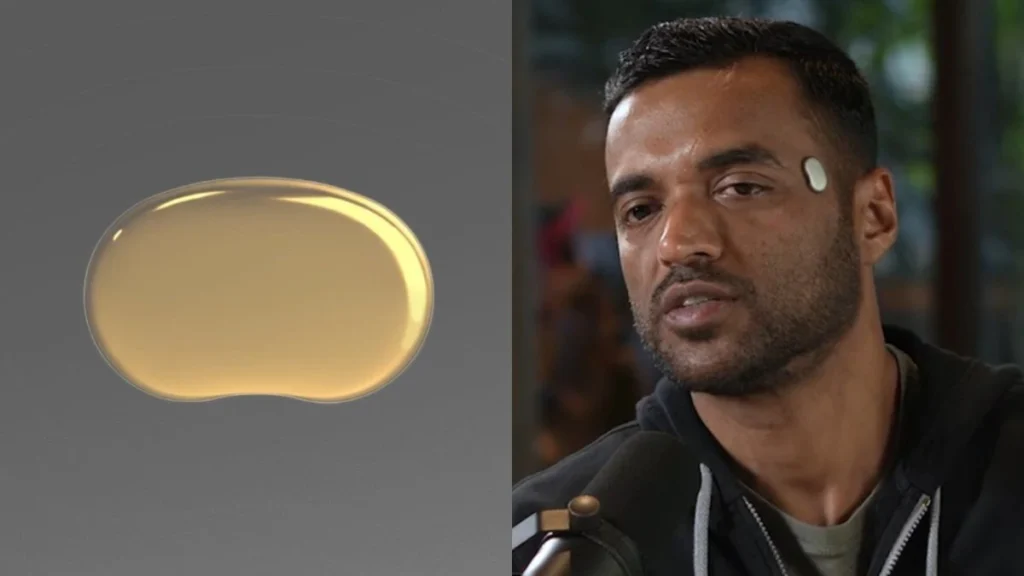
The device first became widely known after Goyal appeared wearing the small clip-like gadget during a podcast. The unusual design quickly triggered online speculation, but Goyal later explained that it was an experimental wearable connected to his research into brain blood flow.
Temple’s current website describes the product around a concept called “Entropy”, which it says measures the metabolic and sympathetic demand placed on the body. The company says healthy bodies keep this demand low at rest and respond with appropriate surges and recovery.
That makes Temple different from a typical smartwatch.
Instead of putting another screen on your wrist, the company is trying to collect physiological information from a location that may provide a different signal profile.
How Much Funding Has Temple Raised So Far?
Temple raised $54 million in its very first funding round, announced in February 2026, at a post-money valuation of roughly $190 million. That’s a striking number for a company that hadn’t shipped a product yet.
Here’s what makes this Deepinder Goyal Temple funding round genuinely unusual:
- Goyal personally led the round, investing around ₹104 crore (~$11.5 million) of his own money
- More than 30 Temple employees invested at the same valuation as outside investors — no employee discount
- Goyal called it a “friends and family” round on X, open to backers “whether or not Temple ever makes it to market”
That last line is worth sitting with. Most founders sell conviction. Goyal openly hedged it — and investors piled in anyway.
Who Are Temple’s Investors?
The round included Steadview Capital, Peak XV Partners, InfoEdge Ventures, Dharana Capital, and Vy Capital. Angel investors read like a who’s-who of Indian startup founders:
- Vijay Shekhar Sharma (Paytm)
- Kunal Shah (CRED)
- Nithin Kamath and Nikhil Kamath (Zerodha)
- Several current and former Eternal executives
By August 2026, an employee ESOP buyback valued Temple at $375 million — nearly double its February valuation. The company is now reportedly in talks for a fresh round at close to $500 million.
How does the Temple wearable work?
Temple uses a sensor positioned on the temple to collect physiological signals, while the companion app turns that information into wellness insights. The company says the device can be worn during exercise and sleep.
According to Temple’s official FAQ, the device uses a PPG sensor, a technology already common in consumer health wearables. The company says the device weighs less than 2 grams and is waterproof.
Key publicly disclosed features include:
- Temple-mounted sensor design
- PPG-based sensing
- Bluetooth connectivity
- Companion mobile application
- Sleep tracking
- Heart-rate monitoring
- Heart-rate variability (HRV)
- Respiratory-rate tracking
- Activity tracking
- Recovery metrics
- Proprietary wellness insights
- Apple Health integration
- Overnight usage
- Waterproof construction
Temple recommends continuous use to build a more complete picture of an individual’s physiological baseline.
According to the business, Bluetooth is necessary for device connectivity and cloud synchronization, although the device can temporarily store data and synchronize with the app later.
What exactly does Temple measure?
Temple is designed to measure a broader set of physiological signals rather than simply counting steps. The company says its platform can generate heart, respiratory, activity, sleep and recovery metrics.
Its official privacy policy lists the following categories of wellness data:
- Heart rate
- Heart-rate variability
- Resting heart rate
- Respiratory rate
- Steps
- Calories burned
- Sleep stages
- Sleep duration
- Sleep efficiency
- Recovery metrics
- Proprietary metrics and insights
The company also says it processes physiological information to personalise the product and improve its algorithms.
This is where Temple’s proposition becomes interesting: it wants to build a continuous physiological picture rather than provide isolated numbers once or twice a day.
What Is Temple’s “Entropy” Score?
Temple’s core metric is something it calls “entropy” — Goyal has described it, half-philosophically, as the cost of survival in the present moment. It updates every second, on a scale of 1 to 250, where a lower score at rest generally signals better health.
Whether “entropy” holds up as a clinically meaningful metric is still an open question — Temple hasn’t published peer-reviewed validation yet, and that’s worth flagging honestly rather than taking the marketing language at face value.
How Much Does the Temple Device Cost?
Deepinder Goyal Temple device price
Temple’s first wearable is priced at around ₹80,000, available currently through an early access programme. That price isn’t just for the hardware.
It bundles in:
- Lifetime access to Temple’s software platform
- A lifetime supply of the adhesive tapes needed to wear the device
- Manufacturing support from Ethereal Machines and Zetwerk, both established Indian hardware manufacturers
At that price point, Temple is positioning itself well above mainstream wearables like Fitbit or even premium smart rings — squarely in “serious athlete or biohacker” territory, not mass-market fitness tracking.
What is the science behind Temple Device?
Temple’s research direction is connected to Deepinder Goyal’s “Gravity Ageing Hypothesis,” but the hypothesis should not be treated as established medical science.
The idea proposes that gravity’s long-term effect on blood circulation could influence blood flow toward the brain and potentially play a role in ageing. Temple’s stated goal is to collect physiological data that could help investigate such relationships.
Temple has also assembled a multidisciplinary scientific advisory board that includes researchers from institutions such as Boston University, Harvard Medical School, Salk Institute, EPFL and other research organisations.
That scientific involvement is notable.
But having respected researchers involved does not automatically validate every underlying hypothesis or product claim. The evidence will ultimately need to come from rigorous research, validation and reproducible results.
Is Temple a medical device?
No. Temple’s own terms explicitly say that the device is not a medical device. It is positioned for general wellness and informational purposes.
This means users should not use Temple’s readings to:
- Diagnose a medical condition
- Replace professional medical advice
- Change prescribed treatment
- Interpret health data as a clinical diagnosis
Temple also warns that its measurements may not have the accuracy of professional medical or scientific instruments.
That disclaimer is particularly crucial because large claims are often drawn to anything affecting the brain.
What makes the Deepinder Goyal Temple Device interesting?
Temple is interesting because it combines wearable hardware, physiological sensing, AI-driven insights and deep-tech research in one product.
The bigger startup story is arguably more important than the gadget itself.
Goyal built his reputation through consumer internet and food delivery. With Temple, he is entering a much harder category involving:
- Hardware engineering
- Sensor technology
- Biological research
- Manufacturing
- Data science
- Privacy
- Scientific validation
That is a very different startup playbook.
The move also reflects the broader growth of India’s deep-tech and AI ecosystem. FounderPin’s Top 10 Indian AI Companies in 2026 explores another side of this rapidly developing technology landscape.
And that explains why, despite being in the early stages of its commercial development, Temple has drawn significant attention from investors.
FounderPin Perspective
The Deepinder Goyal Temple Device says a lot about where India’s consumer-tech founders are headed — more of them are willing to go after genuinely hard problems, not just easy wins.
That $54 million round tells its own story. Investors backed the team and the bet itself, well before Temple had any mass-market traction to point to. And the jump in valuation to $375 million only adds another layer to that.
But here’s the thing — the real test hasn’t happened yet.
Temple still has to prove its sensors actually deliver useful signals. It has to show users genuinely find that data valuable. And it needs to manufacture the hardware reliably, at scale, without cutting corners.
If there’s one lesson for founders here, it’s this: capital can buy you room to experiment, but only evidence builds something that lasts.
For founders thinking about their own startup journey, FounderPin’s guide to 20 Profitable Startup Ideas for India in 2026 offers a useful look at opportunities across emerging sectors.
For Temple, what comes next won’t be about viral curiosity anymore. It’ll be about the science holding up, the product actually working well, and whether execution matches the ambition.
Final Takeaway
The Deepinder Goyal Temple Device is more than a strange-looking gadget that went viral on social media. It represents a serious attempt to build a new category around continuous physiological monitoring, brain-related research and personal wellness.
With $54 million in reported funding, a valuation that reached $375 million by July 2026, early access underway and manufacturing partnerships with Zetwerk and Ethereal Machines, Temple has moved considerably beyond the prototype stage.
For another example of how Indian founders are building and scaling technology-driven companies, see FounderPin’s coverage of Snabbit’s $56 million funding story.
Still, the most important chapter has not been written.
Temple now has to turn an intriguing technology thesis into a reliable product backed by strong evidence, useful insights and repeatable manufacturing.
That is where the real startup story begins.
Frequently Asked Questions
What is the Deepinder Goyal Temple Device?
Temple is a lightweight wearable developed by Deepinder Goyal’s health-tech startup. It sits on the temple and collects physiological signals for wellness and performance insights.
How much funding has Temple raised?
Temple raised $54 million in its first reported funding round in February 2026 at a post-money valuation of about $190 million.
What is Temple’s latest valuation?
Moneycontrol reported in July 2026 that an employee stock liquidity programme valued Temple at $375 million. The company was also reportedly attracting external investor interest at a potential $500 million valuation.
What does the Temple device track?
Temple’s official disclosures list heart rate, HRV, resting heart rate, respiratory rate, activity, sleep and recovery metrics, along with proprietary insights.
Is Temple a medical device?
No. Temple’s own terms state that the device is not a medical device and should not be used for diagnosis, treatment or prevention of medical conditions.