Flipkart Food Delivery App: What the New 10–11% Commission Platform Really Means
Table of Contents
Toggle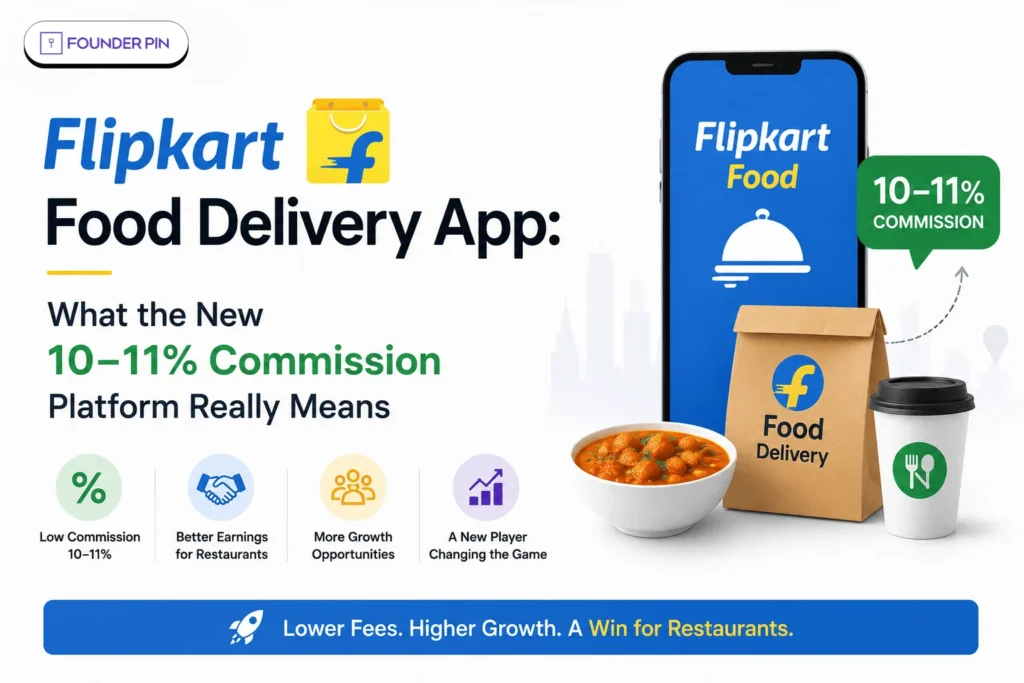
Key Takeaways
- Pilot launch expected around August 15, 2026, in Bengaluru.
- Proposed commission: 10–11%, versus the industry’s typical 15–30% range.
- Built on ONDC (Open Network for Digital Commerce) rather than a closed proprietary network.
- Launch timing overlaps with a restaurant boycott threat against Swiggy and Zomato over high fees.
- Competing directly with Rapido’s Ownly, a flat-fee (not commission-based) rival that has already captured an estimated 7–10% of Bengaluru’s food delivery market.
- Swiggy’s food delivery Gross Order Value stood at roughly ₹9,490 crore in Q1 FY27, up about 17.4% year-on-year — a sign of how large the incumbent business still is.
- Restaurant partners are already being onboarded ahead of the official launch.
- Flipkart is expected to expand beyond Bengaluru only if the pilot proves successful.
Flipkart is stepping into food delivery, and it’s doing it with a number that has restaurant owners paying attention: a 10–11% commission. That’s roughly half of what Swiggy and Zomato typically charge. The pilot is expected to launch in Bengaluru around August 15, 2026, right as restaurant frustration with existing platforms hits a boiling point.
This isn’t just another app launch. It’s Flipkart betting that price-sensitive restaurants — and a market already cracking at the edges — will welcome a cheaper alternative. Let’s break down what’s actually happening, why now, and whether it can work.
What Is Flipkart’s New Food Delivery Platform?
Flipkart is entering India’s food delivery market with a new platform that charges restaurants a 10–11% commission. By contrast, Swiggy and Zomato usually charge between 15% and 30%. As a result, restaurants could save more on every order.
The service will initially be introduced by the company in Bengaluru. Meanwhile, Flipkart has already started onboarding restaurants across the city. According to multiple reports, several restaurant partners have confirmed the rollout. This move marks Flipkart’s biggest step beyond e-commerce and quick commerce.
Instead of building an entirely new delivery network, Flipkart is using India’s Open Network for Digital Commerce (ONDC). This government-backed digital commerce framework helps businesses connect through a shared network. Consequently, Flipkart can enter the market faster while reducing infrastructure costs.
How Does This Compare to Swiggy and Zomato’s Commission Rates?
Swiggy and Zomato’s base commissions typically range from about 15% to 30%, depending on the city, cuisine, order volume, and the specific deal a restaurant has negotiated. On top of that, restaurants often pay GST on the commission itself, plus funding for discounts and promotions.
That combination can push effective deductions well beyond the headline commission number. Industry breakdowns suggest restaurants sometimes keep as little as 65–70% of an order’s menu value after all charges.
Flipkart’s flat 10–11% pitch, even without factoring in extra fees, looks dramatically leaner by comparison. That gap is the entire basis of its restaurant pitch.
Also Read | Swish Funding News: The $38M Bet on 10-Minute Food Delivery
The Flipkart food delivery app is built on ONDC, the government-backed open commerce network, rather than a fully proprietary system. This lets Flipkart plug into an existing pool of restaurants and delivery infrastructure instead of building everything from zero.
ONDC works differently from closed platforms like Swiggy and Zomato. It’s an open protocol, meaning multiple apps — buyer-side and seller-side — can connect to the same underlying network of merchants and logistics partners.
For Flipkart, this cuts both cost and time to market. It doesn’t need to independently convince every restaurant to sign an exclusive listing agreement from scratch.
For restaurants already on ONDC, joining Flipkart’s front end could mean minimal extra setup, since much of the plumbing already exists.
What Does This Mean for Restaurant Partners?
For restaurant owners, Flipkart’s entry means a genuine third (or fourth) option beyond Swiggy, Zomato, and Rapido’s Ownly. Lower commissions, if they hold at scale, translate directly into better margins per order.
Restaurants have been vocal about the squeeze. Industry commentary this year has pointed to base commissions of roughly 15–28% plus GST, packaging costs, and discount funding as reasons that many outlets struggle to clear a 10% net margin on delivery orders.
A platform charging less than half the typical rate is an easy pitch on paper. The real test is whether Flipkart can bring enough order volume to make the lower commission actually matter.
Because commission percentage alone doesn’t pay the bills — order density does. A restaurant would rather pay 25% commission on 100 daily orders than 10% commission on five.
Can Flipkart Really Compete With Swiggy and Zomato?
Flipkart has scale, capital, and an existing customer base, but Swiggy and Zomato have years of logistics investment, loyalty programs, and deeply ingrained customer habits. Winning restaurants is the easy part; winning diners is much harder.
Swiggy’s food delivery business remains large and still growing. Its food delivery Gross Order Value reportedly reached around ₹9,490 crore in Q1 FY27, up roughly 17.4% year-on-year, with overall company revenue climbing about 34% YoY in the same quarter.
That kind of scale doesn’t disappear because a new app offers cheaper listings. Flipkart will need to actively pull customers away from apps they already have installed, rated, and reordering from out of habit.
What About Rapido’s Ownly?
Rapido’s Ownly is another recent disruptor, offering restaurants a flat-fee model instead of a percentage commission. It has reportedly scaled to tens of thousands of orders across roughly 25,000 restaurants in Bengaluru alone, capturing an estimated 7–10% of the local market in just a few months.
Ownly’s early traction shows there’s real appetite for alternatives to the Swiggy-Zomato duopoly. It also shows the disruption playbook — undercut on fees, win restaurants first — can actually work in this market.
Flipkart isn’t entering an empty field. It’s the latest of several challengers, alongside Rapido and Swiggy’s own lower-cost sub-brands, all converging on the same pressure point: commission fatigue.
Rapido’s expansion into food delivery is another example of a company using an existing network to attack an adjacent market. Rapido Startup Story 2026
What Should Customers Expect From the Flipkart Food Delivery App?
Customers should expect a pilot-stage app initially limited to Bengaluru, with Flipkart focused on getting the basics right before expanding. Flipkart has said success won’t come from low prices alone.
The company has indicated it wants to combine competitive pricing with a wide restaurant selection, dependable delivery, and a smooth ordering experience — not just a cheaper checkout screen.
Given Flipkart’s existing base of loyal shoppers and delivery infrastructure from its e-commerce and quick commerce businesses, cross-promotion inside the main Flipkart app is a likely early growth lever.
For founders exploring capital and growth strategies, our [Ultimate Guide to Startup Fundraising in India 2026]can help put these questions into a broader fundraising context.
What Are the Challenges Flipkart Might Face?
Flipkart’s biggest challenge isn’t restaurant onboarding — it’s changing how millions of people already order food. Breaking deeply set consumer habits is far harder than offering restaurants a better deal.
Swiggy has also publicly questioned whether ultra-low commission models are sustainable long-term, given the real operational costs of last-mile food delivery — packaging, delivery partner payouts, support, and returns all add up regardless of the commission charged to restaurants.
There’s also the question of delivery fleet readiness. Swiggy and Zomato have spent years building rider networks tuned for food delivery’s speed and reliability demands; Flipkart will need comparable execution, not just comparable pricing.
Finally, a 10–11% commission has to eventually cover Flipkart’s own costs. Whether that rate is a permanent structure or an introductory hook to win early restaurant sign-ups remains an open question industry watchers are already asking.
The Bottom Line
Flipkart’s food delivery bet lands at a genuinely interesting moment: restaurants are frustrated, rivals are already testing alternative pricing models, and a well-capitalized giant is walking in with a number designed to turn heads. Commission math alone won’t decide the winner here — execution, delivery reliability, and customer habit-breaking will.
Still, a 10–11% commission is hard for restaurant owners to ignore, and that alone guarantees Flipkart a seat at the table. Whether it earns a permanent spot next to Swiggy and Zomato is the story worth watching over the next few months.
Every big disruption starts with one founder willing to challenge the norm — just like Flipkart is doing now. If you’re building something similar, FounderPin helps founders sharpen their idea, connect with the right investors, and get funding-ready. Talk to FounderPin today and take the next step on your startup journey.
Frequently Asked Questions
1 .Is Flipkart food delivery available now?
Not yet. It’s in the pilot stage, expected to launch in Bengaluru around August 15, 2026, before any wider rollout is considered.
2 .What commission does Flipkart charge restaurants?
Reports point to a commission of approximately 10–11%, though the exact figure may vary by restaurant size, location, and specific agreements.
3 .Why is Flipkart’s commission lower than Swiggy and Zomato?
Flipkart is using a lower commission as an entry strategy to attract restaurants quickly, especially amid growing merchant dissatisfaction with existing platforms’ fee structures.
4 .Will Flipkart food delivery expand beyond Bengaluru?
That depends on how the pilot performs. Flipkart has indicated it will expand gradually if the initial rollout succeeds, following the same approach it used for quick commerce.
SHARE