Introduction: Why Most MVPs Fail
Every founder has heard the term MVP (Minimum Viable Product). Yet, many startups still get it wrong. Some MVPs are overbuilt, burning time and money. Others are too minimal, failing to demonstrate value. As a result, users lose interest and investors walk away.
The truth is: An MVP isn’t about building less—it’s about building smart.
In this guide, we’ll walk through how to build an MVP that solves a real problem, attracts early users, and convinces investors that your startup is worth backing.
What an MVP Really Is (and What It Isn’t)
An MVP is the simplest version of your product that delivers core value and allows you to learn from real users.
An MVP IS:
- A learning tool
- A validation mechanism
- A way to test assumptions
An MVP IS NOT:
- A half-baked product
- A feature dump
- A final version
Founders who treat MVPs as experiments move faster and fail cheaper.
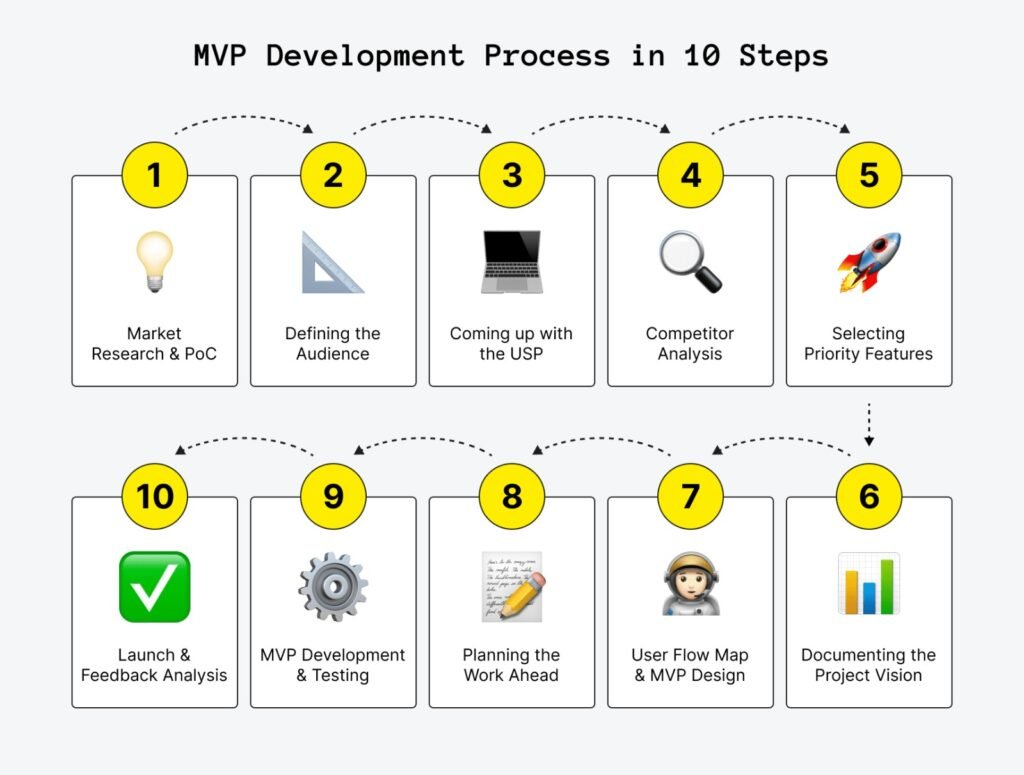
Step 1 : Start with a Validated Problem
Before building anything, you must ensure the problem is real and painful. Ask yourself:
- Who experiences this problem?
- How often does it occur?
- What happens if it remains unsolved?
An MVP built without validation is just a guess.
Step 2 : Define the Core Value Proposition
Your MVP should focus on one primary job it does exceptionally well. Instead of asking: “What features should we build?” Ask: “What is the single most important outcome for the user?”
Example:
- Ride-hailing MVP → “Get a ride quickly”
- Food delivery MVP → “Order food easily”
- SaaS MVP → “Save time or money”
Clarity here prevents feature creep.
Step 3 : Decide What to Build (and What to Ignore)
One of the hardest MVP decisions is choosing what NOT to build.
Focus on:
- One user persona
- One core problem
- One clear use case
Ignore (for now):
- Advanced analytics
- Automation-heavy features
- Complex design systems
- Edge-case workflows
Investors don’t expect polish—they expect focus and insight.
Step 4 : Choose the Right MVP Development Approach
There’s no single way to build an MVP. Choose based on speed, cost, and learning goals.
Common MVP Approaches:
- No-code tools (Webflow, Bubble)
- Concierge MVPs (manual backend)
- Landing page MVPs
- Prototype or clickable demos
- Basic functional product
The best approach is the one that helps you learn fastest with minimal investment.
Step 5 : Build Fast, Test Faster
Speed matters in early-stage startups. Instead of waiting for perfection:
- Launch early
- Collect feedback quickly
- Iterate based on usage
What to Measure:
- User activation
- Retention
- Drop-off points
- Repeated usage
Real behavior is more valuable than opinions.
Step 6 : Turn MVP Feedback into Product Decisions
Feedback without action is wasted insight.
Group feedback into:
- Must-have improvements
- Nice-to-have ideas
- Misaligned requests
Not all feedback should be implemented. Strong founders filter feedback through the startup’s vision.
What Investors Look for in an MVP
Investors don’t expect revenue at the MVP stage—but they do expect clarity.
Investors Want to See:
- Clear problem-solution fit
- User engagement signals
- Founder learning velocity
- Evidence of demand
- Logical next milestones
A strong MVP reduces perceived risk and builds investor confidence.
Common MVP Mistakes Founders Make Avoid these early-stage traps:
- Overbuilding before feedback
- Ignoring negative signals
- Targeting too many users
- Waiting too long to launch
- Confusing MVP with beta perfection
The goal of an MVP is learning—not impressing everyone.
How an MVP Connects to Growth & Marketing
A good MVP supports marketing naturally. When users:
- Share the product
- Talk about it
- Recommend it organically
…it becomes easier to grow without large budgets.
How Founderpin Helps MVP-Stage Startups
Founderpin supports founders during the most critical stage—turning ideas into validated products. Through:
- Practical startup insights
- Founder-focused resources
- Validation and growth guidance
Founderpin helps entrepreneurs build products that make sense—before scaling them.
Final Thoughts : Build to Learn, Not to Perfect
An MVP is not the finish line—it’s the starting point.
Founders who succeed:
- Build intentionally
- Learn continuously
- Adapt quickly
If your MVP helps you learn faster than your competitors, you’re already ahead.