
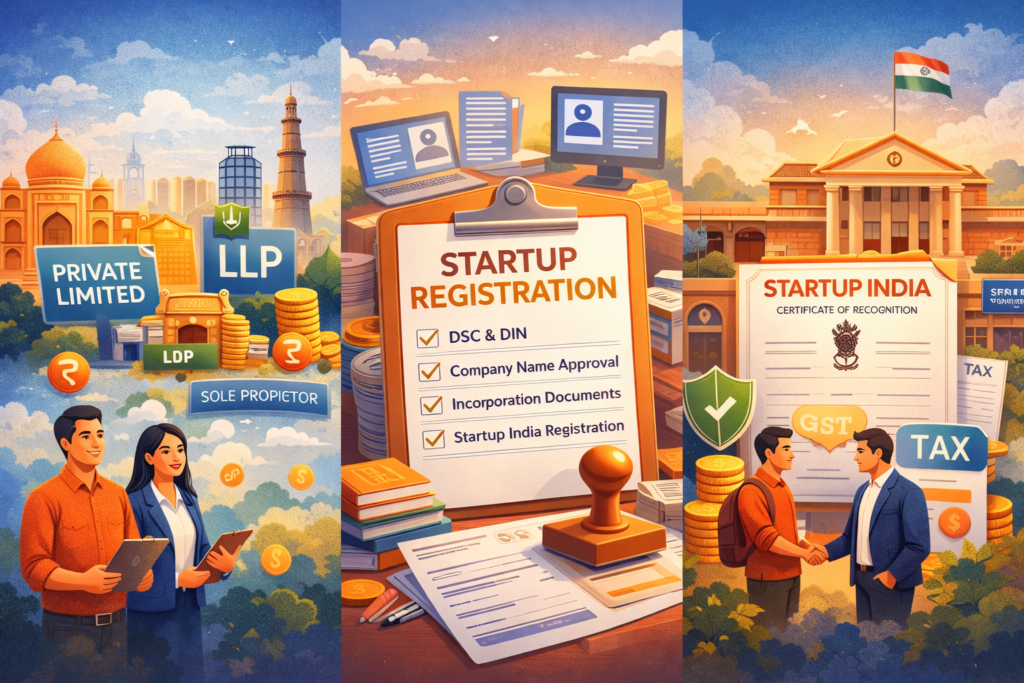
How to Register a Startup in India: Step-by-Step Guide for First-Time Founders.
Startup registration process in India and Starting a company in India has never been more accessible but for first-time founders, the registration process can still feel confusing. Questions like “Should I register as Pvt Ltd or LLP?” or “What is Startup India registration?” are extremely common.
If you are searching for:
• Startup registration process in India
• How to register a startup in India
• Startup registration process step by step
• How to register a company in India for a startup
This guide will walk you through everything in simple language.
Step 1: Decide the Right Business Structure
Before you register, you need to choose your company type. Most startups in India choose one of these:
Private Limited Company
Best for startups planning to raise funding. Investors prefer this structure because it allows easy equity allocation.
LLP (Limited Liability Partnership)
Good for service-based startups or small teams that want limited compliance but still need legal protection.
Sole Proprietorship
Simplest form but not ideal if you want to raise funding or scale significantly.
For tech startups or those planning to approach investors, Private Limited Company is usually the best option.
Step 2: Get Digital Signature Certificate (DSC)
All directors must have a Digital Signature Certificate. This is required to file documents online with the Ministry of Corporate Affairs.
Most CAs or company registration services help you obtain DSC easily.
Step 3: Apply for Director Identification Number (DIN)
Every director in the company needs a DIN. This is a unique number issued by the government and is part of the company incorporation process.
Step 4: Choose and Reserve Your Company Name
Choosing a startup name is exciting but also regulated. Your name must:
• Be unique
• Not resemble an existing company
• Not violate trademarks
You apply for name approval through the MCA portal. It’s wise to keep 2–3 name options ready in case your first choice is rejected.
Step 5: File Incorporation Documents
This step includes submitting:
• Memorandum of Association (MOA)
• Articles of Association (AOA)
• Director details
• Registered office proof
Once approved, you receive a Certificate of Incorporation your company is now officially registered.
Step 6: Get PAN, TAN and Bank Account
After incorporation:
• PAN and TAN are issued automatically
• You can open a current bank account in your company’s name
This allows you to receive payments and run business transactions legally.
Step 7: Register Under Startup India (Optional but Important)
Many founders confuse company registration with Startup India registration.
They are different.
Once your company is registered, you can apply for Startup India recognition through the Startup India portal.
Benefits include:
• Tax exemptions (in some cases)
• Easier access to government grants
• Eligibility for certain funding schemes
Step 8: GST Registration (If Applicable)
GST registration is required if:
• Your turnover exceeds the threshold
• You provide interstate services
• You run an e-commerce business
Even if not mandatory, many startups register early for credibility.
Common Mistakes First-Time Founders Make during the Startup registration process in India
Choosing the wrong structure
Many founders start as sole proprietors and later struggle while raising funding.
Ignoring compliance
After registration, you must file annual returns and maintain basic compliance.
Delaying Startup India registration
This can affect eligibility for government grants later.
How Long Does Startup Registration Take in India?
If documents are ready:
• Company incorporation: 7–10 working days
• Startup India recognition: 2–5 days
Delays usually happen due to document issues or name rejections.
What Is the Cost of Registering a Startup in India?
Typical costs include:
• Government fees
• Professional fees (CA/consultant)
• Digital signatures
On average, startup registration costs range between ₹8,000 to ₹15,000 depending on the structure and service provider.
Why Proper Registration Matters
A properly registered startup can:
• Open a company bank account
• Raise funding
• Apply for government grants
• Enter into contracts
• Build credibility with customers
Without proper registration, scaling becomes very difficult.
Final Thoughts
Registering a startup in India may seem like paperwork, but it’s the foundation of your entrepreneurial journey. Once done, it opens doors to funding, grants, partnerships, and long-term growth.
If you are serious about building a scalable business, taking the time to register properly is one of the smartest early decisions you can make.
FounderPin is a great place to get started.
Start the process here
____________
Bonus Tip: You can also explore various government grants which can help you with initial Funding.