
Indian Startup Success Stories 2026: Founders Who Took Big Risks and Won
Table of Contents
Toggle“Every great Indian startup success story began with a founder who took a risk when others chose comfort.”
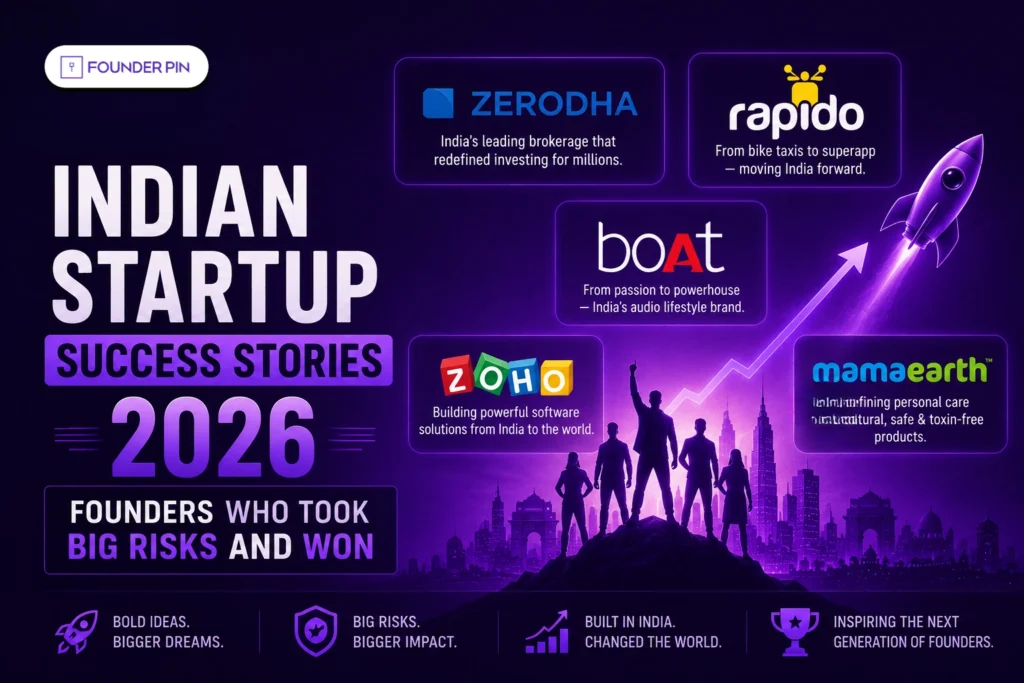
At FounderPin, we believe every successful startup begins with one thing: the willingness to take risks. Behind every unicorn, profitable startup, or disruptive business model is a founder who made difficult decisions despite uncertainty.
The rise of modern entrepreneurship in India has created countless Indian startup success stories, proving that bold execution often matters more than perfect conditions. In 2026, founders are building businesses in AI, fintech, D2C, SaaS, healthtech, and creator-led industries faster than ever before.
What makes these stories powerful is not just their financial success. It is the ability of founders to challenge traditional thinking, survive market pressure, and adapt continuously.
Why Indian Startup Success Stories Matter More Than Ever
India’s startup ecosystem has become one of the largest in the world. However, the entrepreneurial journey remains difficult. Funding conditions are stricter, customer acquisition costs are rising, and competition is intense.
This is why successful founder stories matter. They provide:
- Practical Lessons
Successful startups provide real-world business lessons that founders can apply to their own journey. Entrepreneurs learn how companies handled challenges such as scaling, competition, customer acquisition, hiring, and profitability. - Market Insights
Indian startup success stories help founders understand changing consumer behavior, emerging industries, and new business opportunities. They reveal which sectors are growing and what strategies are working in the current market. - Strategic Inspiration
These stories show how bold decisions, innovation, and long-term thinking can create successful businesses. Founders gain ideas on positioning, branding, product development, and growth strategies from companies that have already succeeded. - Motivation During Difficult Phases
Every startup faces setbacks, uncertainty, and financial pressure. Learning how successful founders overcame failures and market challenges gives entrepreneurs confidence to continue building even during difficult times.
More importantly, these startups show that calculated risk-taking can create extraordinary outcomes.
Top Indian Startups & Valuations
| Startup | Founder(s) | Founded | HQ | Valuation |
|---|---|---|---|---|
| Zerodha | Nithin Kamath, Nikhil Kamath | 2010 | Bengaluru | ₹70K–₹75K Cr |
| Rapido | Aravind Sanka, Pavan Guntupalli, Rishikesh SR | 2015 | Bengaluru | ₹8K–₹10K Cr |
| boAt | Aman Gupta, Sameer Mehta | 2016 | New Delhi | ₹10K–₹12K Cr |
| Zoho | Sridhar Vembu, Tony Thomas | 1996 | Chennai | ₹1.0–₹1.2 L Cr |
| Mamaearth | Varun Alagh, Ghazal Alagh | 2016 | Gurugram | ₹10K–₹11K Cr |
Zerodha — Bootstrapping Without Venture Capital
The Big Risk
When Zerodha was launched by Nithin Kamath and Nikhil Kamath, the Indian brokerage market was dominated by traditional firms charging high fees.
Instead of raising large amounts of venture capital, Zerodha focused on building a profitable and customer-first business model.
Why It Worked
The founders prioritized simplicity, low-cost investing, and technology-driven operations. Today, Zerodha is considered one of India’s biggest bootstrapped startup success stories.
Rapido — Competing Against Giants
The Big Risk
Rapido entered a market already dominated by global ride-hailing companies. Many believed bike taxis would struggle due to regulations and competition.
Why It Worked
Rapido identified a major gap in affordable short-distance transportation. By focusing on tier-2 and tier-3 cities along with cost-efficient mobility, the company built strong market demand.
Read more in our article on Rapido Raised ₹2300 Cr Funding: What It Means for Indian Startups.
boAt — Building a Consumer Brand in a Crowded Market
The Big Risk
When boAt entered the audio accessories market, global competitors already controlled the industry.
Why It Worked
Founders focused heavily on youth branding, influencer marketing, and affordable premium products. Their understanding of Indian consumers helped boAt scale rapidly into one of India’s leading lifestyle technology brands.
Zoho — Creating Global SaaS Products From India
The Big Risk
Zoho chose a very unconventional path by avoiding Silicon Valley expansion pressure and focusing on long-term product development from India.
Why It Worked
Zoho invested deeply in product quality, talent development, and sustainable growth instead of short-term valuation hype. Today, it is one of India’s most respected SaaS companies globally.
Mamaearth — Betting Big on Digital-First D2C Growth
The Big Risk
Mamaearth entered the crowded beauty and personal care industry with a direct-to-consumer strategy at a time when digital-first brands were still emerging.
Why It Worked
By leveraging influencer marketing, social commerce, and clean-brand positioning, Mamaearth quickly gained trust among younger consumers and scaled aggressively online.
What These Indian Startup Success Stories Teach Founders
The biggest lesson from these companies is that success rarely comes from playing safe.
- Strong Positioning Matters
Each startup identified a clear market gap instead of blindly copying competitors. Their ability to solve specific customer problems helped them build stronger brand recognition and long-term loyalty. - Speed and Execution Win
Many successful founders gained an advantage because they executed ideas faster while competitors moved slowly. In the startup ecosystem, quick adaptation and consistent execution often matter more than having perfect plans. - Founder Visibility Builds Trust
Modern startups increasingly rely on founder branding and public visibility to attract customers, investors, and partnerships. Building credibility online has become a major growth advantage. Read our guide on Why Personal Branding for Founders Matters More Than Funding in 2026. - Long-Term Thinking Creates Sustainable Businesses
Most successful founders focused on building durable business models instead of chasing short-term hype. Their long-term approach helped create sustainable growth and stronger customer trust.
Why Risk-Taking Is Becoming More Important in 2026
The startup ecosystem is evolving rapidly because of:
- Artificial intelligence
- Changing consumer behavior
- Faster technology cycles
- Lean startup models
- Global digital distribution
This means founders who adapt early often gain major advantages.
Many emerging entrepreneurs are now building AI-driven startups, solo businesses, and niche SaaS products with significantly lower capital requirements than before.
The Future of Indian Startup Success Stories
The next wave of Indian startup success stories may look very different from traditional venture-backed businesses.
In 2026, successful founders are increasingly:
- Building lean AI-powered companies
- Growing through personal branding
- Scaling with smaller teams
- Prioritizing profitability earlier
- Leveraging automation aggressively
The entrepreneurs who combine technology, speed, and strategic positioning will likely dominate the next decade of Indian startups.
Conclusion
The most inspiring Indian startup success stories are not simply about valuations or funding rounds. They are stories about resilience, unconventional thinking, and bold execution.
Whether it is Zerodha challenging the brokerage industry, Rapido competing against global mobility giants, or Zoho building a global SaaS company from India, these founders proved that calculated risks can create extraordinary outcomes.
For aspiring entrepreneurs in 2026, the biggest opportunity may not be waiting for perfect conditions — but taking action before everyone else does.
Ready to Build Your Startup Brand?
At FounderPin, we help founders build authority, visibility, and strategic content that attracts customers, investors, and opportunities.
Contact us for a consultation and grow your startup with stronger positioning and founder branding.
Frequently Asked Questions (FAQs)
1. What are the biggest Indian startup success stories in 2026?
Some of the biggest Indian startup success stories in 2026 include companies like Zerodha, Rapido, boAt, Zoho, and Mamaearth, which achieved massive growth through innovation and strong execution.
2. What can founders learn from Indian startup success stories?
Founders can learn practical business lessons such as market positioning, fast execution, customer-focused growth, branding strategies, and long-term business planning from successful Indian startups.
3. Why are Indian startups growing rapidly in 2026?
Indian startups are growing rapidly because of increasing internet penetration, AI adoption, digital payments, strong consumer demand, and a growing startup ecosystem supported by investors and government initiatives.
4. How important is risk-taking in startup success?
Risk-taking is one of the most important factors in startup growth. Many successful founders built industry-leading businesses by entering competitive markets, challenging traditional models, and making bold strategic decisions.
5. How does founder branding help startup growth?
Founder branding helps startups build trust, attract investors, improve visibility, and create stronger customer connections. In 2026, personal branding has become a major competitive advantage for entrepreneurs.