Startup Shows vs Startup Accelerators: Which Is Better?
Table of Contents
Toggle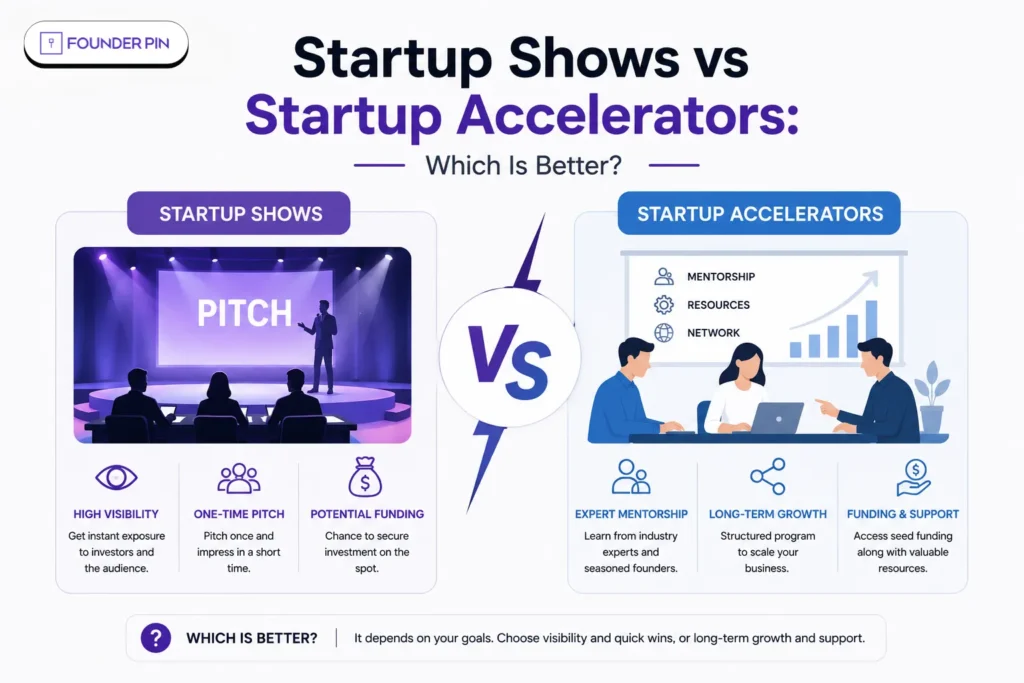
Key Takeaways
- Startup Shows vs Startup Accelerators serve different purposes—startup shows provide rapid brand visibility and investor exposure, while accelerators focus on mentorship, product development, fundraising readiness, and long-term business growth.
- Choose a startup show if your business already has traction and you’re looking for media exposure, customer acquisition, and brand credibility. Choose a startup accelerator if you need structured guidance, mentorship, and investor connections to scale.
- Many successful founders benefit from both by joining an accelerator to strengthen their business before leveraging a startup show for wider recognition and growth.
- The best choice depends on your startup’s stage, goals, and readiness. Focus on selecting the platform that solves your biggest challenge rather than following popular trends.
Introduction
Every creator eventually asks themselves the same question: Should I join a startup accelerator or pitch on a startup show?
Although they have somewhat distinct goals, both choices offer finance, coaching, visibility, and business growth.
While a startup accelerator like Y Combinator, Techstars, or Google for Startups offers organized mentorship, investor access, and long-term business development, a television startup show like Shark Tank can rapidly expose your brand to millions of viewers.
Before choosing where to devote your time and effort, it is crucial to comprehend the distinction between Startup Shows and Startup Accelerators.
Startup Shows vs Startup Accelerators: Key Differences
| Comparison Factor | Startup Shows | Startup Accelerators |
|---|---|---|
| Primary Goal | Public Exposure & Investor Pitching | Long-Term Startup Growth |
| Duration | One-time appearance | 3–6 month structured program |
| Mentorship | Limited guidance | Extensive and ongoing mentorship |
| Funding | May receive investment on-air | Often includes seed funding |
| Equity | Depends on the investment deal | Usually exchanged for funding and support |
| Investor Access | Immediate but limited | Continuous throughout the program |
| Media Visibility | Very High | Moderate |
| Business Development | Limited | Comprehensive |
| Networking | Investors and audience | Founders, mentors, investors, and alumni |
What Are Startup Shows?
Startup showcases are public pitching venues where entrepreneurs showcase their companies to audiences, judges, or investors.
Unlike accelerators, startup shows primarily focus on:
- Business storytelling
- Product demonstrations
- Investor negotiations
- Public exposure
- Entertainment value
Winning isn’t always the biggest benefit.
Many founders experience increased brand awareness, customer acquisition, and media attention simply by appearing on the show.
Popular Startup Shows
Some of the world’s best-known startup shows include:
- Shark Tank (USA)
- Shark Tank India
- Dragon’s Den
- The Big Pitch
- Elevator Pitch competitions
These platforms often feature founders pitching directly to experienced entrepreneurs and investors.
How Startup Shows Work
A typical startup show follows a simple format:
- Founders submit applications.
- Selected companies pitch live.
- Investors ask questions.
- Funding offers may be negotiated.
- The audience watches the entire process.
The emphasis is on creating compelling stories while demonstrating business potential.
What Are Startup Accelerators?
Startup accelerators are organized programs created to assist new businesses in expanding quickly through investor contacts, investment, education, and mentorship.
Accelerators, in contrast to startup exhibitions, collaborate extensively with founders over several months to enhance every facet of the company. The majority of accelerator programs are cohort-based, have a set duration, and conclude with a Demo Day where startups present their ideas to investors. If you’re exploring accelerator programs, review the official Y Combinator website to understand how leading startup accelerators structure funding, mentorship, and Demo Day opportunities.
How Startup Accelerators Work
Most accelerators follow a structured model:
- Competitive application process
- Startup selection
- Cohort-based learning
- Weekly mentor sessions
- Product refinement
- Customer validation
- Fundraising preparation
- Demo Day
Programs typically last 3–6 months and may provide seed funding in exchange for a small equity stake.
What Founders Receive
Accelerators often provide:
- Seed investment
- Industry mentors
- Product strategy
- Business workshops
- Investor introductions
- Alumni networks
- Demo Day opportunities
For many startups, these resources become more valuable than the initial funding itself. Founders can also explore our detailed guide on Microsoft Founders Hub to learn how startups receive Azure credits, technical support, and global mentorship.
Which Option Builds Better Businesses?
The answer depends on your startup’s stage.
If your primary goal is:
- Brand awareness
- Customer acquisition
- Media attention
Startup shows can create immediate visibility.
If your goal is:
- Product refinement
- Investor readiness
- Sustainable scaling
- Long-term fundraising
Startup accelerators generally provide greater long-term value through structured mentorship and investor networks. If you’re interested in startup competitions, our Startup Grind Pitch Battle Explained guide walks you through the application process, judging criteria, and founder benefits.
Startup Shows vs Startup Accelerators: Which Is Better for Different Founders?
The right choice depends on your startup’s objectives.
First-Time Founders
New entrepreneurs usually benefit more from startup accelerators.
Reasons include:
- Learning from mentors
- Avoiding beginner mistakes
- Improving fundraising readiness
- Building stronger business foundations
Accelerators provide a safer environment for early learning.
Student Founders
Students often have limited business experience but strong ideas.
Programs such as:
- Hult Prize
- University accelerators
- Campus incubators
help transform academic projects into real businesses.
AI Startups
Artificial intelligence companies generally benefit more from accelerators.
Reasons:
- Technical mentorship
- Enterprise partnerships
- Cloud credits
- Investor introductions
AI startups usually require deeper product development than startup shows can provide.
SaaS Startups
SaaS businesses need:
- Customer validation
- Product iteration
- Scalable sales systems
Accelerators help founders build recurring revenue models before large fundraising rounds.
Consumer Brands
Consumer startups often gain tremendous value from startup shows.
National television exposure can dramatically increase:
- Brand awareness
- Customer demand
- Retail partnerships
For D2C companies, media visibility often translates directly into sales.
Real-World Examples
Understanding how successful companies have leveraged startup shows and startup accelerators demonstrates that both paths can create extraordinary outcomes when used at the right stage of a founder’s journey.
Shark Tank: Publicity That Drives Business Growth
Appearing on Shark Tank often creates what entrepreneurs call the “Shark Tank Effect.” According to an analysis by Inc., companies featured on the show frequently experience substantial revenue growth in the year following their appearance. Among 149 companies that shared revenue data:
- 101 companies reported higher revenue after appearing on the show.
- 22 companies doubled their annual revenue.
- 44 companies tripled their annual revenue.
- Some businesses achieved even greater growth, regardless of whether they secured an on-air investment.
One of the best-known examples is Bombas, which experienced a 250% increase in revenue the year after its Shark Tank appearance and later became one of the show’s biggest success stories.
Key takeaway: For consumer brands, the publicity generated by startup shows can often be more valuable than the investment itself.
Y Combinator: Building Billion-Dollar Companies
Founded in 2005, Y Combinator (YC) is widely regarded as the world’s most influential startup accelerator.
Its alumni include:
- Airbnb
- Stripe
- Dropbox
- DoorDash
- Coinbase
- Instacart
These companies joined YC during their early stages, where they refined their products, validated their business models, and gained access to experienced mentors and investors. Today, many of them are valued at billions of dollars and operate globally.
Key takeaway: Accelerator programs provide structured mentorship and investor networks that help founders build sustainable, long-term businesses.
Techstars: Scaling Startups Through Mentorship
Techstars has become one of the world’s largest accelerator networks.
According to Techstars:
- More than 10,900 founders have participated in its accelerator programs.
- Portfolio companies have collectively raised over US$32.5 billion in funding.
- The cumulative market capitalization of Techstars-backed companies exceeds US$145 billion.
- Startups raise an average of more than US$1 million after completing the accelerator.
The portfolio includes globally recognized companies such as ClassPass, Chainalysis, Alloy, SendGrid, and many other unicorns.
Key takeaway: Techstars demonstrates how structured mentorship, investor access, and founder support can dramatically improve a startup’s fundraising and long-term growth potential.
How to Choose Between Startup Shows and Startup Accelerators
The choice between Startup Shows vs Startup Accelerators depends on your startup’s current stage, goals, and long-term vision.
Rather of determining whether choice is best overall, founders ought to inquire:
- What does my startup need right now?
- Am I looking for visibility or business development?
- Do I need funding, mentorship, or customer acquisition?
- Is my product validated enough for public exposure?
The answers to these questions will help determine the right path.
Choose a Startup Show If…
Startup shows are ideal if your primary objective is to gain rapid visibility.
You should consider a startup show when:
- Your product is already market-ready.
- You have paying customers or strong user traction.
- Your business has a compelling founder story.
- Brand awareness is your biggest challenge.
- You’re targeting consumer markets.
- You want immediate media exposure.
Consumer brands, D2C companies, food startups, and lifestyle businesses often benefit significantly from television exposure.
Choose a Startup Accelerator If…
Accelerators are better suited for founders focused on building long-term businesses.
Consider joining an accelerator if:
- You’re still refining your product.
- You need experienced mentors.
- You’re preparing for fundraising.
- You want investor introductions.
- You’re entering new markets.
- You want structured business guidance.
Technology startups, SaaS companies, AI startups, DeepTech ventures, and B2B businesses usually benefit more from accelerator programs.
FounderPin Recommendation
We at FounderPin advise entrepreneurs to think strategically as opposed to emotionally.
Because it provides instant notoriety, a lot of business owners aspire to appear on television.
However, sustainable startup success usually comes from:
- Building great products
- Understanding customers
- Improving unit economics
- Preparing for investors
- Creating repeatable growth systems
Accelerators strengthen these fundamentals.
Startup shows then amplify businesses that are already prepared to scale.
The strongest founders don’t chase visibility first—they build businesses worth showcasing.
Conclusion
There is no one-size-fits-all solution to the startup show vs. startup accelerator controversy.
Startup exhibitions offer unparalleled consumer trust, brand visibility, and public exposure. They work well for companies who have successful goods and captivating narratives that are ready for a wider audience.
Conversely, startup accelerators concentrate on long-term company expansion. They assist entrepreneurs in creating businesses that are investment-ready and scalable through strategic advice, investor access, organized learning, and mentoring.
For many entrepreneurs, the best course of action is to use both at the appropriate point in their startup process rather than picking one over the other.
You can select the platform that offers the most value and speeds up sustainable growth by knowing your startup’s present requirements and long-term objectives. If you’re just starting your entrepreneurial journey, don’t miss our list of the Best Startup Competitions in India for Early-Stage Founders, where we compare the country’s leading startup contests and funding opportunities.
Contact FounderPin for Expert Startup Guidance
Choosing the right growth platform is only one part of building a successful startup.
At FounderPin, we help founders with:
- Startup Registration
- DPIIT Recognition
- Business Planning
- Pitch Deck Preparation
- Accelerator Applications
- Startup Competition Applications
- Investor Readiness
- Fundraising Strategy
- Startup Growth Consulting
Whether you’re preparing for a startup show, applying to a global accelerator, or raising your first funding round, our team can help you build a stronger startup.
Contact us today for a consultation and let FounderPin help you choose the right growth path for your startup.
FAQs
1. What is the difference between startup shows and startup accelerators?
The main difference is their purpose. Startup shows focus on public pitching, media exposure, and investor visibility, while startup accelerators provide structured mentorship, seed funding, networking opportunities, and business development programs that help founders build scalable startups over several months.
2. Are startup accelerators better than startup shows?
Neither is universally better—it depends on your startup’s goals. Accelerators are ideal for founders seeking mentorship, fundraising support, and long-term growth, whereas startup shows are better suited for startups looking for brand awareness, customer acquisition, and immediate public exposure.
3. Can founders participate in both startup shows and startup accelerators?
Yes. Many successful founders join a startup accelerator first to strengthen their business model, improve traction, and prepare for fundraising. They later participate in startup shows to gain media visibility, attract customers, and expand their investor network.
4. Which startups benefit most from startup accelerators?
Technology startups, AI companies, SaaS businesses, DeepTech ventures, FinTech startups, and early-stage founders typically benefit the most from accelerators because they receive mentorship, investor introductions, product validation, and structured guidance for scaling their businesses.
5. How do I choose between a startup show and a startup accelerator?
Evaluate your startup’s current stage and objectives. If you need mentorship, product refinement, and investor readiness, choose a startup accelerator. If your startup already has traction and you’re looking for brand recognition, customer growth, and media exposure, a startup show may be the better option.
SHARE