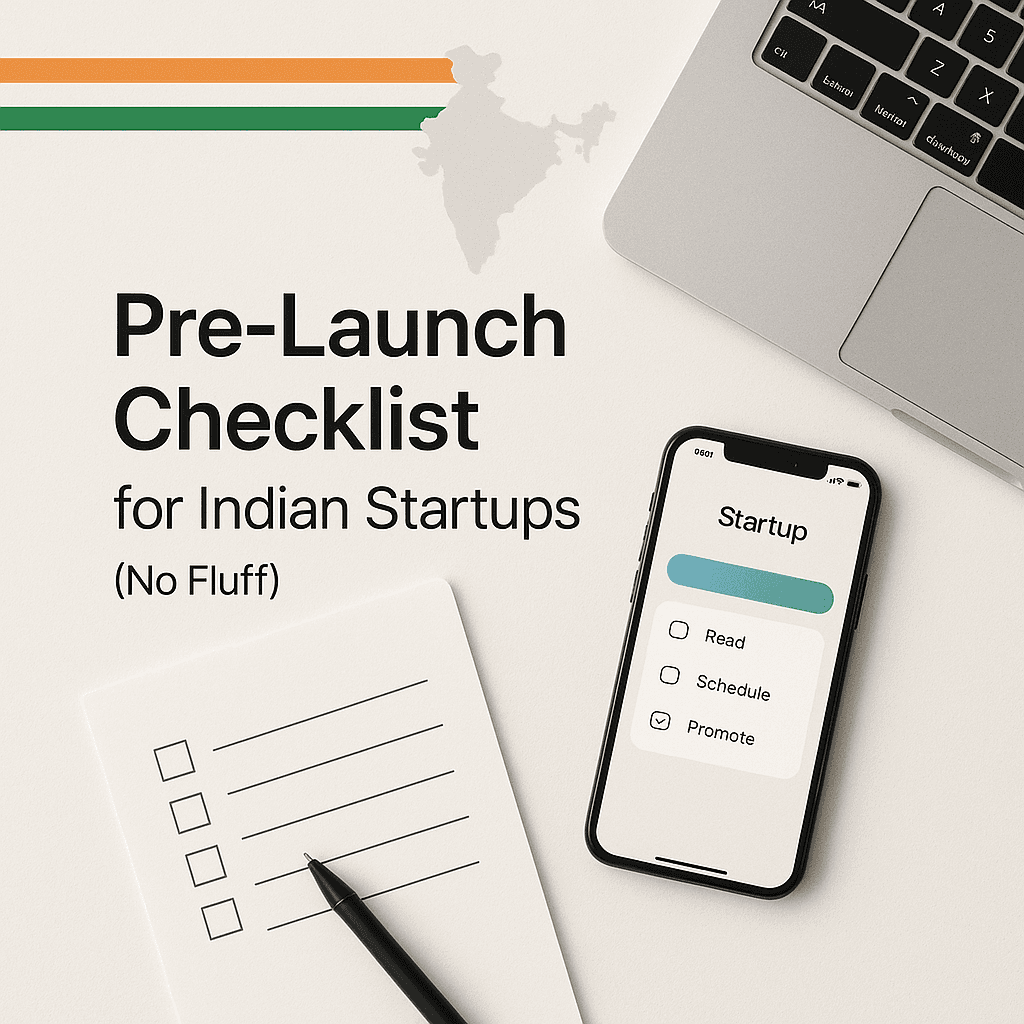
A Pre-Launch Checklist for Indian Startups (No Fluff)
A Pre-Launch Checklist for Indian Startups (No Fluff) Most startup advice sounds like this: build an MVP, talk to users, raise money, scale. This is a complete guide on Pre-Launch Checklist for Indian Startups Right before launch, the real problems are usually boring. GST. payment failure rates. a WhatsApp number that nobody replies to. one missing clause in your Terms that gets you in trouble later. a landing page that loads in 8 seconds on Jio. So here’s a pre launch checklist for Indian startups that is actually usable. Not perfect. Just practical. [Pre-Launch Checklist for Indian Startups] 1) Pre-Launch Checklist for Indian Startups: Define what “launch” even means for you If you don’t define it, you’ll keep “preparing” forever. Or you will ship too early and call it a launch because you posted on LinkedIn. Pick one: Private beta launch: 20 to 200 users, invite only, goal is feedback and retention. Public launch: anyone can sign up, goal is acquisition and conversion. Paid launch: payment enabled from day one, goal is revenue and proof. Pilot launch (B2B): 1 to 5 companies, goal is a case study and renewal. Write it down in one line: “We are launching a paid public version for freelancers in India with UPI, aiming for 100 paid users in 30 days.” That line decides everything else below. 2) Pre-Launch Checklist for Indian Startups : Confirm your ICP and the first use case (don’t keep it broad) Indian founders love saying “we’re building for SMBs”. That is not an ICP. That’s like saying you’re building for “humans”. Before launch, tighten it: Who exactly is the buyer and who is the user? What is the first job they hire you for? What are they doing today instead of using you? Excel, WhatsApp, Tally, Google Sheets, Notion, “my cousin manages it”. Quick test: if your onboarding can’t mention a specific persona, it’s too broad. Example: Not “business owners” Instead: “D2C founders doing 10 to 30 lakhs per month who need daily cash visibility and inventory signals without hiring a finance person.” 3) Your MVP must have one killer workflow end to end (Pre-Launch Checklist for Indian Startups) A Pre-Launch Checklist for Indian Startups : A lot of Indian SaaS products ship with 50 half features. Because it feels safer. But the first 100 users don’t care about your roadmap. They care if the one thing works, fully. Checklist: One primary workflow from start to finish. No dead ends. No “contact sales” unless you’re truly enterprise. No “coming soon” buttons in the core flow. It kills trust. If you have to remove 5 features to make 1 workflow solid, do it. It’s annoying. But it works. 4) Payments and pricing (India edition) This is where a surprising number of launches break. Especially consumer and prosumer products. Pre-Launch Checklist for Indian Startups: Decide your payment rails UPI (mandatory for a lot of segments) Cards (still important, especially for higher ticket and B2B) Netbanking is optional, but helpful for some profiles If you’re using a payment gateway, test the basics: Payment success rate on mobile UPI collect vs UPI intent behavior Webhook reliability Refund flow (customers will ask, even if you think they won’t) Invoice generation, if B2B Pre-Launch Checklist for Indian Startups: Pricing sanity checks Does your pricing look “Indian”? Or copied from US SaaS. Do you have a monthly plan? Indian users like monthly. Do you have an annual plan with a real incentive? Some will take it if trust is high. Is there a simple first paid plan? Not 9 tiers. Also. write your pricing page like a human. Nobody wants “Starter, Growth, Scale”. 5) Legal and compliance basics (just cover the obvious stuff) Not legal advice. But you need baseline hygiene before you go public. Company and tax Incorporation done (usually Pvt Ltd for venture scale, LLP for some cases) PAN, TAN if needed GST registration if applicable (many B2B scenarios expect it) Current account opened, payment collections mapped properly Contracts and policies Website Terms of Service – this is crucial as it sets the ground rules for using your service. A well-drafted Terms of Use can protect your interests. Privacy Policy Refund policy (if you take payments) If you handle sensitive data, be extra careful about consent and data storage. If you’re B2B: a simple MSA template NDA template (only when needed, not for every call) Pre-Launch Checklist for Indian Startups: Founder Pin has a lot of founder resources and services around startup compliance and grant readiness. If you’re trying to avoid running around for basics, it’s worth checking their ecosystem once you’re close to going live. 6) Product instrumentation before launch (or you will fly blind) You don’t need a fancy data team. But you do need to answer: Where do users drop off? What do retained users do differently? Which acquisition channel brings better users? Minimum instrumentation checklist: Install event tracking (PostHog, Mixpanel, Amplitude, GA4, whatever you can manage) Events to track: signup started signup completed activation event (your one key action) first value delivered (moment of wow) payment started and payment success (if paid) churn signal (subscription cancelled, inactivity) Also add: error logging (Sentry) uptime monitoring (UptimeRobot etc.) This is not “nice to have”. It saves you weeks. 7) Onboarding and support: set it up like you’re already busy Because after launch, you will be. Checklist: A welcome email (simple, clear) A 3 step onboarding inside the product Set up contact methods that actually work: WhatsApp business number or support chat support email in app help link Decide response time expectations: If you can’t do 24×7, don’t pretend you can. Say “we reply within 24 hours” and actually do it. Create a basic help doc with: “How to get started” “Common issues” “How refunds work” “How to contact support” Boring. But launches fail when users get stuck and nobody helps. 8) Infrastructure and performance (India networks are not forgiving) Your product must work on: mid range Android phones slower networks weird browser