
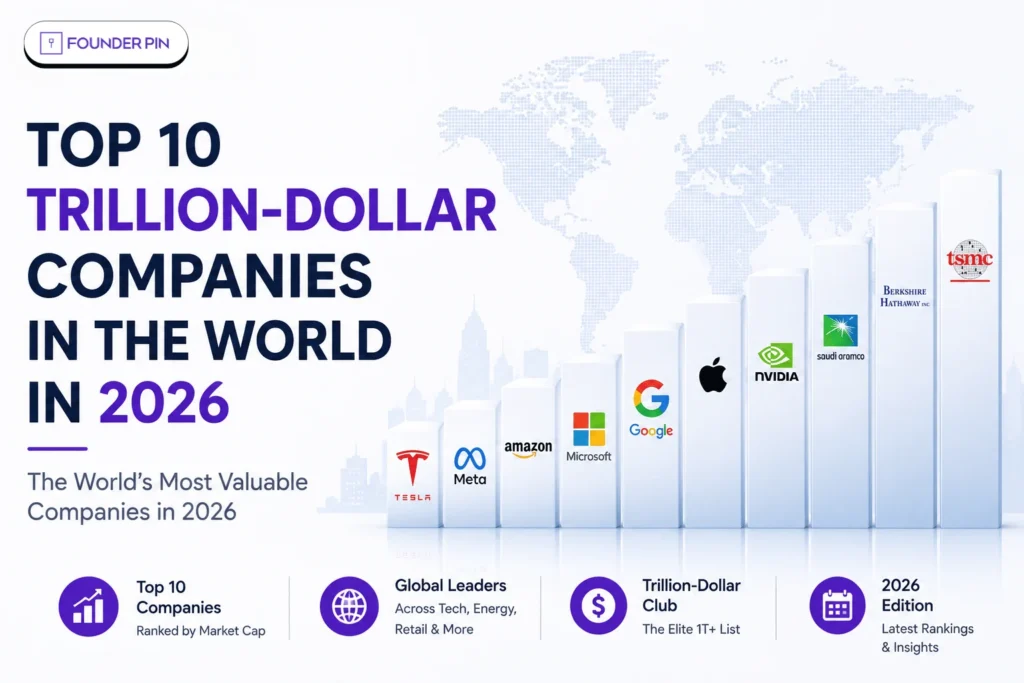
Market capitalization can move significantly during market hours, so these numbers should be viewed as a dated snapshot rather than permanent valuations.
What Is a Trillion Dollar Company?
A trillion-dollar company is simply a publicly traded business worth at least $1 trillion on the stock market.
That number — market capitalization — comes from multiplying a company’s share price by how many shares it has outstanding. It’s really just what the market currently thinks the company’s equity is worth. Not its revenue, not its cash on hand, not its total economic footprint.
Here’s a simple way to picture it: if a company has 10 billion shares trading at $100 each, that’s a $1 trillion market cap right there.
That distinction actually matters a lot. A company can pull in enormous revenue and still fall short of a $1 trillion valuation, while another company can command a sky-high valuation simply because investors are betting on major growth down the road.
1. Why Is NVIDIA the World’s Most Valuable Company?
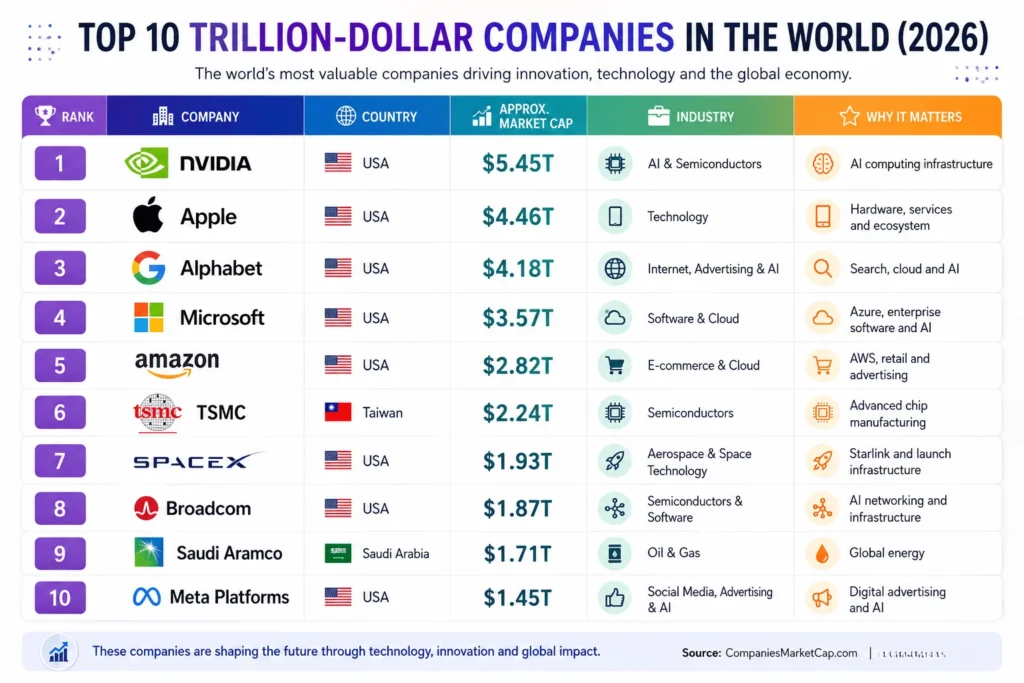
NVIDIA leads the 2026 trillion-dollar ranking at roughly $5.45 trillion. This reflects the enormous value investors currently place on AI computing infrastructure.
NVIDIA is best known for its graphics processing units, or GPUs. However, its role in technology has expanded far beyond traditional graphics.
Companies widely use NVIDIA’s processors and computing platforms to train and run advanced AI models. Cloud providers, technology companies, and AI developers have built enormous amounts of infrastructure around accelerated computing.
As a result, NVIDIA has become an important part of the AI supply chain rather than simply another chip company.
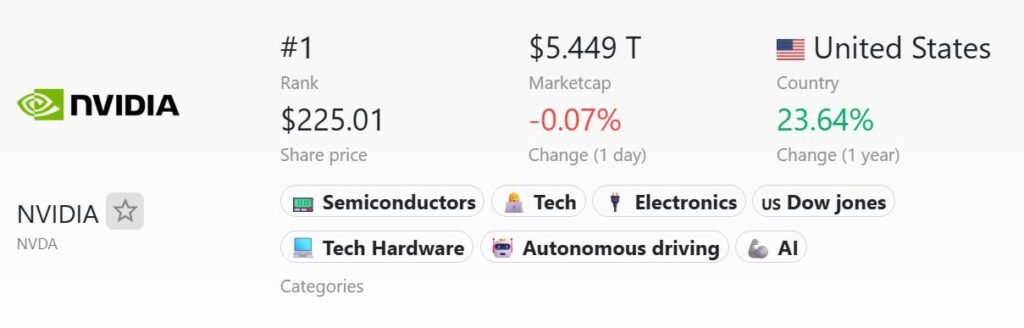
Note: Market cap figures are based on NVIDIA Companies Market Cap data as of 18 August 2026.
Why NVIDIA’s valuation matters
The bigger story here is that the AI boom has created demand for an entire computing stack.
GPUs sit at the center of this stack. But data centers also require networking, memory, software, and massive amounts of computing capacity.
So, NVIDIA’s valuation reflects investors’ belief that AI infrastructure spending can remain enormous for years.
The scale of the AI infrastructure opportunity is also reflected in India’s own startup ecosystem. Founders interested in seeing how Indian companies are building across AI models, healthcare, logistics and enterprise software can explore FounderPin’s Top 10 Indian AI Companies in 2026
FounderPin insight: One of the biggest lessons from NVIDIA is this — companies supplying the infrastructure behind a technology revolution can become more valuable than many of the consumer products built on top of it.
2. Why Is Apple Still Above $4 Trillion?
Apple’s roughly $4.46 trillion market capitalization reflects the strength of a business built around a huge installed user base, hardware and recurring services.
Apple makes the iPhone, Mac, iPad and Apple Watch, while its services business includes the App Store, subscriptions and other digital services.
But describing Apple simply as a hardware company misses the bigger picture.
The company has built an ecosystem in which hardware, software and services reinforce each other. A customer who buys an iPhone can become a user of multiple Apple services and products over time.
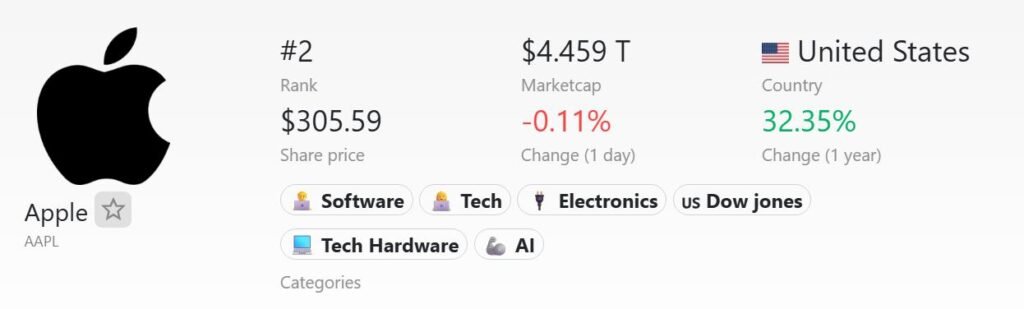
Note: Market cap figures are based on Apple Companies Market Cap data as of 18 August 2026.
Why Apple’s valuation matters
Apple demonstrates how ecosystem economics can create durable market value.
The company’s enormous customer base gives it opportunities to generate revenue across multiple products and services rather than depending entirely on one device.
FounderPin insight: For startups, Apple’s example shows that the most valuable customer relationship may be the one that creates several future revenue opportunities—not just one transaction.
3. Why Is Alphabet Worth More Than $4 Trillion?
Alphabet’s approximately $4.18 trillion valuation reflects the continued power of Google Search and advertising, combined with YouTube, Google Cloud and artificial intelligence.
Google Search remains central to Alphabet’s business, but the company now operates across several major technology markets.
YouTube gives Alphabet a huge global video platform. Google Cloud provides infrastructure and enterprise services. AI gives the company another layer of opportunity across search, consumer products, models and cloud computing.
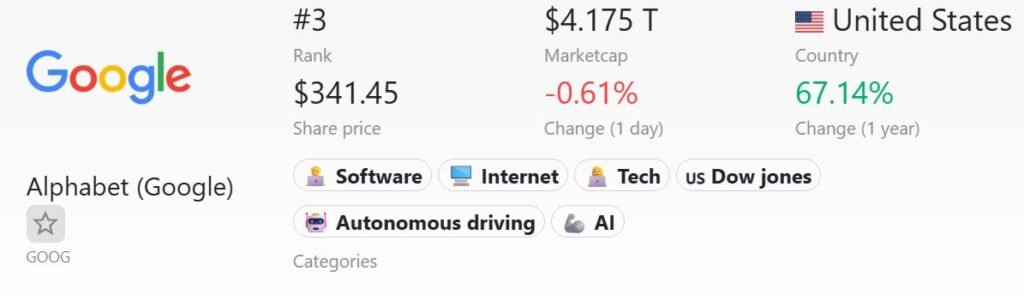
Note: Market cap figures are based on Alphabet Companies Market Cap data as of 18 August 2026.
Why Alphabet’s position matters
Alphabet is an interesting example of a company trying to use AI to strengthen an existing business rather than building an AI company from scratch.
The challenge is balancing investment in AI with the economics of its established advertising business.
FounderPin insight: The real question for Alphabet isn’t simply whether it can build powerful AI. It is whether AI can strengthen the company’s existing distribution and create new revenue without damaging its core search economics.
4. What Makes Microsoft a $3.5 Trillion Company?
Microsoft’s roughly $3.57 trillion market cap reflects the combination of enterprise software, cloud infrastructure and its growing position in AI.
Microsoft’s business stretches across Windows, Microsoft 365, Azure, gaming and enterprise software.
Azure is particularly important to the current valuation story because businesses increasingly need cloud infrastructure to build and deploy AI applications.
Microsoft also benefits from the enormous distribution of its enterprise products. Businesses already using Microsoft software can adopt additional cloud and AI services within the same ecosystem.
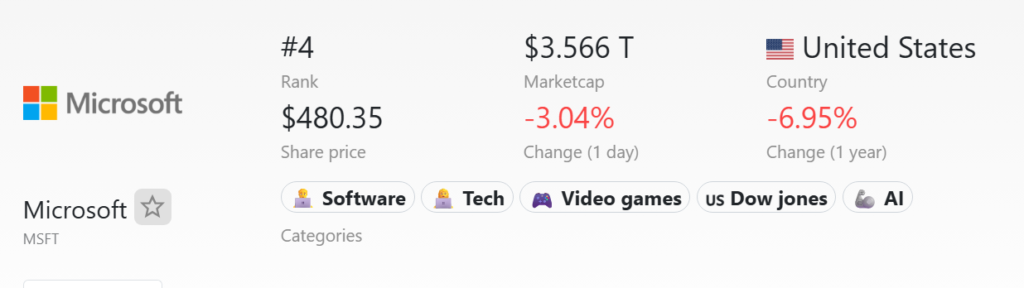
Note: Market cap figures are based on Microsoft Companies Market Cap data as of 18 August 2026.
Why Microsoft matters
Microsoft illustrates how AI can create value for an established software company by increasing demand for cloud computing and enterprise tools.
AI is therefore not necessarily replacing Microsoft’s traditional business model. It can expand the amount of computing and software businesses purchase from the company.
5. Why Is Amazon Still One of the World’s Biggest Companies?
Amazon’s roughly $2.82 trillion valuation is no longer just an e-commerce story; AWS and advertising are central parts of the company’s economic engine.
Amazon operates one of the world’s largest online retail businesses, but its cloud division, AWS, has become strategically important.
AWS provides computing, storage and other infrastructure services to businesses around the world. The company also operates an increasingly important advertising business alongside logistics and other operations.
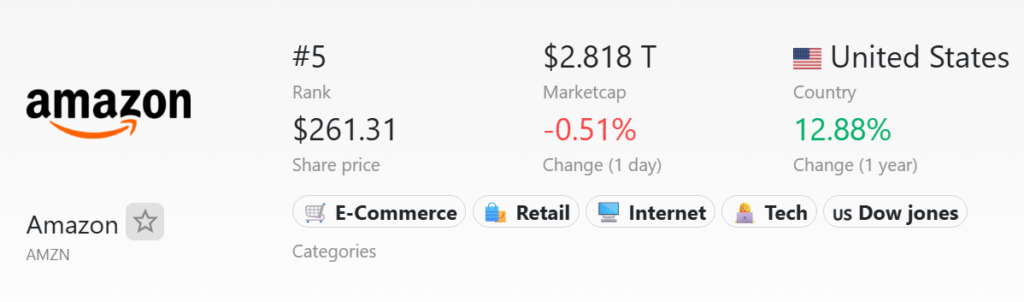
Note: Market cap figures are based on Amazon Companies Market Cap data as of 18 August 2026.
Why Amazon’s valuation matters
Amazon demonstrates how a company can use a huge customer and infrastructure base to build multiple businesses.
Retail brings consumers into the ecosystem. AWS serves businesses. Advertising monetizes the attention generated across the platform.
That diversification helps explain why Amazon’s market value extends far beyond what a simple e-commerce comparison would suggest.
6. Why Is TSMC So Valuable?
TSMC is the highest-ranked company outside the United States in this top 10, with a market capitalization of roughly $2.24 trillion.
Taiwan Semiconductor Manufacturing Company operates the world’s largest dedicated semiconductor foundry.
Unlike companies that primarily design chips, TSMC manufactures chips designed by other businesses.
That makes the company a critical part of the global technology supply chain.
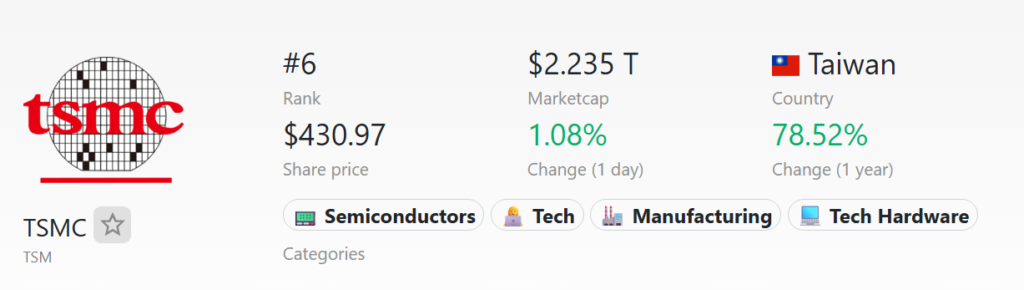
Note: Market cap figures are based on TSMC Companies Market Cap data as of 18 August 2026.
Why TSMC’s valuation matters
The AI boom doesn’t only benefit companies designing AI processors.
It also increases the importance of the companies capable of manufacturing advanced chips at enormous scale.
NVIDIA, Apple and other technology businesses depend on sophisticated semiconductor manufacturing.
FounderPin insight: TSMC shows that enormous value can sit one layer underneath the products consumers actually see. The company doesn’t sell smartphones or AI applications to consumers, but its manufacturing capability is fundamental to both industries.
7. How Did SpaceX Enter the Trillion-Dollar Top 10?
SpaceX is one of the biggest changes in the 2026 ranking because its public listing made its valuation visible through a live stock-market price.
SpaceX operates in space transportation, satellite communications and aerospace technology.
Its Starlink satellite business has become a major part of the company’s commercial story, while its launch business gives SpaceX a distinctive position in the global space industry.
The company’s arrival in the public market also changed how investors can compare it with companies such as NVIDIA, Amazon and TSMC. Reuters reported that SpaceX’s June 2026 IPO valued the company at roughly $86 billion at the offering stage, while subsequent trading pushed its market value much higher.
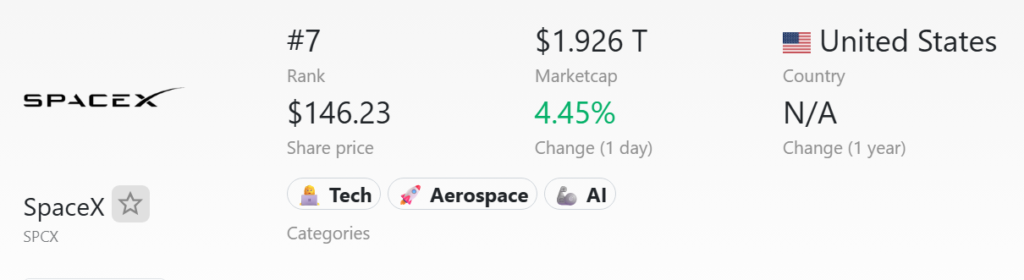
Note: Market cap figures are based on Space X Companies Market Cap data as of 18 August 2026.
Why SpaceX’s valuation matters
SpaceX is unusual because it combines two very different businesses:
- launch infrastructure
- satellite connectivity through Starlink
That combination gives investors exposure to both aerospace infrastructure and a recurring communications business.
Its public valuation can also move quickly because investors are pricing future growth, not simply today’s revenue.
FounderPin insight: SpaceX’s inclusion demonstrates how public markets can suddenly make a previously difficult-to-compare private technology company part of the world’s biggest-company rankings.
8. Why Is Broadcom Worth Nearly $2 Trillion?
Broadcom’s roughly $1.87 trillion market capitalization reflects demand for semiconductors, networking and infrastructure software.
Broadcom is particularly interesting in the AI era because data centers need much more than GPUs.
AI infrastructure also requires networking, connectivity and specialized chips capable of moving and processing huge amounts of data.
Broadcom’s business gives it exposure to these less visible but critical parts of the computing stack.
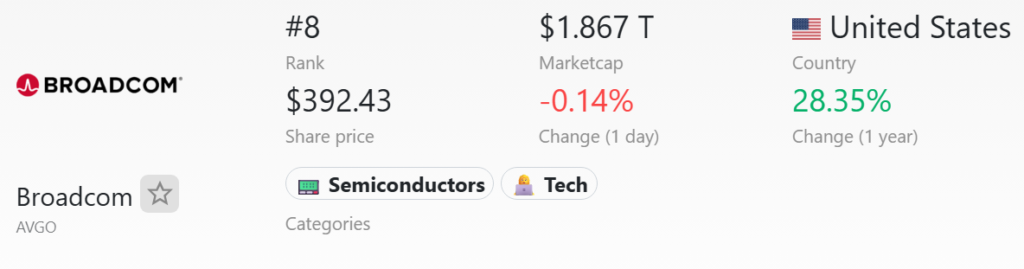
Note: Market cap figures are based on Broadcom Companies Market Cap data as of 18 August 2026.
Why Broadcom matters
The company’s position highlights an important point about the AI economy:
The AI infrastructure market is bigger than GPUs.
As data centers become larger and more sophisticated, networking and custom silicon can become just as strategically important as general-purpose AI accelerators.
9. Why Is Saudi Aramco Still Above $1 Trillion?
Saudi Aramco is the only traditional energy company in the top 10, with a market capitalization of roughly $1.71 trillion.
The Saudi Arabian energy giant remains one of the world’s most important oil and gas companies.
Its position is a useful counterpoint to the technology-heavy nature of the rest of the list.
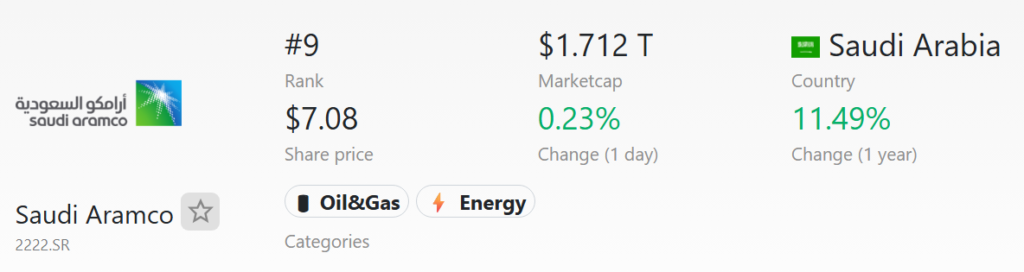
Note: Market cap figures are based on Saudi Aramco Companies Market Cap data as of 18 August 2026.
Why Saudi Aramco matters
The trillion-dollar economy is not entirely about AI, software and semiconductors.
Energy remains fundamental to the global economy, and companies operating at enormous scale can maintain extraordinary market values even during technology-led investment cycles.
Saudi Aramco’s presence therefore shows that the world’s largest companies still span both digital infrastructure and physical resources.
10. Why Does Meta Remain Above $1 Trillion?
Meta Platforms rounds out the top 10 at approximately $1.45 trillion, supported by its enormous advertising ecosystem and growing use of AI across its platforms.
Meta operates Facebook, Instagram and WhatsApp, with advertising remaining a major source of revenue.
AI increasingly influences recommendation systems, advertising technology and consumer products across the company’s platforms.
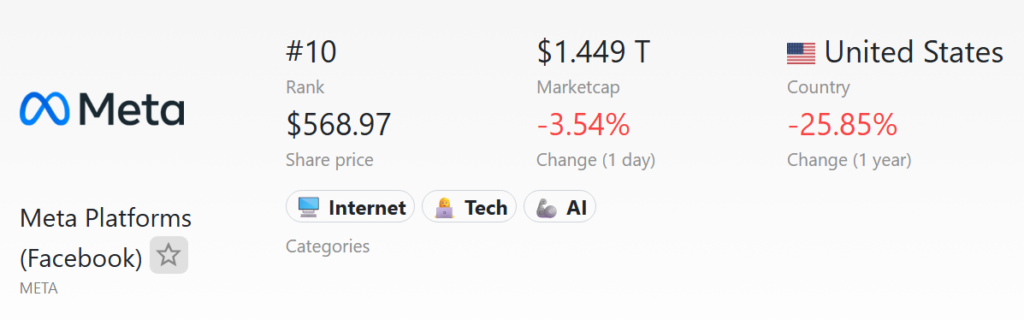
Note: Market cap figures are based on Meta Companies Market Cap data as of 18 August 2026.
Why Meta’s valuation matters
Meta demonstrates how AI can improve the economics of an existing digital platform.
Better recommendations can increase engagement. Better advertising systems can improve targeting. AI-powered products can potentially create new forms of user interaction.
The company therefore combines one of the world’s largest digital audiences with significant AI investment.
What Do These 10 Trillion-Dollar Companies Have in Common?
The biggest pattern isn’t simply that these companies are large.
It is that many control infrastructure, ecosystems or distribution at enormous scale.
This infrastructure-first approach is increasingly relevant for Indian founders as well. If you’re looking for sectors where a smaller company can build around emerging technology and infrastructure trends, FounderPin’s 20 Profitable Startup Ideas in India for 2026 is a useful starting point.
AI has become an infrastructure story
- NVIDIA supplies computing.
- TSMC manufactures advanced chips.
- Broadcom supplies networking and specialized semiconductor infrastructure.
- Microsoft and Amazon provide cloud infrastructure.
- Alphabet and Meta apply AI across enormous consumer platforms.
That means AI value is spreading across an interconnected technology stack rather than being captured by one type of company.
Scale remains a powerful advantage
- Apple has a huge installed base.
- Amazon has global logistics and cloud infrastructure.
- Alphabet and Meta have enormous audiences.
- Microsoft has deep enterprise relationships.
These companies can invest billions in new technologies because their existing businesses provide enormous scale.
Physical infrastructure still matters
TSMC, SpaceX and Saudi Aramco show another side of the trillion-dollar economy.
Not every valuable company is a software platform.
Advanced manufacturing, energy and space infrastructure can also support enormous valuations when the underlying market opportunity is large enough.
How Many Trillion-Dollar Companies Are There in 2026?
The August, 2026 snapshot used for this article shows 15 companies above the $1 trillion market-cap threshold.
Beyond the top 10, the next five companies in the supplied market-cap snapshot are:
| Rank | Company | Approx. Market Cap |
| 11 | Tesla | $1.34T |
| 12 | Samsung Electronics | $1.27T |
| 13 | Micron Technology | $1.14T |
| 14 | Berkshire Hathaway | $1.07T |
| 15 | Eli Lilly | $1.05T |
The composition is notable.
Micron’s presence reflects the importance of memory chips to AI infrastructure, while Eli Lilly demonstrates that the trillion-dollar club isn’t limited to technology and energy.
The exact membership can change quickly when companies near the $1 trillion threshold.
What Is the Difference Between Market Cap and Company Value?
Market capitalization is not the same thing as the price someone would pay to acquire an entire company.
Market cap represents the market value of a company’s publicly traded equity.
An acquisition analysis can also consider:
- debt
- cash
- enterprise value
- revenue
- earnings
- free cash flow
So when NVIDIA has a market capitalization of approximately $5.45 trillion, that does not mean someone could simply write a $5.45 trillion cheque and acquire the whole business.
Market capitalization is better understood as the stock market’s current valuation of the company’s equity.
This distinction is particularly important when comparing public companies with private companies.
What Does the 2026 Trillion-Dollar Ranking Tell Us?
The ranking provides a useful snapshot of where investors see enormous long-term economic opportunities.
1. AI infrastructure is the dominant theme
Four companies in the top 10—NVIDIA, TSMC, Broadcom and Microsoft—have particularly strong connections to the AI infrastructure boom.
Amazon and Alphabet are also investing heavily in AI and cloud infrastructure.
The result is an ecosystem in which chip designers, manufacturers, cloud providers and software companies can all benefit from the same technology cycle.
2. Semiconductor manufacturing has become strategically important
TSMC’s position is perhaps the clearest evidence.
A company that primarily manufactures chips designed by others can command a valuation above many of the world’s biggest consumer brands.
That tells us how strategically important advanced semiconductor production has become.
3. Scale remains one of the world’s strongest business advantages
The companies at the top of this list have something difficult for competitors to replicate:
massive scale.
Whether that scale comes from users, data centers, semiconductor factories, distribution networks, energy assets or satellite infrastructure, it creates advantages that smaller companies cannot easily reproduce.
4. The biggest opportunities aren’t always consumer-facing
NVIDIA, TSMC and Broadcom are excellent examples.
Most consumers don’t directly buy their products.
Yet their infrastructure sits underneath some of the world’s most important technology businesses.
For founders, that’s an important lesson: the biggest business opportunity may sometimes be the infrastructure enabling a much larger market.
FounderPin Perspective: What Can Startup Founders Learn?
The most useful lesson from the trillion-dollar list isn’t simply that NVIDIA is worth more than Apple.
It is that the world’s largest companies often control a critical layer of a huge market.
NVIDIA sits at the heart of AI computing. TSMC controls an important part of advanced chip manufacturing. Microsoft and Amazon provide cloud infrastructure. Alphabet and Meta control enormous digital distribution networks. SpaceX combines launch infrastructure with satellite connectivity.
For startup founders, the lesson is not to chase a trillion-dollar valuation.
It is to ask a more practical question:
What important problem can my company solve at a scale large enough to support a massive market?
Another lesson is that valuation should not be confused with certainty. A market capitalization reflects what investors expect a business to generate in the future. Expectations can change, sometimes very quickly.
The strongest companies therefore aren’t simply those with high valuations today. They are businesses that have built difficult-to-replicate advantages around customers, infrastructure, technology, distribution or capital.
Frequently Asked Questions
What is a trillion-dollar company?
A trillion-dollar company is generally a publicly traded company with a market capitalization of at least $1 trillion.
Which is the world’s most valuable company in 2026?
Based on the August 18, 2026 snapshot used in this article, NVIDIA ranks first with a market capitalization of approximately $5.45 trillion.
How many trillion-dollar companies are there in 2026?
The snapshot used for this article shows 15 companies above the $1 trillion market-cap threshold.
Is SpaceX a trillion-dollar company?
Yes, based on the market-cap snapshot used here. SpaceX became publicly traded in 2026, allowing its valuation to be measured through its public share price. Its market value subsequently moved into the trillion-dollar range.
Is market capitalization the same as revenue?
No. Market capitalization measures the market value of a company’s publicly traded equity. Revenue measures the income a company generates from its business operations. They are completely different financial measures.
Final Verdict: What Can We Learn From the World’s Trillion-Dollar Companies?
The 2026 trillion-dollar ranking tells a bigger story than simply which company occupies the number-one position.
AI infrastructure is the strongest common theme, but it is not the only one. Semiconductors, cloud computing, digital ecosystems, energy and space technology are also supporting enormous businesses.
NVIDIA’s position at the top is particularly notable, but the broader lesson may be even more important: companies that control critical infrastructure, distribution or technology platforms can capture enormous economic value.
And because market capitalizations change with share prices, this ranking should always be treated as a snapshot, not a permanent leaderboard.
For founders, the more useful question isn’t simply who is worth the most?
It’s why does the market believe these businesses can continue creating enormous value?
Building or scaling a company and thinking about long-term market positioning? Contact FounderPin today for a consultation, and let’s map out the right path for your business.
Data source: The ranking and market-cap figures in this article use the latest global market-cap snapshot available from CompaniesMarketCap as of August 18, 2026. Market values fluctuate continuously during trading.
Current reporting also confirms NVIDIA’s position among the world’s largest companies and highlights the continued dominance of AI-related businesses in the global market-cap rankings. SpaceX’s inclusion is particularly significant because its 2026 IPO moved the company from the private-company valuation universe into public-market trading.