
Methodology: Funding figures represent cumulative publicly reported funding raised by each startup as of September 2026. Figures are compiled from company announcements, investor disclosures, regulatory filings and reputable startup databases. Undisclosed rounds are not included in the dollar totals. Funding databases can report different totals because they may use different definitions for debt, secondary transactions, corporate investments and other financing types. Therefore, the figures should be treated as publicly reported estimates rather than audited financial figures.
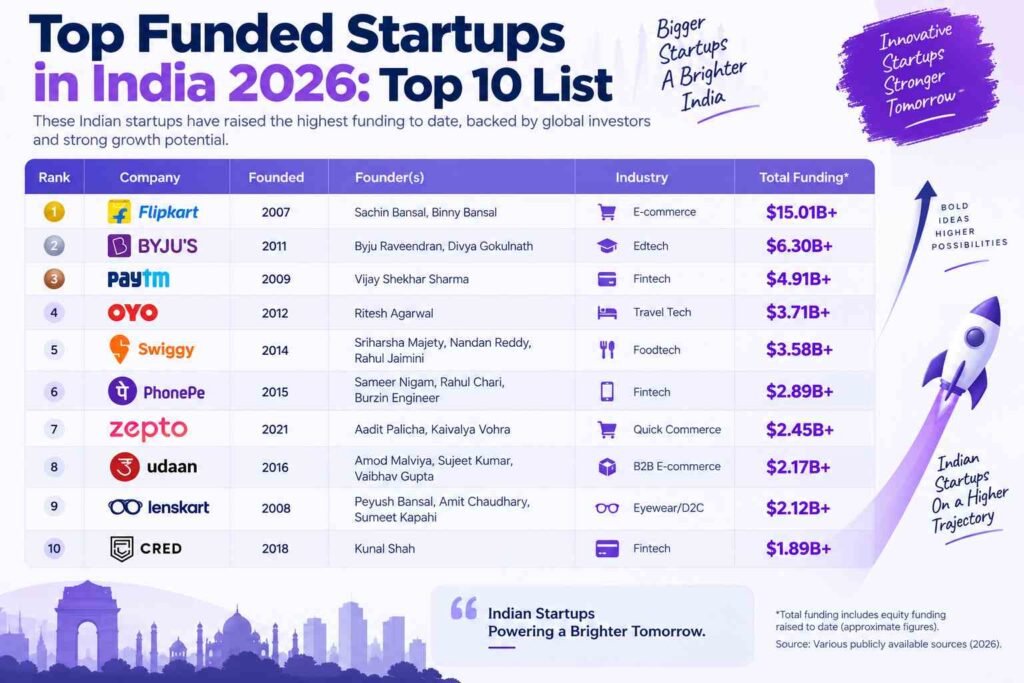
1. Flipkart — $15 Billion+ Raised
Flipkart sits way ahead of pretty much every other Indian startup when it comes to cumulative funding.
- Founded: 2007
- Founders: Sachin Bansal and Binny Bansal
- Industry: E-commerce
- Reported funding: $15.01 billion+
It started out as a simple online bookstore before growing into the sprawling e-commerce marketplace we know today. That evolution tells you a lot about just how much capital it takes to actually compete in Indian e-commerce.
Inc42 currently tracks more than $15.01 billion across 25 funding rounds. Google joined in during Flipkart’s 2024 round, and Walmart still holds its position as the major shareholder.
The takeaway here is pretty straightforward: commerce at this scale eats capital fast — logistics, technology, inventory infrastructure, and customer acquisition all pull from the same enormous pot.
2. BYJU’S — $6.3 Billion+ Raised
BYJU’S became one of the most heavily funded edtech companies in India during the boom years.
- Founded: 2011
- Founders: Byju Raveendran and Divya Gokulnath
- Industry: Edtech
- Reported funding: $6.30 billion+
Inc42 puts the number at more than $6.3 billion across 32 funding rounds — enough to make BYJU’S one of the biggest funding recipients in India’s startup history, period.
The company grew well beyond its original learning app, expanding into multiple education businesses and picking up several acquisitions along the way.
But its story also drives home an important lesson for founders: raising huge amounts of capital and building a sustainable business are two very different things.
3. Paytm — $4.91 Billion+ Raised
Paytm built one of India’s largest fintech ecosystems, and it pulled in billions from both private investors and public markets along the way.
- Founded: 2009
- Founder: Vijay Shekhar Sharma
- Industry: Fintech
- Reported funding: $4.91 billion+
It started with mobile payments, then branched out into financial services, merchant payments, commerce, and a handful of related products.
Inc42 reports more than $4.91 billion raised across 14 rounds before Paytm even reached its post-IPO stage.
Paytm’s journey also shows something worth noting: startup funding often shifts from venture capital into public-market capital as a company matures and eventually goes public.
4. OYO — $3.71 Billion+ Raised
OYO pulled in billions building a tech-led accommodation network that spread across India and eventually into international markets too.
- Founded: 2012
- Founder: Ritesh Agarwal
- Industry: Travel Tech
- Reported funding: $3.71 billion+
It started small — a budget hotel aggregation platform — before growing into something much bigger, layering hospitality technology on top of an expanding accommodation network.
Inc42 currently tracks more than $3.71 billion across 18 funding rounds.
OYO’s story explains a lot about why investors have gravitated toward this kind of business over the years: there’s real appeal in platforms that can wrap technology and distribution around industries that were traditionally fragmented and offline.
5. Swiggy — $3.58 Billion+ Raised
Swiggy became one of the most heavily funded consumer internet companies in India by not staying confined to food delivery.
- Founded: 2014
- Founders: Sriharsha Majety, Nandan Reddy and Rahul Jaimini
- Industry: Foodtech and quick commerce
- Reported funding: $3.58 billion+
Inc42 puts its cumulative funding at more than $3.58 billion.
Food delivery was just the start — Swiggy later pushed into quick commerce through Instamart, alongside a handful of other consumer services.
Its funding journey makes a useful point: a strong customer base and logistics network can become a launchpad into entirely new markets, not just a moat around the original one.
6. PhonePe — $2.89 Billion+ Raised
PhonePe has attracted substantial capital while building one of India’s largest digital payments platforms.
- Founded: 2015
- Founders: Sameer Nigam, Rahul Chari and Burzin Engineer
- Industry: Fintech
- Reported funding: $2.89 billion+
Inc42 lists more than $2.89 billion across 14 funding rounds, including a $600 million round from General Atlantic in 2025.
PhonePe separated from Flipkart and changed its domicile to India during its expansion phase. Its growth has been closely linked to India’s UPI ecosystem.
The company has also explored financial services beyond payments, including lending, insurance and wealth management.
7. Zepto — $2.45 Billion+ Raised
Zepto is one of the youngest companies on this list, yet it has already raised more than $2 billion.
- Founded: 2021
- Founders: Aadit Palicha and Kaivalya Vohra
- Industry: Quick commerce
- Reported funding: $2.45 billion+
Inc42 records more than $2.45 billion across 12 funding rounds, with its latest listed funding coming in October 2025.
Zepto’s rapid fundraising reflects the capital-intensive nature of quick commerce, where companies need dense delivery networks, dark stores, technology and customer acquisition.
It is a useful example of how quickly India’s startup funding landscape can change when investors back a fast-growing category.
8. Udaan — $2.17 Billion+ Raised
Udaan brought institutional capital into India’s fragmented B2B commerce market.
- Founded: 2016
- Founders: Amod Malviya, Sujeet Kumar and Vaibhav Gupta
- Industry: B2B e-commerce
- Reported funding: $2.17 billion+
Inc42 reports more than $2.17 billion across 17 funding rounds.
Udaan connects manufacturers, wholesalers, traders and retailers through a technology-led B2B marketplace.
In September 2026, Udaan also announced a deal to acquire Swiggy’s retail distribution business Lynk, showing how the company continues to build its distribution network.
9. Lenskart — $2.12 Billion+ Raised
Lenskart transformed eyewear into a large omnichannel consumer brand.
- Founded: 2008
- Founders: Peyush Bansal, Amit Chaudhary and Sumeet Kapahi
- Industry: Eyewear and D2C
- Reported funding: $2.12 billion+
Inc42 lists more than $2.12 billion across 23 funding rounds.
Lenskart combined online sales with physical stores, eye-testing services and a broad eyewear portfolio.
Its funding history demonstrates how investors have backed Indian consumer brands that combine technology with offline distribution.
10. CRED — $1.89 Billion+ Raised
CRED entered the billion-dollar funding club after raising a $900 million Series H round from Meta in 2026.
- Founded: 2018
- Founder: Kunal Shah
- Industry: Fintech
- Reported funding: $1.89 billion+
CRED’s June 2026 funding round was particularly significant. The company announced that Meta would invest approximately $900 million, valuing CRED at about $4.5 billion.
CRED says its platform has 17 million monthly members and processes more than 40% of India’s credit-card bill payments.
The company has expanded beyond credit-card payments into lending, insurance, wealth and other financial services.
What Do the Top Funded Startups in India Have in Common?
The biggest funding stories generally combine a large addressable market with technology, distribution and the potential to scale.
Key patterns include:
- Large consumer markets: E-commerce, fintech, food delivery and education can serve millions of users.
- Network effects: Payments and marketplaces can become more valuable as participation grows.
- Technology plus offline infrastructure: Lenskart and Zepto show that software alone is not always enough.
- Multiple revenue opportunities: Paytm, PhonePe and CRED have expanded into several financial products.
- Heavy infrastructure requirements: Logistics, fulfilment centres and delivery networks require significant capital.
- Institutional investor confidence: Large rounds often involve global investors with long investment horizons.
- Category expansion: Swiggy moved from food delivery into quick commerce, while several fintech companies expanded beyond payments.
- Capital efficiency still matters: A large funding total does not automatically mean profitability or long-term success.
Why Funding Amount Alone Doesn’t Tell the Full Story
Funding matters, sure — but treating it as the only measure of success is a mistake.
A startup can raise billions and still stumble over profitability, governance, valuation, or how fast it’s burning cash. Meanwhile, another company can build something genuinely valuable with a fraction of the external capital. Funding size just doesn’t guarantee much on its own.
So what should founders and investors actually look at? Revenue growth, margins, cash flow, customer retention, valuation, market share, and capital efficiency — all alongside the funding number, not instead of it.
That combination is usually where the real story starts to show up.
Final Takeaway
Look across the top funded startups in India, and you’re really watching the evolution of the country’s tech economy — from Flipkart’s early e-commerce push, to PhonePe scaling fintech, to Zepto’s breakneck growth in quick commerce.
The biggest numbers belong to very different eras and business models. Some companies took years, even a decade or more, to raise what they raised. Younger startups like Zepto, on the other hand, hit multi-billion-dollar totals in a fraction of that time.
For founders, the lesson underneath all of it is pretty clear: capital can accelerate a strong business model, but it was never going to replace one.
Frequently Asked Questions
1. Which is the most funded startup in India in 2026?
Flipkart is the most funded startup in India among the companies covered in this list, with more than $15 billion in publicly reported cumulative funding. Inc42 currently records $15.01 billion+ across 25 funding rounds.
2. What are the top funded startups in India in 2026?
The top funded startups in India include Flipkart, BYJU’S, Paytm, OYO, Swiggy, PhonePe, Zepto, Udaan, Lenskart and CRED. Their funding comes from multiple rounds involving domestic and international investors, with cumulative totals ranging from more than $1.8 billion to over $15 billion.
3. Which Indian startup has raised the most funding after Flipkart?
BYJU’S is among the highest-funded Indian startups after Flipkart, with more than $6.3 billion in publicly reported funding. Inc42 records $6.30 billion+ across 32 rounds, including equity and debt financing.
4. How much funding has Zepto raised?
Zepto has raised more than $2.45 billion in publicly reported funding across 12 rounds. Its latest listed round was a $450 million funding round in October 2025, according to Inc42.
5. Does raising more funding mean a startup is more successful?
No. Funding is an important measure of investor interest and capital raised, but it does not by itself prove profitability or long-term business success. Revenue growth, margins, cash flow, customer retention, valuation, market position and capital efficiency also matter when evaluating a startup.