Unit Economics of IPL 2026: Analyzing Startup CAC vs. Ad Spend
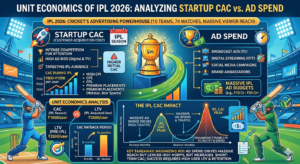
At Founder Pin, we’ve long argued that the IPL is the “Super Bowl of India”—a high-stakes arena where brands are made or broken. But as we move deeper into the 2026 season, the conversation in startup boardrooms has shifted from “How many impressions did we get?” to “What was the actual cost of each new customer?“
In a year defined by Capital Efficiency, the unit economics of an IPL ad campaign are under more scrutiny than ever. With viewership crossing 515 million in the opening weekend alone and ad revenues projected to exceed ₹5,200 crore, the scale is undeniable.
However, for a startup, the math must work. If your Customer Acquisition Cost (CAC) during the IPL exceeds your Lifetime Value (LTV), that prime-time slot isn’t a growth engine—it’s a burn rate accelerator.
The Reality of Ad Rates in 2026
If you want to play in the big leagues this year, the entry price is steeper than ever. While base rates for a 10-second spot on linear TV (SD+HD) have stabilized at around ₹18 lakh, the costs for high-impact moments have skyrocketed. A 10-second slot during the IPL 2026 Final now commands a record ₹50 lakh.
For startups, the “entry-level” budget has moved to digital. Even there, costs are rising. Connected TV (CTV) rates have seen a 25% hike, with base CPMs (cost per mille/thousand impressions) moving from ₹480 to ₹600. Mobile remains the “scale engine,” with CPMs ranging between ₹180 and ₹340, depending on the match’s marquee value.
When you factor in the sheer volume of ads, a startup needs to spend at least ₹5–10 crore just to achieve a “baseline” frequency where viewers actually remember the brand.
The CAC Trap: Why High Reach Doesn’t Mean High ROI
The danger for startups in 2026 is the “Vanity Metric Trap.” It is easy to get seduced by a report showing 32.6 billion minutes of total watch time. But for a fintech or e-commerce startup, the conversion funnel is what matters.
Let’s look at the hypothetical math for a mid-market startup spending ₹5 crore on a digital-first IPL campaign:
-
Total Impressions: ~15-20 million (at a blended CPM).
-
Click-Through Rate (CTR): Typically 0.2% to 0.8% for video ads.
-
Estimated App Installs/Visitors: 40,000 to 160,000.
-
Implied CAC: ₹300 to ₹1,250 per user.
In an era where VCs are demanding Burn Multiples below 1.5x (as we discussed in our Venture Capital Trends 2026 guide), a CAC of ₹1,000 is only sustainable if that user generates significant margin within their first 90 days. For many D2C and gaming startups, the math simply doesn’t add up, leading to the “category exits” we’ve seen from Real-Money Gaming (RMG) firms this year.
The Shift to “Precision Play” over “Land Grab”
In 2026, the smart money has stopped “spraying and praying.” We are seeing a 26% drop in the total number of unique advertisers, as startups move toward a more disciplined, outcome-led approach. The “Gaming Pullback” has opened inventory for sectors like Quick Commerce, Fintech, and Electric Vehicles (EVs), which are now using the IPL for “Precision Orchestration.“
Instead of buying national TV spots, startups are leveraging:
-
Regional Feeds: Buying slots in specific languages (Tamil, Telugu, Bengali) where rates are ₹1–2.5 lakh per 10 seconds. This allows for hyper-local targeting at a fraction of the cost.
-
CTV for Premium Households: With over 40 million households now watching on Smart TVs, startups like Ather and Zepto are targeting the top 5% of India’s earners, ensuring their CAC is spent on high-LTV customers.
-
L-Band Overlays: Using non-intrusive horizontal banners that appear during live play. At ₹4.5 lakh per exposure on CTV, these are becoming high-value “interruptions” that don’t make the viewer look away.
The “Halo Effect” vs. Performance Marketing
It is important to remember that the IPL isn’t just a performance channel; it’s a Trust Engine. In the Most Successful Companies of Shark Tank India, we saw that national visibility often leads to an “organic tail.“
A startup might have a high CAC during the six weeks of the IPL, but the brand recognition built during that time can lower the CAC on Google and Meta for the rest of the year. This “Halo Effect” is why giants like Google and Reliance continue to dominate the airwaves—they aren’t just looking for clicks; they are looking for “Mindshare.“
Conclusion: Balancing the 70/30 Split
For the 2026 founder, the verdict is in: the IPL is a maturity milestone, not a startup shortcut. The most efficient players this year are opting for a 70/30 or 60/40 split, favoring digital for its attribution and precision, while using TV only for top-of-funnel reach.
At Founder Pin, we believe the startups that “win” IPL 2026 won’t be the loudest ones, but the ones that understand their unit economics well enough to know when to show up and when to step back. If you can’t prove that an IPL user is more valuable than a Community-Led Growth user, the 10-second spot can wait.
Join the 1 Million Founder Mission
-
Marketing Budget Audit? Contact Us to help you analyze your IPL-readiness.
-
Raising for Growth? Read our Full Guide on Raising Funding in India.
-
Learn More: Explore About Our Mission to see how we’re helping India’s founders build profitable, resilient businesses.