
10 Essential Skills for Startup Founders Every Founder Must Have
Table of Contents
Toggle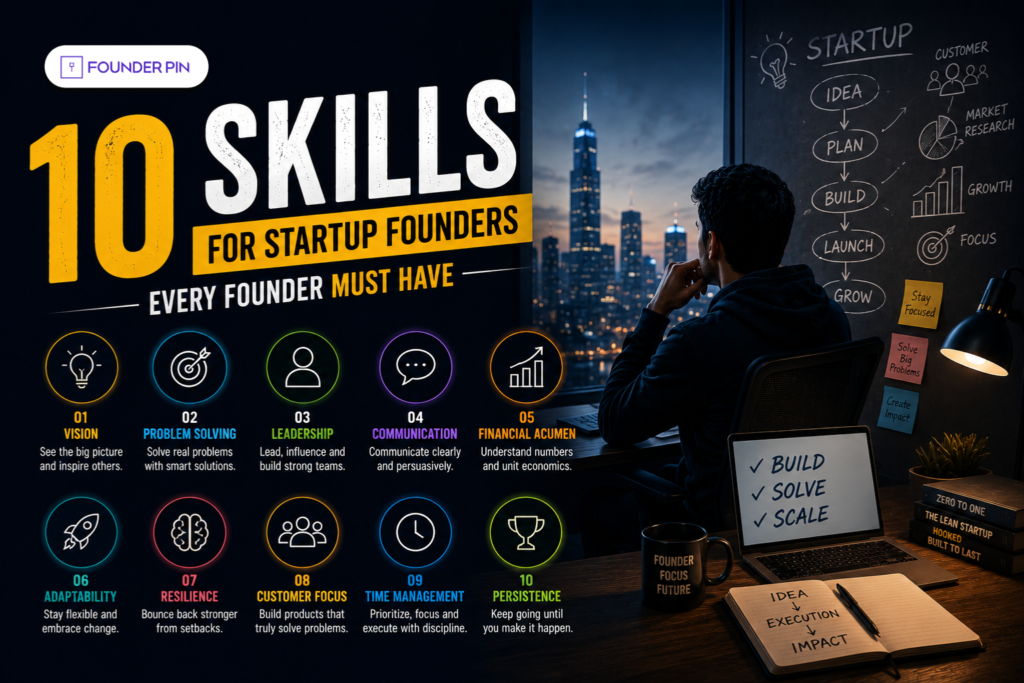
Why Skills for Startup Founders Matter More Than Ever
Building a startup is often romanticized as a journey driven by ideas and passion. However, the reality is far more complex. The difference between success and failure rarely lies in the idea itself—it lies in the skills for startup founders. In today’s hyper-competitive ecosystem, founders must wear multiple hats, from strategist and marketer to leader and operator.
Unlike traditional career paths, entrepreneurship does not offer a fixed playbook. This is why developing the right entrepreneur skills becomes critical. These skills not only help founders navigate uncertainty but also enable them to build resilient, scalable businesses. More importantly, they shape how founders think, make decisions, and lead teams under pressure.
1. Vision and Strategic Thinking
Every successful startup begins with a clear vision, but vision alone is not enough. Founders must translate that vision into actionable strategies. Strategic thinking allows founders to anticipate market trends, identify opportunities, and position their business effectively.
Without this skill, even the most innovative ideas can fail due to poor execution. Strong strategic thinking helps founders prioritize resources, avoid distractions, and stay focused on long-term goals while managing short-term challenges.
Strategic thinking also involves identifying the right opportunities at the right time. If you’re exploring potential business ideas, you can check out 20 profitable startup ideas for India in 2026 with low investment to align your vision with market demand.
2. Leadership Skills for Founders
Building and Inspiring Teams
One of the most critical leadership skills for founders is the ability to build and inspire a team. Startups operate in high-pressure environments, and employees often look to the founder for direction and motivation. A strong leader creates clarity, fosters trust, and aligns the team around a shared mission.
Decision-Making Under Uncertainty
Leadership is not just about inspiring others—it’s about making tough decisions with limited information. Founders must develop the confidence to act decisively while remaining adaptable to change. This balance is what separates effective leaders from reactive managers.
Developing strong leadership skills is essential for founders, especially in high-growth environments. According to Harvard Business Review, effective leadership is one of the most critical factors influencing long-term business success.
3. Adaptability and Resilience
Startups are unpredictable by nature. Market conditions change, customer preferences evolve, and unexpected challenges arise. Adaptability allows founders to pivot when necessary, while resilience ensures they can recover from setbacks.
This combination is essential for long-term survival. Founders who resist change often struggle, whereas those who embrace it can turn challenges into opportunities.
Adaptability becomes even more important when founders face emotional and mental challenges. Many entrepreneurs struggle with isolation during tough phases, which is why understanding founder loneliness blog can help founders build resilience and stay consistent.
4. Financial Intelligence
Financial intelligence goes beyond managing cash flow—it also includes understanding government benefits and startup incentives. For example, learning about programs like DPIIT recognition guide 2026 can help founders unlock tax exemptions, funding opportunities, and long-term financial advantages.
Understanding finances is one of the most overlooked skills for startup founders. From managing cash flow to evaluating investment opportunities, financial intelligence plays a crucial role in decision-making.
Founders do not need to be accountants, but they must understand key financial metrics such as burn rate, runway, and profitability. This knowledge helps them make informed decisions and avoid costly mistakes.
5. Communication and Storytelling
A founder’s ability to communicate effectively can determine the success of their startup. Whether pitching to investors, marketing to customers, or leading a team, communication is key.
Storytelling, in particular, is a powerful tool. It helps founders connect emotionally with their audience, making their vision more compelling and memorable. Strong communication skills also improve collaboration and reduce misunderstandings within the team.
6. Sales and Marketing Skills
No matter how great a product is, it will not succeed without customers. This is why sales and marketing are essential entrepreneur skills. Founders must understand their target audience, craft effective messaging, and build strategies to acquire and retain customers.
Early-stage startups, in particular, rely heavily on the founder’s ability to sell—whether it’s selling a product, a vision, or a partnership.
Visual Representation of Founder Skills
A well-rounded founder combines multiple skills, each contributing to different aspects of business growth and sustainability.
7. Problem-Solving and Critical Thinking
Entrepreneurship is really about finding solutions to issues. Founders need to be able to comprehend complicated circumstances, pinpoint underlying issues, and create workable solutions.
Critical thinking enhances this process by enabling founders to evaluate options objectively and avoid biases. This skill is particularly valuable when dealing with uncertainty and high-stakes decisions.
8. Time Management and Focus
One of the most important resources for every founder is time. Having a lot of duties makes time management crucial.
Prioritization is key. Founders must focus on high-impact activities that drive growth while delegating or eliminating less important tasks. Strong time management not only improves productivity but also reduces stress and burnout.
9. Networking and Relationship Building
It takes more than one person to build a startup. Growth depends heavily on relationships with partners, investors, mentors, and clients.
Networking is more than just making connections—it’s about building meaningful relationships that create value over time. Founders who invest in relationships often gain access to opportunities, insights, and resources that accelerate their success.
10. Emotional Intelligence and Self-Awareness
Emotional intelligence is one of the most underrated leadership skills for founders. It involves understanding and managing one’s emotions while being aware of others’ feelings.
This skill improves communication, strengthens relationships, and enhances decision-making. Self-aware founders are better equipped to handle stress, resolve conflicts, and lead with empathy.
How to Develop These Skills for Startup Founders
Developing these skills for startup founders requires intentional effort. Founders should actively seek learning opportunities, whether through books, mentorship, or real-world experience.
Practical application is key. Skills are not built overnight—they are developed through consistent practice and reflection. Founders should also be open to feedback, as it provides valuable insights for growth.
Conclusion: Mastering the Skills That Drive Success
The journey of entrepreneurship is challenging, but the right skill set can make all the difference. By developing these essential entrepreneur skills, founders can navigate uncertainty, build strong teams, and create sustainable businesses.
Success is not just about having a great idea—it’s about having the ability to execute, adapt, and lead effectively. The more a founder invests in developing these skills, the greater their chances of long-term success.
Ready to Build a Stronger Founder Skillset?
At FounderPin, we help founders develop the strategies, skills, and mindset needed to scale their startups successfully.
Contact us for a consultation and take the next step in your entrepreneurial journey.

The Inner Circle Advantage: Why Top Founders Join Private Mastermind …
Frequently Asked Questions (FAQS)
1. What are the most important skills for startup founders?
The most important skills for startup founders include leadership, strategic thinking, financial management, communication, and adaptability. These skills help founders navigate uncertainty, build strong teams, and scale their businesses effectively.
2. Why are leadership skills important for founders?
Leadership skills for founders are crucial because they directly impact team performance, company culture, and decision-making. Strong leaders can inspire teams, manage crises, and align everyone toward a shared vision, which is essential for startup success.
3. How can entrepreneurs develop essential startup skills?
Entrepreneurs can develop essential skills by gaining hands-on experience, learning from mentors, reading industry resources, and continuously seeking feedback. Practicing real-world problem-solving is one of the fastest ways to build strong entrepreneur skills.
4. Do startup founders need marketing and sales skills?
Yes, marketing and sales are critical skills for startup founders, especially in the early stages. Founders must understand their target audience, communicate value effectively, and drive customer acquisition to ensure business growth.
5. Can a founder succeed without all these skills?
A founder doesn’t need to master every skill initially, but they must be willing to learn or build a team that complements their weaknesses. Continuous improvement and adaptability are key to long-term success in the startup journey.