15 Government Funding Schemes Every Indian Founder Should Know About
Table of Contents
Toggle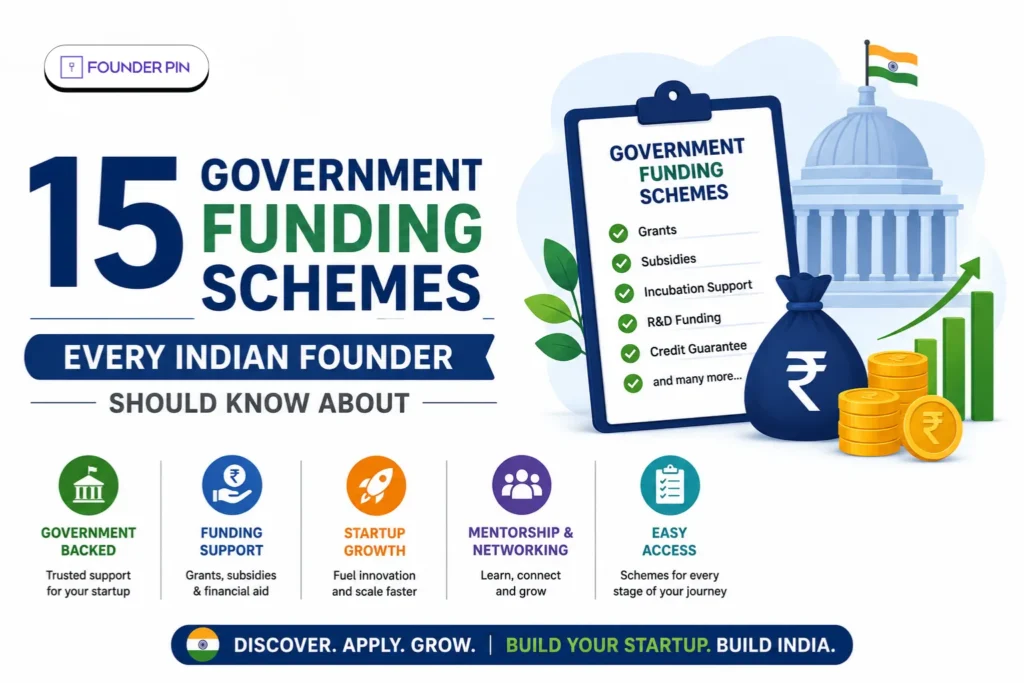
Key Takeaways
- Government funding schemes for startups provide valuable non-dilutive capital, helping founders grow without giving up equity.
- India offers numerous funding opportunities, including grants, seed funds, innovation programs, and startup support initiatives.
- Popular schemes such as the Startup India Seed Fund Scheme, BIG, NIDHI PRAYAS, and MSME Innovative Scheme support startups at different growth stages.
- Choosing the right funding scheme depends on your industry, startup stage, innovation level, and capital requirements.
- Strong business proposals, complete documentation, and clear commercialization plans can improve approval chances.
- Government-backed funding can enhance startup credibility and make it easier to attract angel investors and venture capital in the future.
- Leveraging the right government funding schemes can accelerate product development, market entry, and long-term business growth.
One of the greatest obstacles facing startup founders is still obtaining capital. Although venture capital and angel investment receive significant attention, they are not the only funding options available. In fact, many entrepreneurs overlook the benefits of government-backed funding programs.
One of the fastest-growing startup ecosystems in the world has been established in India. As a result, founders now have access to a wide range of grants, seed funds, innovation programs, and entrepreneurship initiatives. These government funding schemes help startups validate ideas, develop products, create jobs, and scale their businesses. Moreover, they provide financial support without requiring founders to give up equity in the early stages.
At FounderPin, we help startups identify funding opportunities that match their industry and growth stage. Therefore, understanding the available government schemes can be a significant advantage for entrepreneurs.
In this guide, we explore 15 government funding schemes every Indian founder should know about. Additionally, we explain how these programs can support startup growth and long-term success.
Why Government Funding Schemes Matter for Startups
Government-backed funding programs offer several advantages:
- Non-dilutive capital
- Lower financial risk
- Startup ecosystem support
- Innovation incentives
- Access to mentors and incubators
- Improved investor credibility
For early-stage startups, these schemes can provide the resources needed to build traction before approaching private investors.
Top 15 Government Funding Schemes Every Indian Founder Should Know
The Indian government offers a wide range of funding programs to support startups and entrepreneurs. These initiatives provide access to grants, venture capital support, credit guarantees, and business subsidies. Together, central and state-level schemes help founders secure funding at various stages of growth, from idea validation to large-scale expansion.
1. Startup India Seed Fund Scheme (SISFS)
SISFS supports early-stage startups with up to ₹20 lakh in grant funding for proof-of-concept development, prototype creation, and product testing. In addition, eligible startups can receive up to ₹50 lakh through debt instruments or convertible debentures for commercialization activities.
2. Biotechnology Ignition Grant (BIG)
Managed by BIRAC, the Biotechnology Ignition Grant provides funding of up to ₹50 lakh to biotech and healthcare innovators for proof-of-concept validation and early-stage product development.
3. NIDHI-PRAYAS
The NIDHI-PRAYAS program, supported by the Department of Science and Technology (DST), offers grant assistance of up to ₹10 lakh to help innovators transform ideas into functional prototypes.
4. iDEX (Innovations for Defence Excellence)
The iDEX initiative supports startups working in defence and aerospace technologies. Selected startups can receive funding of up to ₹1.5 crore for innovation, product development, and prototype validation.
5. Fund of Funds for Startups (FFS)
The Fund of Funds for Startups is backed by a ₹10,000 crore corpus managed by SIDBI. Instead of investing directly in startups, the scheme channels capital through SEBI-registered Alternative Investment Funds (AIFs), which then invest in high-growth ventures.
6. SAMRIDH Scheme
SAMRIDH supports digital and technology-driven startups by providing matching investment support of up to ₹1 crore along with acceleration, mentorship, and business development assistance.
7. RKVY-RAFTAAR
This program supports startups in agriculture, food processing, and allied sectors. Eligible businesses can access grants ranging from ₹5 lakh to ₹25 lakh for innovation and commercialization activities.
8. Credit Guarantee Scheme for Startups (CGSS)
CGSS helps DPIIT-recognized startups access collateral-free financing by offering government-backed credit guarantees. Eligible startups can obtain funding support of up to ₹20 crore.
9. Pradhan Mantri Mudra Yojana (PMMY)
PMMY provides collateral-free loans to micro and small enterprises through three categories:
Shishu: Up to ₹50,000
Kishore: ₹50,000 to ₹5 lakh
Tarun / Tarun Plus: ₹5 lakh to ₹20 lakh
10. Stand-Up India Scheme
The Stand-Up India Scheme encourages entrepreneurship among women and SC/ST founders by offering business loans ranging from ₹10 lakh to ₹1 crore.
11. Prime Minister’s Employment Generation Programme (PMEGP)
PMEGP is a credit-linked subsidy scheme that provides financial assistance through margin money subsidies ranging from 15% to 35% of the approved project cost.
12. Credit Linked Capital Subsidy Scheme (CLCSS)
CLCSS supports technology modernization among micro and small enterprises by offering capital subsidies of up to ₹15 lakh for machinery and technology upgrades.
13. Atal Innovation Mission (AIM)
Led by NITI Aayog, AIM promotes innovation through incubation centers, startup challenges, grants, and ecosystem development initiatives for entrepreneurs and innovators.
14. TIDE 2.0
The Technology Incubation and Development of Entrepreneurs (TIDE 2.0) program, supported by MeitY, offers funding of up to ₹7 lakh for idea-stage startups and up to ₹50 lakh for growth-stage technology ventures.
15. State Startup Policies and Grants
Several state governments operate startup funding programs tailored to local entrepreneurs. Examples include:
Karnataka ELEVATE Program – Grants up to ₹50 lakh
Tamil Nadu TANSEED Program – Seed funding for innovative startups
Maharashtra State Innovation Society (MSInS) – Startup grants and innovation support
These state-backed initiatives provide funding, mentorship, incubation support, and networking opportunities for startups incorporated within their respective regions.
How to Pick the Best Government Funding Program
Not every startup will benefit equally from every program. Founders should evaluate funding opportunities based on several factors.
Industry Focus
Some schemes target specific sectors such as biotechnology, agriculture, manufacturing, healthcare, or deep technology.
Startup Stage
Funding programs may support:
- Idea-stage startups
- Prototype development
- Product validation
- Market expansion
- Commercialization
Selecting schemes aligned with your current growth stage increases success rates.
Funding Requirements
Understand how much capital is required and whether grants, debt financing, or seed support are most appropriate for your business model.
Common Mistakes Founders Make When Applying for Government Funding
Many entrepreneurs miss funding opportunities due to avoidable errors.
Weak Business Proposals
Applications that fail to clearly explain innovation, market potential, and commercialization strategies are often rejected.
Incomplete Documentation
Missing registrations, financial records, or compliance documents can delay or prevent approvals.
Ignoring Eligibility Criteria
Each scheme has unique requirements. Applying without meeting eligibility conditions wastes valuable time and resources.
How Government Funding Helps Startups Attract Investors
An often-overlooked advantage of government funding schemes for startups is investor perception.
Government-backed support demonstrates:
- Innovation potential
- Credibility
- Market validation
- Reduced risk
Startups that secure grants often become more attractive to angel investors and venture capital firms because external validation strengthens confidence in the business.
The Future of Startup Funding in India
India’s startup ecosystem is evolving rapidly, with governments increasingly prioritizing entrepreneurship, technology innovation, sustainability, and job creation.
Founders who actively leverage government funding programs gain access to resources that can accelerate growth while preserving equity. As more sector-specific and state-level initiatives emerge, government support is becoming a critical component of modern startup financing strategies.
Conclusion
The availability of government funding schemes for startups has created unprecedented opportunities for Indian entrepreneurs. From seed funding and innovation grants to technology commercialization and incubation support, these programs help startups reduce financial barriers and accelerate growth.
Understanding which schemes align with your business model, industry, and stage of development can significantly improve your chances of securing funding and building a sustainable company.
Contact FounderPin for Expert Funding Support
Navigating startup grants, government schemes, and funding applications can be challenging without expert guidance. At FounderPin, we help founders identify the right opportunities, prepare strong applications, and build funding strategies that support long-term growth.
Contact us for a consultation today and discover the best government funding schemes available for your startup.
Frequently Asked Questions (FAQs)
1. What are the best government funding schemes for startups in India?
Some of the most popular government funding schemes for startups include the Startup India Seed Fund Scheme (SISFS), Biotechnology Ignition Grant (BIG), NIDHI PRAYAS, MSME Innovative Scheme, SAMRIDH, and the Fund of Funds for Startups (FFS). These programs support startups with funding, incubation, and growth opportunities.
2. Who is eligible to apply for government funding schemes for startups?
Eligibility varies by scheme, but most government funding schemes for startups are available to DPIIT-recognized startups, innovators, entrepreneurs, and early-stage businesses that demonstrate innovation, scalability, and growth potential.
3. Do government funding schemes for startups require equity sharing?
Many government grants and funding programs provide non-dilutive funding, meaning startups can receive financial support without giving up ownership or equity. However, some schemes may have specific terms and conditions depending on the funding structure.
4. How can startups apply for government funding schemes in India?
Startups can apply through official government portals, incubators, or implementing agencies. Applicants typically need to submit a business plan, startup registration details, financial information, and supporting documents that demonstrate innovation and market potential.
5. Can startups receive both government funding and private investment?
Yes, many startups combine government funding schemes with angel investment or venture capital. Government grants help validate ideas and reduce financial risk, while private investors provide additional capital and strategic support for scaling the business.
SHARE