
Government Grants vs Angel Investment: Which Is Better for Early-Stage Startups?
Table of Contents
Toggle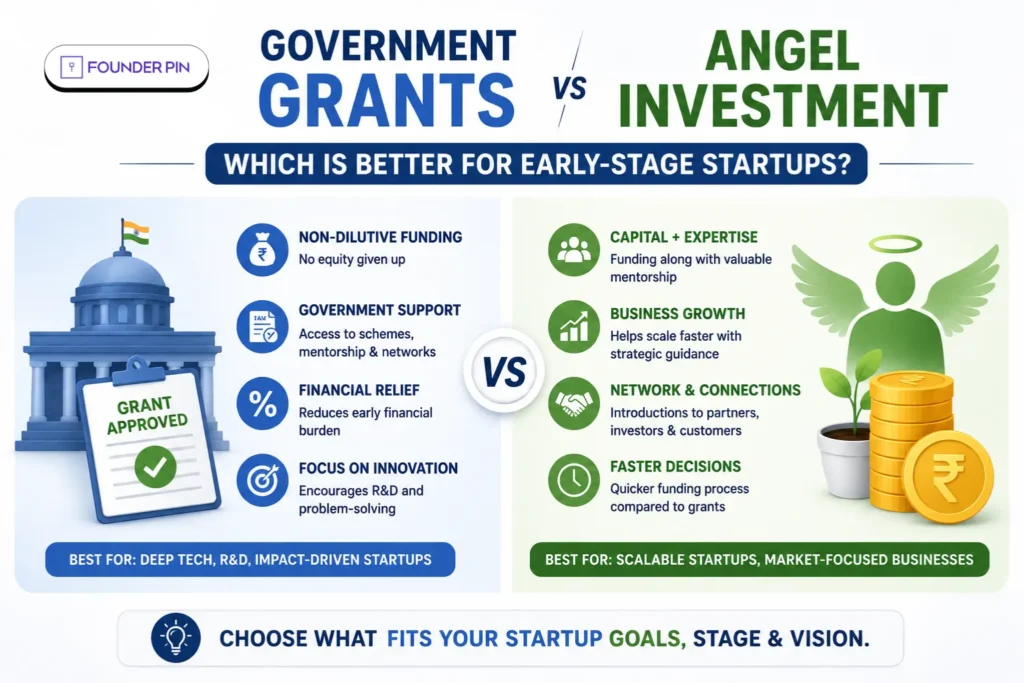
Key Takeaways
- Government Grants vs Angel Investment is a crucial funding decision for early-stage startups seeking growth capital.
- Government grants provide non-dilutive funding, allowing founders to retain full ownership while supporting innovation and product development.
- Angel investors offer capital, mentorship, industry expertise, and valuable business networks in exchange for equity.
- Grants are ideal for startups focused on research, innovation, and market validation, while angel investment is often better suited for rapid scaling.
- The right funding choice depends on your startup’s stage, funding needs, growth goals, and long-term vision.
- Many successful startups combine government grants and angel investment to maximize funding while minimizing equity dilution.
Securing funding is one of the most important decisions an early-stage startup will make. The right funding source can accelerate product development, support market expansion, and improve long-term sustainability. The wrong choice, however, can create financial pressure or limit future growth opportunities.
Among the most common funding options available to founders today are government grants and angel investment. While both can provide much-needed capital, they differ significantly in terms of ownership, expectations, scalability, and strategic value.
Understanding the differences between Government Grants vs Angel Investment is essential for making informed financial decisions and building a sustainable growth strategy. In this guide, we’ll compare government grants and angel investment, explore their advantages and limitations, and help you determine which funding option is best suited for your startup’s stage and goals.
Why Funding Strategy Matters for Early-Stage Startups
Most startups face similar challenges during their early stages:
- Product development costs
- Market validation expenses
- Hiring and talent acquisition
- Technology infrastructure investments
- Customer acquisition costs
Without adequate funding, even promising startups can struggle to gain traction. This makes selecting the right funding source a critical strategic decision rather than simply a financial one.
Entrepreneurs exploring government funding opportunities can learn more through the Startup India Official Portal, which provides information on startup schemes, grants, and funding programs available across India.
What Are Government Grants?
Government grants are financial assistance programs offered by government departments, agencies, and innovation bodies to support entrepreneurship, research, technology development, and business growth.
Grants typically don’t need to be repaid, in contrast to loans. Unlike equity funding, they do not require founders to surrender ownership.
Key Benefits of Government Grants
Government grants offer several advantages for startups:
- Non-dilutive funding
- No equity dilution
- Reduced financial risk
- Validation from government institutions
- Support for innovation and research
- Access to incubation and mentoring programs
For startups focused on research, technology, healthcare, sustainability, or deep-tech innovation, grants can be particularly valuable.
Limitations of Government Grants
Despite their advantages, grants have certain challenges:
- Competitive application processes
- Lengthy approval timelines
- Strict eligibility criteria
- Restricted use of funds
- Detailed reporting requirements
Not every startup will qualify, and obtaining grant funding often requires patience and careful preparation.
Also Read | DPIIT Recognition Benefits: Grants, Tax Exemption and Startup Schemes Explained
What Is Angel Investment?
Angel investment refers to funding provided by high-net-worth individuals who invest personal capital into startups in exchange for equity ownership.
Angel investors typically support businesses during their earliest growth stages before venture capital funding becomes accessible.
Key Benefits of Angel Investment
Angel investors offer more than just capital.
Benefits often include:
- Faster funding access
- Industry expertise
- Strategic mentorship
- Business connections
- Investor credibility
- Market expansion support
For founders seeking experienced guidance alongside funding, angel investors can become valuable partners.
Limitations of Angel Investment
Angel funding also comes with trade-offs.
Potential challenges include:
- Equity dilution
- Shared decision-making
- Investor expectations
- Growth pressure
- Potential founder-investor conflicts
Founders must carefully evaluate whether the long-term value of investor support outweighs the ownership being given up.
Government Grants vs Angel Investment: Key Differences
| Feature | Government Grants | Angel Investment |
|---|---|---|
| Equity Diluted | 0% (Non-dilutive Capital) | 10% – 25% Average |
| Speed to Fund | 3 – 9 Months | 1 – 3 Months |
| Usage Limits | Approved R&D Only | Flexible Usage |
| Repayment | Not Required* | No, But Requires Exit |
| Added Value | Credibility & Validation | Mentorship & Network |
When Government Grants Make More Sense
Government grants can be a suitable funding option in the following situations:
Innovation-Focused Startups
Businesses operating in sectors such as biotechnology, healthcare, agritech, clean technology, and artificial intelligence often qualify for government grant programs that support research and innovation.
Protecting Founder Ownership
Entrepreneurs who want to maintain a larger ownership stake in their company may prefer grants, as they provide funding without requiring equity dilution.
Early-Stage Product Validation
For startups that are still developing a prototype or validating market demand, grants can offer financial support before seeking external investors.
Also Read | Top Government Grants for Women Entrepreneurs in India
When Angel Investment May Be More Suitable
In some growth scenarios, angel capital may be a superior option:
Faster Business Expansion
Startups aiming for rapid market entry and aggressive growth may benefit from angel investment, which is often secured more quickly than government grants.
Access to Mentorship and Expertise
Many angel investors bring valuable industry knowledge, business experience, and professional networks that can help founders scale more effectively.
Higher Funding Requirements
As startups grow, they may require larger amounts of capital than grant programs typically provide. In such cases, angel investment can offer the financial resources needed to accelerate expansion.
Why the Best Startups Often Use Both
A common misconception is that founders must choose either grants or investors.
In reality, many successful startups use both strategically.
Government grants can fund research, product development, and validation activities. Once traction is established, angel investment can provide additional capital for scaling, marketing, hiring, and expansion.
This hybrid approach allows founders to maximize non-dilutive funding before raising equity-based investment.
Building a Funding Strategy for Long-Term Success
The most effective funding strategy depends on factors such as:
- Business model
- Industry sector
- Growth stage
- Capital requirements
- Founder goals
- Market opportunity
Rather than focusing solely on funding availability, founders should evaluate how each option aligns with their long-term vision.
Conclusion
The debate around Government Grants vs Angel Investment is not about identifying a universally better option. Instead, it is about understanding which funding source best supports your startup’s current stage and future objectives.
Government grants provide non-dilutive capital, lower risk, and innovation support, while angel investors offer funding, mentorship, networks, and growth acceleration. For many startups, combining both funding sources creates the strongest foundation for sustainable success.
Contact FounderPin for Expert Funding Guidance
Choosing the right startup funding strategy can significantly impact your company’s future. At FounderPin, we help entrepreneurs identify government grant opportunities, prepare funding applications, connect with investors, and build scalable growth plans.
Contact us for a consultation today and discover the best funding path for your startup’s success.
Frequently Asked Questions (FAQs)
1. What is the difference between Government Grants and Angel Investment?
The main difference between Government Grants vs Angel Investment is ownership. Government grants provide non-dilutive funding that does not require founders to give up equity, while angel investors provide capital in exchange for ownership stakes in the startup.
2. Are government grants better than angel investment for early-stage startups?
Government grants can be better for startups that want to retain full ownership and need funding for research, innovation, or product development. Angel investment may be more suitable for startups seeking larger capital amounts, mentorship, and industry connections for faster growth.
3. Do startups have to repay government grants?
In most cases, government grants do not require repayment, provided the startup complies with the grant terms and uses the funds for approved purposes. This makes grants an attractive funding option for early-stage startups.
4. Can a startup receive both government grants and angel investment?
Yes, many successful startups use a combination of government grants and angel investment. Grants can help validate a business idea and fund early development, while angel investors can provide additional capital and strategic support for scaling operations.
5. How do I choose between government grants and angel investors?
The choice depends on factors such as your startup’s growth stage, funding requirements, industry sector, and long-term goals. Founders who prioritize ownership may prefer grants, while those seeking mentorship and rapid expansion may benefit more from angel investment.
SHARE