
5 Manufacturing Businesses Under ₹5 Lakhs in India
Table of Contents
Toggle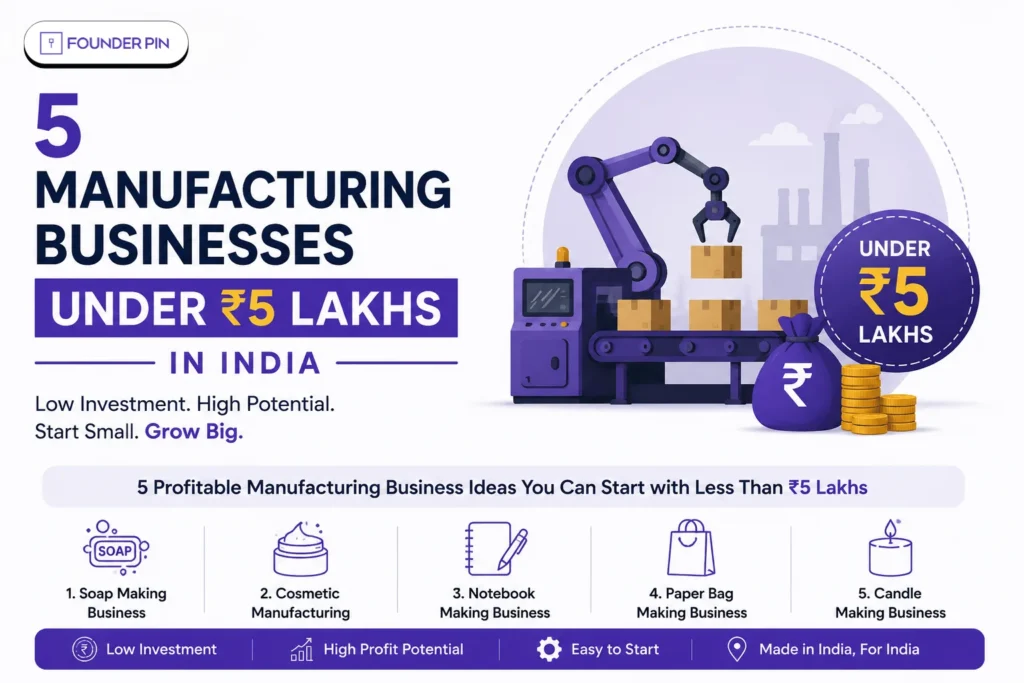
Starting a small manufacturing unit in India doesn’t necessarily mean you need a big factory or heavy machinery. Pick the right product, get a small workspace sorted, and plan the production process carefully. There are genuinely several manufacturing businesses worth exploring with ₹5 lakh or less.
Also Read | FounderPin’s guide to 20 Profitable Startup Ideas in India in 2026 with Low Investment, which covers opportunities across service, D2C, technology and other sectors.
The tricky part isn’t just finding a machine that fits your budget, though. You’ve also got to think through raw materials, electricity, labour, packaging, compliance, distribution, and working capital. This is the stuff that’s easy to overlook until it starts eating into your margins.
Below are 5 manufacturing businesses under ₹5 lakh that first-time entrepreneurs might want to look at. Each one includes rough estimates for investment, the products involved, machinery, demand, margins, and the key risks to watch for.
A quick note: the investment figures below are indicative estimates for a small-scale setup. Actual costs will shift depending on machine capacity, location, rent, automation level, raw-material prices, and product quality. Treat these as a starting point, not guaranteed project costs or profits.
Key Details at a Glance
| Manufacturing Business | Estimated Setup Budget | Space Needed* | Main Products | Demand | Difficulty |
|---|---|---|---|---|---|
| Paper Plates & Cups | ₹2–₹5 lakh | 500–1,000 sq. ft. | Plates, bowls, cups | High | Low–Medium |
| Incense Sticks | ₹1.5–₹4 lakh | 500–1,000 sq. ft. | Agarbatti, dhoop | High | Low |
| Detergent & Cleaning Products | ₹2–₹5 lakh | 500–1,000 sq. ft. | Detergent, cleaners | High | Medium |
| Spice Processing & Packaging | ₹2–₹5 lakh | 500–1,000 sq. ft. | Powdered spices, blends | High | Medium |
| Candle Manufacturing | ₹1.5–₹4 lakh | 300–800 sq. ft. | Decorative & utility candles | Medium–High | Low–Medium |
*Indicative space requirements, not statutory requirements.
1. Paper Plate Manufacturing: Is It a Good Business Under ₹5 Lakhs?
Short answer: yes, this works at small scale. The real question is how you split up that ₹5 lakh, because machinery alone can swing wildly — anywhere from tens of thousands of rupees to several lakhs, depending on what you buy. So budgeting here takes some actual thought, not just picking whatever machine looks affordable first.
Key Details
- Estimated investment: Up to ₹5 lakh for a small setup
- Products: Paper plates, bowls, similar disposables
- Machinery: A hydraulic or semi-automatic plate-making machine, dies, and whatever supporting equipment you need
- Raw materials: Paper sheets or rolls, plus packaging
- Customers: Caterers, restaurants, food stalls, wholesalers, event suppliers
- Demand: Solid, especially in food-service and catering
- Main risk: Competition, paper prices going up and down, orders that don’t come in consistently
How to Start a Paper Plate Manufacturing Business
Roughly, this is how it plays out:
- Research your local market — go talk to caterers, restaurants, wholesalers, event suppliers. Find out what sizes and types they’re actually buying
- Choose your production scale — don’t jump to a high-capacity machine before you know demand is real
- Select a suitable workspace — something affordable, with electricity, storage, and easy delivery access for raw materials
- Purchase machinery — check at least three suppliers, compare capacity, warranty, installation, and after-sales support
- Buy raw materials — start small, test a few paper grades, don’t commit to bulk right away
- Set up production — train your operators, build in quality checks for size, strength, finish
- Build a wholesale network — go directly to caterers, restaurants, retailers, distributors
- Track your unit economics — work out material, electricity, labour, packaging, transport, per packet
Here’s the mistake almost everyone makes: producing more than they can sell. Get confirmed customers first. Scale up only once demand’s actually there.
2. Can Incense Stick Manufacturing Be Started Under ₹5 Lakhs?
Agarbatti-making is genuinely one of the easier small-scale manufacturing options to get into in India. There’s even an official operational-guidelines page from the MSME Development Commissioner covering agarbatti projects specifically — worth a look before you start.
Key Details
- Estimated investment: ₹1.5–₹4 lakh for a small setup
- Products: Agarbatti, incense sticks, dhoop
- Machinery: Mixing machine, agarbatti-making machine, drying equipment
- Raw materials: Bamboo sticks, charcoal or wood powders, binders, fragrance materials
- Customers: Retailers, wholesalers, temples, religious stores, distributors
- Demand: Solid, both domestically and for export
- Main risk: Getting fragrance right, competition, and distribution
How to Start an Agarbatti Manufacturing Business
The basic production flow goes something like this: mixing, forming the sticks, drying, adding fragrance, checking quality, then packaging.
Here’s how to actually get started:
- Pick your product — regular agarbatti, premium fragrances, dhoop, or some mix of these
- Look into your customers — visit local pooja stores, wholesalers, retailers, and get a sense of price points and which fragrances actually sell
- Register the business — sort out the necessary business and MSME registrations, and check whatever local requirements apply
- Find reliable raw-material suppliers — bamboo sticks, powders, binders, fragrance oils, all sourced from people you trust
- Test your formulation first — make small batches, check burning time, fragrance strength, and how consistent it is
- Buy your machinery — manual, semi-automatic, or automatic, depending on how much demand you’re actually expecting
- Set up drying and production properly — good ventilation matters here, plus safe storage and handling
- Work on packaging — build something people recognize, rather than just competing on who’s cheapest
- Sell through distributors — retailers, wholesalers, institutional buyers, whoever fits
The government’s own MSME agarbatti documentation backs this up too, pointing to fragrance, packaging, product variety, and quality as the things that actually matter most here.
3. Is Detergent Manufacturing a Good Small Manufacturing Business?
Detergent and cleaning products can target a large everyday-use market, but formulation quality and compliance matter. A small entrepreneur can begin with a focused product range instead of trying to manufacture every type of cleaner from day one.
Key Details
- Estimated investment: ₹2–₹5 lakh
- Products: Detergent powder, liquid detergent, dishwash and floor cleaners
- Machinery: Mixer/blender, weighing equipment, filling and packaging equipment
- Raw materials: Surfactants, builders, fragrances and other formulation ingredients
- Customers: Retailers, offices, hotels, restaurants and households
- Demand: High because cleaning products have recurring use
- Main risk: Competition and maintaining consistent product quality
How to Start a Detergent Manufacturing Business
- Choose one or two products: Start with a focused range such as detergent powder and liquid cleaner.
- Study competitors: Compare local brands on price, pack sizes, fragrance and performance.
- Develop the formulation: Work with a qualified formulation expert where necessary rather than experimenting blindly.
- Check applicable regulations: Identify product-specific legal, labelling, environmental and local requirements.
- Set up the workspace: Arrange adequate ventilation, storage, electricity and safety measures.
- Purchase mixing and filling equipment: Choose capacity according to your expected sales.
- Run trial batches: Test cleaning performance, consistency, fragrance and shelf stability.
- Design compliant packaging: Clearly communicate ingredients and other required information.
- Start with B2B sales: Approach local hotels, restaurants, offices and cleaning-service companies.
- Expand into retail: Once the product gains acceptance, approach shops and distributors.
Don’t compete with national brands on advertising budget. A small manufacturer can instead focus on local distribution, institutional customers and specialised formulations.
4. Can Spice Manufacturing Start With ₹5 Lakhs?
Spices sell year-round — every household needs them, every restaurant runs through them. That’s the appeal here. What trips people up is the regulatory side, because food manufacturing carries responsibilities most other small-scale businesses don’t have to think about.
FSSAI’s rules are clear on this: food businesses in India need the appropriate registration or licence, and which one depends on your specific setup and eligibility.
Key Details
- Estimated investment: ₹2–₹5 lakh
- Products: Chilli, turmeric, coriander, cumin, blended masalas
- Machinery: Grinder or pulveriser, mixer, sieve, packaging machine
- Raw materials: Whole spices
- Customers: Retailers, restaurants, wholesalers, direct consumers
- Demand: High, and it keeps coming back
- Main risk: Food safety, quality control, and a market that’s already crowded with established players
How to Start a Spice Manufacturing Business
- Pick a narrow niche to start — two or three products, not fifteen different spices at once. Trying to do everything from day one usually just spreads you too thin.
- Before you commit to anything, look at what’s actually selling in your target market. Which brands dominate, which varieties people reach for most.
- Registration comes next. Figure out which FSSAI category applies to your business before you start producing anything.
- Sourcing matters more than people expect — work with suppliers you trust, and actually check moisture levels, cleanliness, and consistency batch to batch.
- On the equipment side, get a grinder, mixer, sieve, and packaging setup that fits your actual scale, not what looks impressive.
- Once you’re producing, lock in standard recipes so taste, colour, and aroma stay consistent every single time — that consistency is what builds trust with repeat buyers.
- Quality controls need to be real, not just for show. Hygienic production, proper testing, documentation — this all matters, especially in food.
- Labelling has to be compliant too, covering whatever information the food-labelling rules require.
- For your first sales, stay local — supermarkets, grocery stores, restaurants, wholesalers. That’s where traction usually starts.
- Once you’ve got some momentum, work on building an actual brand — regional blends, premium ingredients, or specialty masalas can help you stand out from the bigger players.
One thing worth remembering here: because this is food, quality and compliance need to come before branding, not after. No amount of nice packaging saves a product that isn’t actually good.
5. Is Candle Manufacturing a Good Business Under ₹5 Lakhs?
Candles are a pretty forgiving business to start — the equipment barrier’s low, and you can run it small. Where it actually gets interesting is when you steer away from plain commodity candles and lean into decorative, scented, or gifting products instead. That’s where the real margin sits.
Key Details
- Estimated investment: ₹1.5–₹4 lakh
- Products: Scented, decorative, utility, and gift candles
- Machinery: Wax melting equipment, moulds, weighing tools, packaging equipment
- Raw materials: Wax, wicks, fragrances, dyes, packaging
- Customers: Gift stores, décor retailers, event planners, online buyers
- Demand: Medium to high, depending on which segment you’re in
- Main risk: Seasonal swings in demand, plus stiff competition online
How to Start a Candle Manufacturing Business
- Pick your segment first — utility candles, scented, decorative, or premium gifting all pull in different directions
- Look at what competitors are doing — pricing, packaging, fragrances, designs, both on marketplaces and in local stores
- Test small before you commit to anything big — make a few batches before buying large quantities of wax or packaging
- Choose your raw materials carefully — paraffin, soy, beeswax, whatever fits your target customer best
- Get the basics sorted — melting equipment, moulds, weighing scales, packaging tools
- Spend real time on fragrance — test different combinations and see how they actually burn
- Set your own quality bar — appearance, scent throw, how the wick performs, overall burn behaviour
- Don’t skimp on packaging — it matters a lot for gifting and D2C sales especially
- Sell wherever your customers are — Instagram, marketplaces, gift shops, boutiques, corporate gifting
- Look for custom orders too — weddings, birthdays, hotels, corporate events can turn into solid bulk business
The smart move here is differentiation. Nobody needs another ordinary candle. Build something people actually remember — through fragrance, design, gifting angle, or customisation.
Which ₹5 Lakh Manufacturing Business Should You Choose?
The best choice depends on your market access, manufacturing skills and ability to sell consistently.
| Business | Best suited for |
|---|---|
| Paper plates | Entrepreneurs with strong B2B/local distribution |
| Agarbatti | Beginners looking for a relatively simple production model |
| Detergents | Entrepreneurs interested in recurring-use products |
| Spices | Founders interested in food and brand building |
| Candles | D2C, gifting and creative-product businesses |
The common thread is simple: validate demand before investing heavily in machinery.
A ₹5 lakh budget should not disappear into equipment. Keep enough money for raw materials, packaging, marketing, compliance and working capital. That’s what gives a small manufacturing business room to survive long enough to grow.
What Should You Check Before Starting a Manufacturing Business?
Here’s a mindset shift worth making early: the machine should be one of the last things you buy, not the first thing you go shopping for.
Before you put that ₹5 lakh anywhere, work through these questions first:
- Local demand — Who’s actually going to buy this?
- Raw-material availability — Can you actually source it, consistently, month after month?
- Machine capacity — Can you realistically sell everything it produces?
- Power requirements — What’s electricity actually going to cost you?
- Labour — Can you find people, and more importantly, keep them?
- Packaging — Does this product need something specialised?
- Compliance — Any licences, registrations, or testing required before you can even sell? Compliance can become more complicated as your business grows, so it is worth understanding the legal paperwork early. FounderPin’s guide to 20 Legal Documents for Startups in India covers agreements, registrations and other documents founders may encounter while building a business.
- Distribution — How’s the product going to reach customers, practically speaking?
- Working capital — Can you actually survive the first few rough months?
- Break-even — How many units do you need to move each month just to cover costs?
Worth checking too: the official Udyam portal has a searchable database of registered MSME units by product or activity. It’s a decent way to see how businesses are already running in different manufacturing categories before you commit to one yourself.
What Government Support Can Help Small Manufacturers?
A ₹5 lakh manufacturing business may qualify for MSME-related support and financing schemes, depending on eligibility.
India’s official Udyam Registration portal says registration is free, paperless and based on self-declaration. It also states that a micro enterprise can currently have investment in plant and machinery or equipment of up to ₹2.5 crore and turnover of up to ₹10 crore.
That means a business with ₹5 lakh of investment comfortably falls within the current investment ceiling for the micro-enterprise category, assuming it meets the other classification criteria.
If your manufacturing venture is structured as an eligible innovation-led startup, it may also be worth understanding DPIIT Startup Recognition and Its Benefits before deciding which government support routes are relevant to you.
PMEGP is another option to investigate
The government’s Prime Minister’s Employment Generation Programme (PMEGP) supports eligible new micro-enterprises.
The current PMEGP guidelines allow margin-money subsidy consideration for manufacturing projects with a maximum project cost of ₹50 lakh. The entrepreneur’s own contribution and the remaining project financing depend on the applicable category and scheme conditions.
This does not mean every ₹5 lakh project automatically receives a subsidy. Eligibility, application approval and scheme conditions still apply.
How should you divide a ₹5 lakh manufacturing budget?
FounderPin Point of View
Do not spend the entire ₹5 lakh on machinery. Working capital can matter more than the machine itself during the first few months.
A simple planning structure could look like this:
| Expense | Suggested allocation |
|---|---|
| Machinery & equipment | ₹2.0–₹2.75 lakh |
| Initial raw materials | ₹75,000–₹1 lakh |
| Packaging | ₹25,000–₹40,000 |
| Rent/deposit & setup | ₹40,000–₹60,000 |
| Registrations/testing/misc. | ₹15,000–₹25,000 |
| Marketing & working-capital reserve | ₹50,000–₹75,000 |
These are planning ranges, not official project costs. Your actual requirement depends on location, machinery capacity, product and supplier quotations.
Common Mistakes to Avoid When Starting a Manufacturing Business Under 5 lakhs
A ₹5 lakh manufacturing business can fail because of poor planning, not necessarily because the product is bad. The biggest mistakes usually involve buying too much machinery, underestimating working capital and starting production without confirmed demand.
Avoid these common mistakes before investing:
1. Spending the Entire Budget on Machinery
Don’t put ₹4–₹5 lakh into equipment and leave nothing for operations. You still need money for raw materials, rent, electricity, packaging, labour and marketing.
Better approach: Keep a portion of your budget as working capital and start with machinery that matches your initial sales capacity.
2. Choosing a Product Without Checking Demand
A product may look profitable on paper but fail to sell in your local market.
Better approach: Speak with retailers, wholesalers, distributors and potential customers before setting up production. Try to secure initial buyers or orders where possible.
3. Ignoring Raw-Material Costs
Raw materials can directly affect your margins, particularly in businesses such as paper products, spices and detergents.
Better approach: Get quotations from multiple suppliers and calculate your cost per unit before deciding your selling price.
4. Buying a Machine Based Only on Its Price
The cheapest machine isn’t always the best machine. Poor after-sales service, low output or frequent breakdowns can quickly become expensive.
Better approach: Compare production capacity, warranty, electricity consumption, spare-parts availability, installation and supplier support.
5. Underestimating Compliance
Manufacturing businesses may require registrations, licences, product-specific approvals, safety measures or local permissions. Food businesses, for example, need to comply with applicable FSSAI requirements.
Better approach: Identify all applicable compliance requirements before purchasing equipment or starting production.
6. Producing Too Much Too Early
More production does not automatically mean more profit. Unsold inventory ties up your working capital.
Better approach: Start with smaller batches, measure actual demand and increase production as repeat orders grow.
7. Competing Only on Price
Trying to become the cheapest manufacturer can destroy your margins. Larger competitors may already have better economies of scale.
Better approach: Compete through quality, packaging, reliability, faster delivery, customised products or a specific customer segment.
8. Forgetting Packaging and Branding
Even a good product can struggle if customers don’t trust how it looks or if the packaging doesn’t protect it properly.
Better approach: Treat packaging as part of the product, especially for spices, candles, detergents and consumer-facing products.
9. Ignoring Distribution
Manufacturing is only half the business. You need a reliable way to move products from your factory to customers.
Better approach: Build relationships with distributors, retailers, institutional buyers or online channels before scaling production.
10. Expecting Immediate Profits
A new manufacturing unit may take time to reach consistent production, customer acquisition and break-even.
Better approach: Prepare a realistic cash-flow plan for at least the initial operating period and calculate your break-even point before launching.
Final Verdict
Starting a manufacturing business under ₹5 lakh is genuinely doable in India — but here’s the catch most people miss: your budget can’t just be about the machine.
Think of your real startup cost as everything combined: equipment, raw materials, workspace, compliance, packaging, marketing, and enough working capital to actually survive the early months.
Get those costs under control, build a customer base you can count on, and a small manufacturing setup can grow into something genuinely bigger over time. That’s a far healthier path than dropping everything on the biggest machine you can afford, only to figure out later who’s actually going to buy what it churns out.
Planning to start your manufacturing business in India? Contact FounderPin today for a consultation and turn your idea into a practical business plan.
SHARE