Top AI Tools for Shopify in 2026: Features, Pricing & Comparison
Table of Contents
Toggle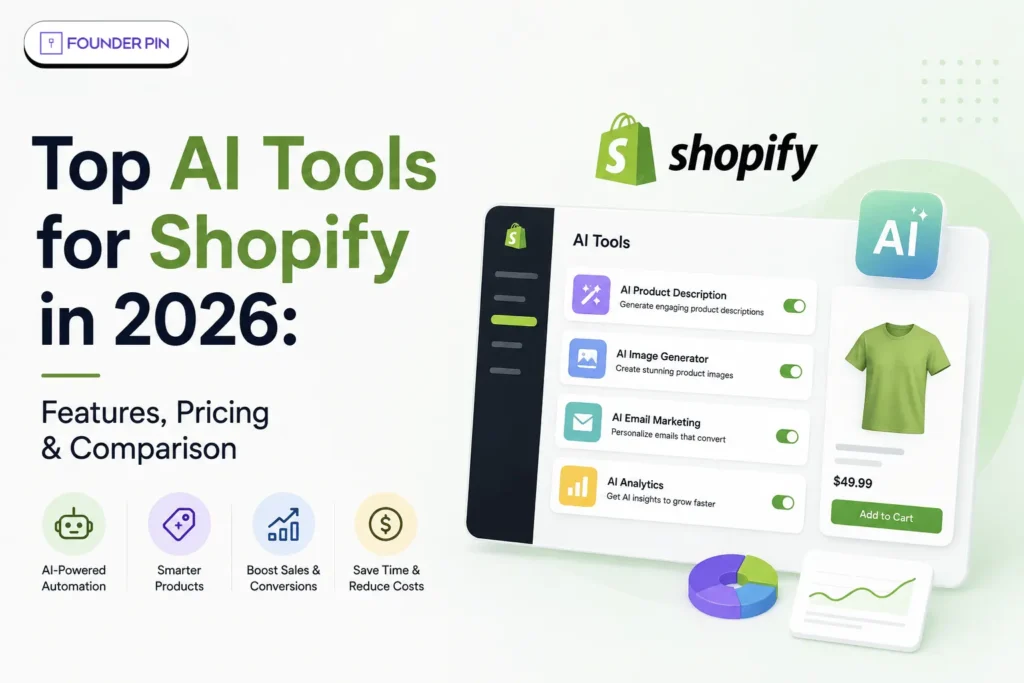
By 2026, AI isn’t some add-on for Shopify stores anymore — it’s just part of how things run day to day. Writing product descriptions, generating images, answering customer questions, analyzing store data — AI’s involved in all of it now. And the real opportunity here isn’t replacing your ecommerce team. It’s freeing them up from repetitive work so they can actually focus on growing the business.
The best AI tools for Shopify today cover pretty much every stage of the customer journey. Shopify itself baked AI right into the platform with Sidekick, while specialist tools like Klaviyo and Gorgias handle marketing and customer support respectively.
But here’s the catch — piling on more AI apps doesn’t automatically make your store better. What actually works comes down to your catalog size, your marketing strategy, how much support volume you’re dealing with, and what your budget allows.
What are AI tools for Shopify?
AI tools for Shopify are software products that use artificial intelligence to automate or improve ecommerce tasks such as content creation, marketing, customer support, analytics and store management.
Some work directly inside Shopify, while others connect to your store and use Shopify data to power their features.
Typical applications include:
- Product-description generation
- AI image creation and editing
- Customer-service automation
- Email and SMS personalisation
- Product recommendations
- SEO content
- Store analytics
- Inventory and operational assistance
- Marketing automation
- AI-powered sales conversations
The important distinction is integration.
A generic AI chatbot may write a product description, but a Shopify-connected AI tool can potentially work with your actual products, customers, orders or store settings.
What are the best AI tools for Shopify in 2026?
The best tool depends on what you want AI to do inside your ecommerce business. There is no single winner across content, marketing, customer service and store management.
Here is a practical comparison:
| AI Tool | Best For | Key AI Features | Pricing Approach |
|---|---|---|---|
| Shopify Sidekick | Store Management | Analysis, content, workflows, store tasks | Included with Shopify |
| Shopify Magic | Content Creation | Product copy, email and marketing content | Included with Shopify features |
| Klaviyo AI | Marketing | Personalisation, campaigns, customer insights | Plan / usage based |
| Gorgias AI Agent | Customer Support | Automated support and ecommerce actions | Subscription + AI usage |
| Jasper | Brand Content | AI marketing workflows and brand controls | Subscription / credits |
| Shopify Inbox | Store Chat | AI-assisted selling and customer conversations | Free Shopify app |
| Tidio | AI Customer Service | AI chatbot and support automation | Plan / usage based |
| Yotpo | Reviews & Retention | AI-powered ecommerce marketing features | Plan-dependent |
| Replo | Store Design | AI-assisted page creation and optimisation | Subscription / plan based |
| ChatGPT | Custom Workflows | Copy, analysis, strategy and automation | Free / paid plans |
1. Shopify Sidekick — Best AI Tool for Shopify Store Management
Shopify Sidekick is a useful starting point for Shopify merchants. Unlike a separate AI assistant, it works within the Shopify environment.
For merchants interested in the wider AI ecosystem beyond ecommerce, our guide to the Top 10 Indian AI Companies in 2026 provides useful context on how India’s AI landscape is developing.
Shopify describes Sidekick as an AI commerce assistant that helps merchants start, run, and grow their businesses.
For example, it can help with:
- Product descriptions
- Store design changes
- Marketing content
- Discount creation
- Collections
- Shipping audits
- Performance summaries
- Pricing analysis
- Store workflows
In addition, Sidekick can work with Shopify data and perform tasks inside the Shopify admin. Its actions depend on the user’s permissions.
Shopify says Sidekick is included with Shopify plans. However, available features and usage limits may vary by plan.
Another useful feature is its ability to provide information based on your store data. This can make everyday store management faster and easier.
Best for: Almost every Shopify merchant, especially small teams.
Price: Included with your Shopify subscription.
Shopify confirms that Sidekick itself does not cost an additional fee. Features and usage limits vary depending on the Shopify plan.
So, if you’re already paying for Shopify, there is no separate Sidekick subscription.
Shopify Sidekick pricing and features
2. Shopify Magic — Best for AI Content Creation
Shopify Magic is all about speeding up content creation right inside the Shopify ecosystem — no need to jump to a separate writing tool.
Merchants can use it to whip up product descriptions, marketing copy, and other ecommerce content on the fly. That’s a real time-saver when you’re staring down a catalog with dozens, or even hundreds, of products.
Instead of starting every single description from a blank page, you just feed it your product info and let it generate a draft to work from.
One thing worth flagging: accuracy still matters here. Shopify itself recommends reviewing anything AI-generated, since it can sometimes introduce claims that weren’t actually in your original product info.
Best for: Product descriptions, marketing copy, and everyday ecommerce content.
Price: Included with Shopify.
Right now, Shopify says its Magic AI features come at no extra cost — no separate AI subscription needed. That makes it one of the more budget-friendly picks out there for product descriptions and everyday content.
3. Klaviyo — Best for AI-Powered Ecommerce Marketing
Klaviyo earns its spot here for one reason: it’s genuinely good at turning raw customer and order data into marketing that doesn’t feel like spam.
The Shopify integration handles the syncing part — customer profiles, order history, all of it — and onsite tracking catches behavioral signals too, like when someone views a product or adds it to cart without checking out. From there, that data can power quite a bit:
- Email campaigns
- SMS marketing
- Customer segmentation
- Personalised messaging
- Product recommendations
- Automated customer journeys
On pricing, there’s no flat number to quote. Klaviyo bills based on what you actually use — profiles, email volume, mobile messaging, and a few other variables — so costs move depending on your setup.
Best for: Shopify brands focused on retention, email, and lifecycle marketing.
Price: Free plan available; paid pricing depends on contacts, messaging, and selected products.
There’s a free tier to start with, and it’s not bare-bones either — email marketing, text messaging, Customer Hub, and reporting are all included. Once you outgrow that, pricing climbs in step with your scale and feature needs.
4. Gorgias — Best for AI Customer Support
Gorgias is designed for ecommerce customer service, with AI handling repetitive questions and helping support teams work faster.
For Shopify stores, this can be useful when customers repeatedly ask about:
- Order status
- Returns
- Shipping
- Product availability
- Discounts
- Common policies
Gorgias uses a usage-based model for its helpdesk, while its AI Agent adds an outcome-based fee for AI-automated interactions.
That pricing model is worth watching carefully.
A low monthly subscription can look attractive until a growing store starts generating significant support volume.
Best for: Growing Shopify stores with substantial customer-support workloads.
Price: Subscription + AI Agent usage.
Gorgias uses a ticket/conversation-based pricing structure, while its AI Agent is charged based on resolved interactions. Gorgias says most plans currently price AI Agent at about $0.90 per resolved interaction, with some starter plans beginning at $1 per interaction.
This means a store with heavy customer-support volume should calculate expected AI interactions before choosing a plan.
5. Jasper — Best for Brand-Controlled Marketing Content
Jasper is particularly relevant to Shopify brands that need consistent marketing content across multiple channels.
Instead of treating AI as a simple copy generator, Jasper focuses on brand knowledge, workflows and marketing operations.
That can help larger teams maintain consistency across:
- Product marketing
- Advertising
- Campaigns
- Landing pages
- Social content
- Ecommerce messaging
Jasper’s current pricing model combines a platform fee with consumption-based credits for certain advanced features, while core features such as Chat, Agents, Studio and IQ are included within business plans.
Best for: Mid-market and enterprise ecommerce marketing teams.
Price: $69/month when billed monthly or $59/month when billed annually for Pro.
Jasper’s current pricing page lists two main options: Pro and Business. Pro costs $69/month monthly or $59/month when billed annually. Business uses custom pricing.
Jasper makes more sense for brands that need sophisticated marketing workflows and brand controls rather than simply generating a few product descriptions.
6. Shopify Inbox — Best for Store Conversations
Shopify Inbox is a solid, no-fuss pick for merchants who want customer conversations built right into the Shopify ecosystem, rather than bolted on from somewhere else.
It lets you chat with shoppers while they’re actually browsing your store. And that matters more than it sounds — ecommerce chat isn’t just glorified customer service. It can genuinely shape whether someone buys.
Think about it: a shopper asking “Does this fit a 16-inch laptop?” is a lot closer to hitting checkout than someone just scrolling through a product page.
Best for: Small Shopify stores that want simple customer conversations without a complicated support stack.
Price: Free.
Shopify Inbox comes as a free app for managing store conversations and talking with shoppers directly. For a smaller business, that makes it a natural starting point — something to use before you’re ready to invest in a heavier, more advanced support platform.
7. Tidio — Best for AI Chatbots
Tidio combines live chat, automation and AI-powered customer service to help online stores handle customer conversations.
Its AI capabilities can help answer common questions and reduce repetitive support work.
For Shopify merchants, this can be particularly useful when the store receives customer questions outside normal working hours.
The bigger advantage is not merely answering questions.
A well-designed AI support system can help customers find products, understand policies and move closer to checkout.
Best for: Small and growing stores looking for AI-powered chat support.
Price: Free plan available, with paid plans and AI usage charges depending on requirements.
Tidio currently lists a $0/month option. Its pricing page also says the first 50 Lyro AI Agent conversations are free for life, after which merchants can purchase higher conversation limits.
This makes Tidio particularly interesting for smaller stores testing AI customer support.
8. Yotpo — Best for Reviews and Customer Retention
Yotpo has built its name around reviews, loyalty, and customer engagement — which makes it a natural fit for Shopify brands leaning on social proof and repeat business.
AI slots into these workflows nicely too, helping merchants make sense of customer feedback and personalize how they communicate with shoppers.
For premium and D2C brands especially, reviews carry real weight. They offer something your own product copy just can’t fully deliver — actual, real-world validation from people who’ve bought the thing.
Best for: D2C brands focused on reviews, loyalty, and repeat purchases.
Price: Free starter options, with paid plans starting around $89/month for certain products or plans.
Right now, Yotpo’s pricing page lists $89/month for up to 500 orders — though other plans and products come with their own pricing structures.
One thing worth knowing: Yotpo runs multiple products, so it’s worth checking pricing for whatever specific tool you actually need rather than assuming $89 is the universal price tag.
9. Replo — Best for AI-Assisted Store Design
Replo is built for Shopify teams who want real control over their landing pages and store experiences — without building every single page from scratch.
Its AI-assisted design workflows help marketers move faster when putting together things like:
- Campaign landing pages
- Product pages
- Collection pages
- Promotional experiences
- Conversion-focused layouts
That speed matters most during product launches, when waiting days on development resources can seriously slow down a marketing push.
Best for: Shopify brands running frequent campaigns and landing-page experiments.
Price: $99/month for the listed plan; Pro runs $499/month.
Right now, Replo’s pricing page shows a $99/month plan and a $499/month Pro tier — and going annual can bring the effective cost down further.
The $99 plan covers the essentials: AI-built pages, Shopify theme-editor access, and a set allowance for A/B testing. Pro raises those limits, built for larger teams and stores running at bigger scale.
10. ChatGPT — Best for Custom Shopify AI Workflows
ChatGPT stands out for one big reason: flexibility. It can be shaped to fit almost any ecommerce workflow you throw at it.
For founders thinking beyond individual AI tools and exploring how AI is changing the economics of entrepreneurship, FounderPin’s analysis of the rise of the one-person billion-dollar company offers a useful perspective.
Here’s where it genuinely helps:
- Product descriptions
- SEO briefs
- Customer-support scripts
- Competitor research
- Email campaigns
- Ad copy
- Product-page analysis
- Pricing ideas
- Content calendars
- Data interpretation
The catch is integration. ChatGPT doesn’t automatically plug into your Shopify store — it’s a general AI assistant, not a dedicated app. To connect it safely to your business data, you’ll need the right integrations, apps, connectors, or workflows in place first.
Best for: Founders, agencies, and advanced ecommerce teams that want customised AI workflows.
Price: Free plan available; ChatGPT Plus costs $20/month.
OpenAI currently offers Free, Go, Plus, and Pro tiers. Plus runs $20/month, and the higher tiers unlock more usage and added capabilities.
For Shopify merchants specifically, ChatGPT really shines when you want a flexible assistant for product copy, SEO, customer-service scripts, analysis, and custom workflows — rather than something built just for Shopify out of the box.
Note: Pricing and feature availability can vary by plan, region and usage. Always verify the current price before purchasing.
How Much Can AI Tools Actually Improve Shopify Store Performance?
AI tools for Shopify can lift average order value by 10–20% when implemented correctly, based on real-world implementation data across hundreds of Shopify projects. That’s a meaningful, measurable number — not just a marketing claim.
A few more grounded numbers worth knowing:
- Well-configured AI tools typically return their cost within 60–90 days of proper setup
- Data-driven features like recommendations and predictive analytics need 30–60 days of store history before results stabilise
- About 30% of Shopify store owners say they are always overburdened with support, content, and marketing responsibilities—exactly the gap these solutions are designed to fill.
Which AI tools should Shopify stores use together?
Most Shopify businesses do not need ten AI tools. A small, well-connected stack is usually more practical.
A sensible setup could look like:
Small Shopify store
- Shopify Sidekick
- Shopify Magic
- Shopify Inbox
Growing D2C brand
- Shopify Sidekick
- Klaviyo
- Gorgias
- Replo
Enterprise ecommerce brand
- Shopify Plus ecosystem
- Klaviyo
- Gorgias
- Jasper
- Custom AI workflows
The goal is not to collect AI apps like Pokémon.
The goal is to eliminate repetitive work while keeping the customer experience consistent.
How can Shopify merchants choose the best AI tools?
Start with the actual problem in your business, not the feature list on some AI tool’s landing page.
A few questions worth asking yourself:
- What’s eating up the most employee time?
- Where are customers dropping off?
- Which process generates the most repetitive, grinding work?
- Which tool actually connects cleanly to Shopify?
- Will this save more money — or make more — than it costs?
If you’re still evaluating the broader business opportunity around ecommerce and technology, you can also explore FounderPin’s guide to 20 Profitable Startup Ideas for India in 2026.
Take a store buried in support tickets, for example. That business probably needs an AI support tool way before it needs an AI copywriter. Meanwhile, a store sitting on 10,000 SKUs is likely facing the exact opposite problem.
The bottom line: let your actual operational pain drive what you pick, not whatever’s trending.
FounderPin Perspective
The Shopify AI race is becoming less about individual features and more about how well different AI systems fit into the entire ecommerce operating model.
A merchant does not wake up thinking, “I need an AI tool.”
They wake up thinking:
“Why are we spending six hours answering the same customer questions?”
Or:
“Why does uploading 500 products take our team two weeks?”
Or:
“Why are we paying people to manually create variations of the same email campaign?”
Those are the problems AI should solve.
Shopify’s decision to put Sidekick directly inside the merchant admin is especially important because it shows where ecommerce software is heading: AI is becoming part of the operating system rather than another browser tab.
For founders, that creates a useful rule.
Don’t buy AI because it sounds futuristic. Buy it because it removes a bottleneck.
Final Takeaway
The best AI tools for Shopify in 2026 aren’t necessarily the ones with the longest feature list. They’re the ones that actually fit into how you already work.
For most merchants, Shopify Sidekick and Shopify Magic are a natural starting point — they’re already built into Shopify, so there’s nothing extra to set up. From there, marketing-heavy brands might add Klaviyo, support-heavy stores could look at Gorgias, and larger marketing teams may get real value out of Jasper.
There’s no single “right” stack here — it really depends on your store size and business model.
The smarter move is to start small: pick one painful process, automate it, see what actually changes, and expand from there.
Because at the end of the day, the best AI tool in ecommerce isn’t the one that wows everyone in a demo. It’s the one that quietly gives your team its time back.
Scaling your Shopify store and not sure which AI tools are actually worth the investment? Contact FounderPin today for a consultation, and let’s map out the right path for your startup.
Frequently Asked Questions
What are the best AI tools for Shopify in 2026?
Shopify Sidekick is the strongest all-round starting point. Klaviyo is useful for AI-powered marketing, Gorgias for customer support, Jasper for brand content and Replo for ecommerce design workflows.
Is Shopify Sidekick free?
Sidekick is included with Shopify plans, although available features and usage limits vary by plan.
What is the best AI tool for Shopify product descriptions?
Shopify Magic and Sidekick are convenient choices because they work within Shopify. Dedicated AI writing tools can provide more advanced workflows for large catalogs.
Can AI tools automate Shopify customer support?
Yes. Tools such as Gorgias and Tidio can automate common customer-service interactions. The exact capabilities depend on the app, configuration and plan.
Will AI tools replace Shopify employees?
They are more likely to automate repetitive tasks than eliminate the need for an entire ecommerce team. Human oversight remains important for customer experience, brand decisions, product accuracy and sensitive business operations.
SHARE