Starting a startup is exciting. But the uncomfortable truth is that many startups don’t fail because the founder had a bad idea. They fail because seemingly small mistakes compound until the business runs out of options.
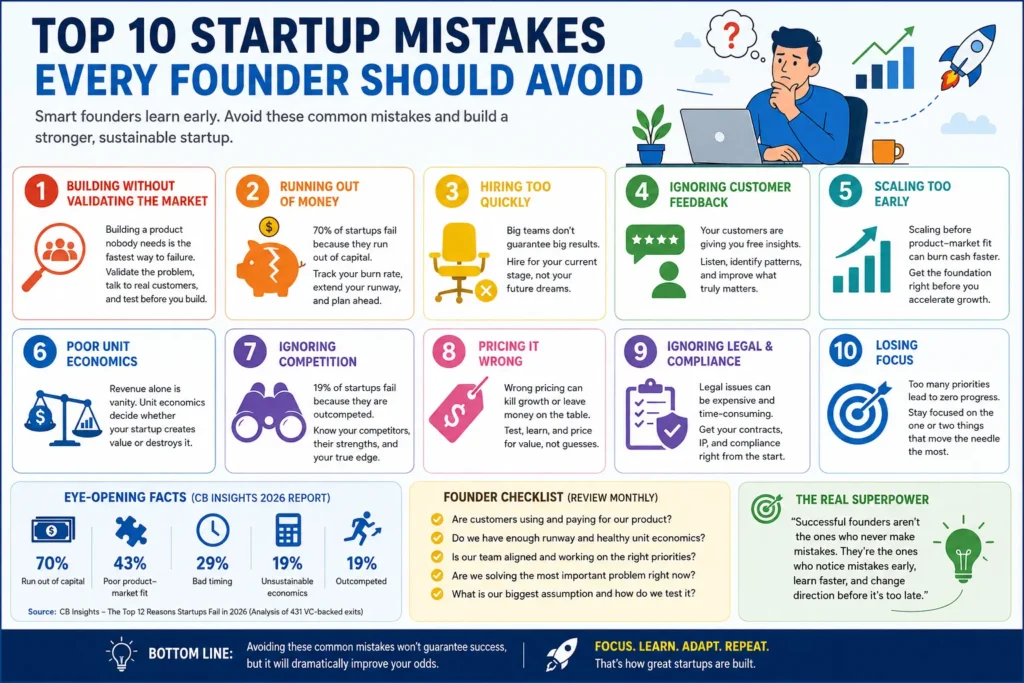
CB Insights’ latest analysis of 431 VC-backed startup shutdowns found that 70% ran out of capital, while poor product-market fit affected 43% and bad timing 29%.
The good news? Most of these problems can be identified much earlier.
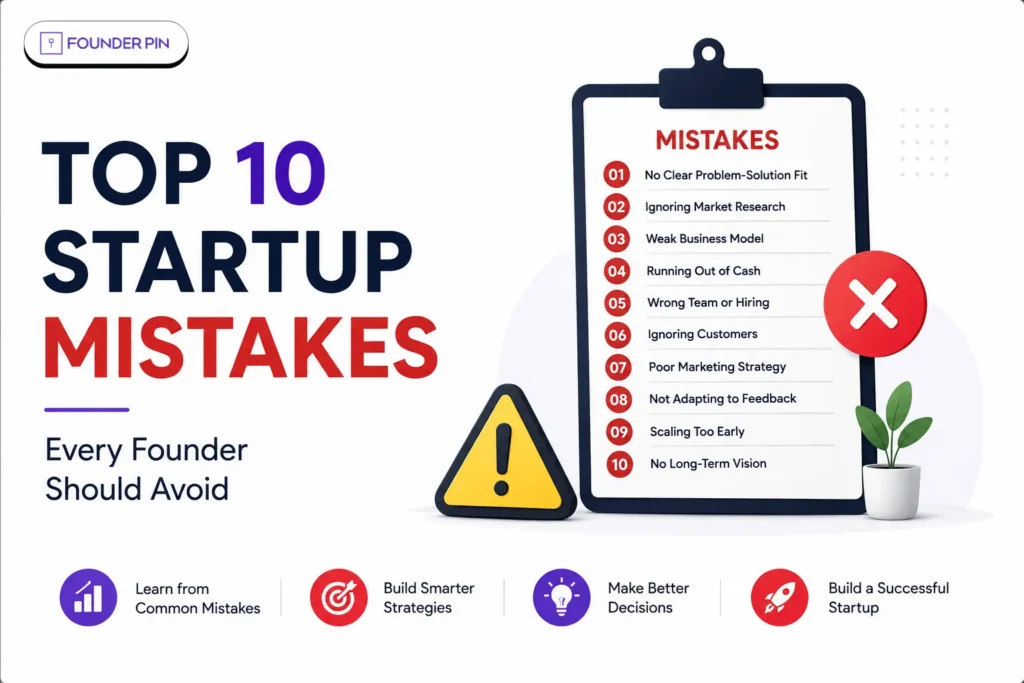
Here are the Top 10 Startup Mistakes every founder should actively avoid.
What are the Top 10 Startup Mistakes founders make?
The biggest mistakes usually involve building without validation, spending too quickly, hiring too early, ignoring customers and confusing growth with progress.
The 10 mistakes at a glance
- Building a product nobody urgently needs
- Skipping proper market validation
- Spending money before finding product-market fit
- Hiring too quickly
- Ignoring cash flow and runway
- Poor unit economics
- Ignoring customer feedback
- Ignoring competitors
- Neglecting legal and founder agreements
- Scaling before the business is ready
Let’s examine each one.
1. Are you building something customers actually need?
The single biggest mistake founders make is solving a problem that just isn’t painful enough for anyone to actually pay for.
It’s an easy trap to fall into. Founders naturally fall in love with their own ideas — that’s just human nature. Customers, though, don’t carry that same emotional attachment. They only care whether it solves something real for them.
Key points
- Talk to potential customers before building too much
- Look for a painful, recurring problem, not a minor annoyance
- Ask what people currently do instead, even if it’s a clunky workaround
- Actually test whether they’ll pay, not just whether they say they like the idea
YC’s advice here lines up with this too — launch early, talk to users constantly, and keep iterating rather than waiting around for some perfect version of the product.
FounderPin insight: If you can’t clearly say who has this problem, how often they run into it, and what they’re currently paying to deal with it, you probably need more validation before going further.
2. Are you confusing compliments with market validation?
People saying “great idea” is not product validation.
One of the most common startup mistakes is treating positive conversations, social-media likes or investor interest as evidence of demand.
What should founders validate?
Try to establish:
- Real customer pain
- Willingness to pay
- Repeat usage
- Retention
- A clearly defined target customer
A customer opening their wallet is considerably stronger evidence than a customer saying your product is “interesting.”
3. Are you spending too much before finding product-market fit?
Raising funding doesn’t mean you should immediately increase spending.
YC specifically warns founders against scaling the team or product before they have built something people genuinely want.
The common trap
A founder raises ₹2 crore and suddenly:
- hires 15 employees,
- rents an expensive office,
- launches multiple features,
- spends heavily on marketing,
- and assumes the next funding round will arrive.
That can turn a promising startup into a cash-burning machine.
Funding should buy learning and progress—not simply more time.
Founders should also understand how different funding stages work before raising capital. Our guide to seed funding vs angel funding vs VC funding explains how these funding routes differ and when each may make sense.
4. Are you hiring too early?
Hiring feels like growth, but premature hiring can create a very expensive problem.
Before hiring, ask whether the work is genuinely recurring and whether the role can materially improve a critical business metric.
A better approach
Startups should remain lean while searching for product-market fit. YC recommends focusing heavily on building and talking to users rather than creating unnecessary organisational complexity.
One excellent engineer solving a critical problem can be more valuable than five employees working on low-priority features.
5. Do you know exactly how much runway you have?
Revenue, valuation and funding can look impressive while cash flow quietly deteriorates.
Cash management should be a founder-level responsibility.
Track these numbers regularly
- Monthly burn
- Cash balance
- Runway
- Customer acquisition cost
- Gross margin
- Revenue growth
- Accounts payable and receivable
CB Insights’ 2026 research found that running out of capital was the most common final cause of shutdown, although underlying problems such as poor product-market fit and unsustainable economics often caused the cash crisis.
In simple terms: cash is the oxygen, but bad economics are often the disease.
6. Why Is Poor Unit Economics a Dangerous Mistake?
Revenue alone doesn’t tell you whether your startup works. Unit economics tells you whether growth creates or destroys value.
CB Insights’ latest analysis identified unsustainable unit economics in 19% of the failures where reasons could be identified.
For many startups, founders should understand metrics such as:
- Customer acquisition cost (CAC)
- Lifetime value (LTV)
- Gross margin
- Contribution margin
- Average order value
- Customer payback period
A company that loses ₹500 to acquire a customer who generates ₹300 in contribution margin doesn’t have a growth problem. This is why understanding startup unit economics and CAC analysis is so important before increasing marketing spend. Growth only becomes valuable when the economics behind that growth make sense.
7. Are you ignoring customer feedback?
Founders don’t need to implement every customer request—but they do need to listen.
Repeated complaints can reveal product weaknesses that internal meetings will never uncover.
Ask better questions
Instead of asking:
“Do you like our product?”
Ask:
- What were you trying to accomplish?
- What frustrated you?
- What did you use before us?
- What would make you stop using us?
- Would you recommend or pay for this?
The goal isn’t compliments. The goal is useful evidence.
8. What Happens When Founders Ignore Competitors?
Being first doesn’t guarantee being the winner.
CB Insights found that 19% of analyzed startup failures involved being outcompeted.
Competitor research shouldn’t mean copying another company’s features.
Instead, understand:
- Why customers choose competitors
- Where competitors are weak
- What customers complain about
- How competitors price their products
- What distribution channels they control
- What makes your product genuinely different
Your competitive advantage should be clear enough that a customer can explain it to someone else.
9. Are you ignoring legal documents and founder agreements?
Legal problems rarely feel urgent during the exciting first months of a startup—which is exactly why founders postpone them.
That can become expensive later.
Don’t overlook
- Founder agreements
- Equity ownership
- Intellectual-property assignment
- Employment agreements
- Customer contracts
- Privacy policies
- Terms of service
- Regulatory requirements
- ESOP documentation
Founder disagreements can become especially damaging when roles, equity or decision-making rights were never clearly discussed.
Founders should document these arrangements early. FounderPin’s guide to legal documents for startups in India covers the key agreements and documents businesses should consider as they grow.
A simple agreement today can prevent an extremely complicated dispute later.
10. Are you scaling before you’ve earned the right to scale?
Growth is supposed to amplify a business that’s already working — not paper over one that’s broken.
If your product has weak retention, thin margins, or demand nobody’s really sure about, pouring more money into marketing and headcount doesn’t fix anything. It just multiplies whatever’s already going wrong.
YC’s take on this is refreshingly blunt: growth is usually a result of building something people actually want, not a shortcut around finding product-market fit in the first place.
So before you hit the accelerator, it’s worth asking:
- Are customers actually sticking around?
- Are unit economics getting better, not worse?
- Is demand repeatable, or was that last spike a fluke?
- Can operations even handle more growth right now?
- Do we know which acquisition channels genuinely work?
- Could the company survive if fundraising takes longer than expected?
If those answers are fuzzy, fix the foundation first. Scaling can wait.
What can founders learn from these startup mistakes?
The biggest lesson is that startup failure is rarely caused by one dramatic decision.
Small mistakes compound.
You build without validation. Then hire too early. Then increase marketing. Then burn cash. Then discover retention is weak. Then fundraising becomes urgent.
Suddenly, the problem looks like a funding problem—but the funding problem started months earlier.
CB Insights’ research reinforces this pattern: capital exhaustion often represents the end of a chain of operational problems rather than the original cause.
How Can Founders Avoid These Startup Mistakes?
The best defense isn’t a perfect business plan. Instead, it’s a system for identifying problems early.
Create a simple monthly founder review covering the following areas.
Product
- Are customers using the product?
- Do they keep returning?
- What problems appear repeatedly?
Finance
- What is monthly burn?
- How much runway remains?
- Are unit economics improving?
Growth
- Which acquisition channels work?
- Is retention improving?
- Are customers willing to pay more?
Team
- Are responsibilities clear?
- Are key roles missing?
- Is the team solving the most important problems?
Strategy
- What is our biggest assumption?
- What evidence supports it?
- What would prove us wrong?
So, this approach turns startup management from guesswork into a continuous learning process.
FounderPin Perspective
At FounderPin, we believe founders should spend less time asking “How do I grow faster?” and more time asking “What could break this company six months from now?”
That mindset changes how you approach hiring, fundraising, legal structures, customer acquisition and product development.
The best founders aren’t people who never make mistakes.
They’re the ones who identify expensive mistakes early enough to correct them.
Final Takeaway: How can founders avoid startup mistakes?
Turns out, the Top 10 Startup Mistakes aren’t all that mysterious. Building something nobody actually needs, ignoring your customers, overspending, hiring too soon, chasing metrics that look good but mean nothing, scaling before you’ve found product-market fit — it’s the same handful of traps, over and over.
You don’t need to eliminate every risk. Honestly, that’s not even possible.
What you can do is build systems that help you catch problems early, keep an eye on what actually matters, and hold onto enough cash and flexibility to adapt when things shift.
If you’re building a startup and could use help with strategy, funding, business structure, growth planning, or just working through tough founder decisions, reach out to FounderPin for a consultation.
Frequently Asked Questions
What is the most common startup mistake?
Poor product-market fit is one of the most important failure patterns. CB Insights’ 2026 analysis found it in 43% of analyzed VC-backed startup failures.
Why do startups run out of money?
Often because spending grows faster than revenue, fundraising takes longer than expected, or the business has weak economics. CB Insights found capital exhaustion in 70% of its 2026 failure sample.
Should startups hire quickly after raising funding?
Not automatically. Hiring should support clearly defined business milestones and remain compatible with the company’s runway.
How can founders validate a startup idea?
Talk to potential customers, identify their existing alternatives, build a simple prototype or MVP, test willingness to pay and measure actual behavior rather than relying only on survey enthusiasm.
Can a startup recover after making these mistakes?
Yes. A mistake becomes particularly dangerous when founders ignore evidence and continue investing in the same failing assumption. Early detection gives a startup more room to pivot or correct course.