
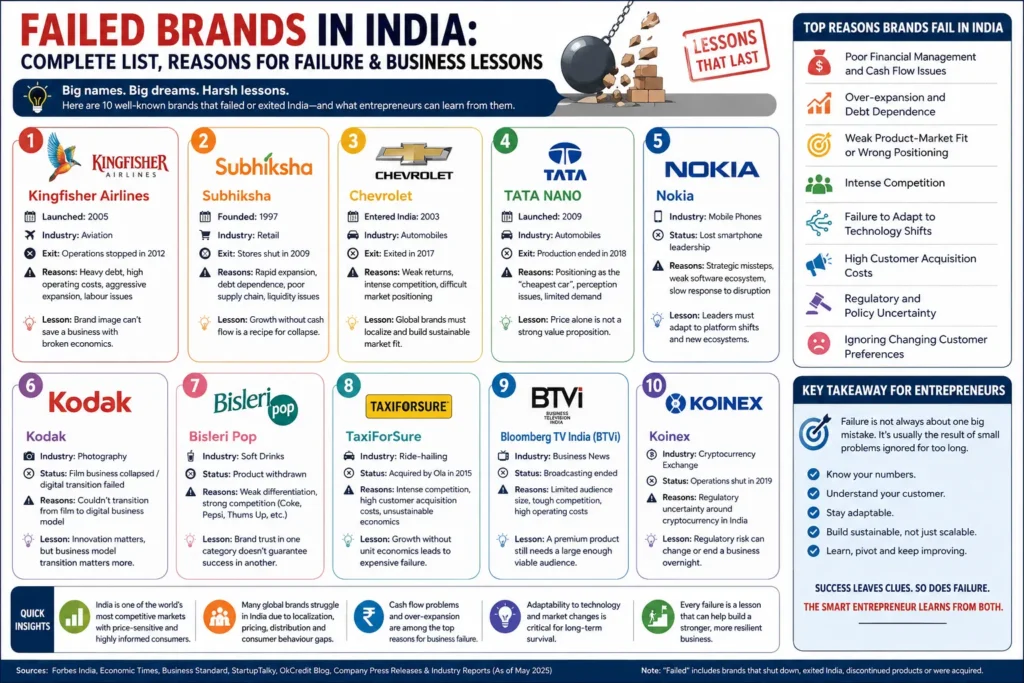
Some of these are classic corporate failures, while others are examples of products or businesses that failed to achieve sustainable scale. That distinction makes the lessons much more useful.
1. Kingfisher Airlines: When premium branding could not fix the numbers
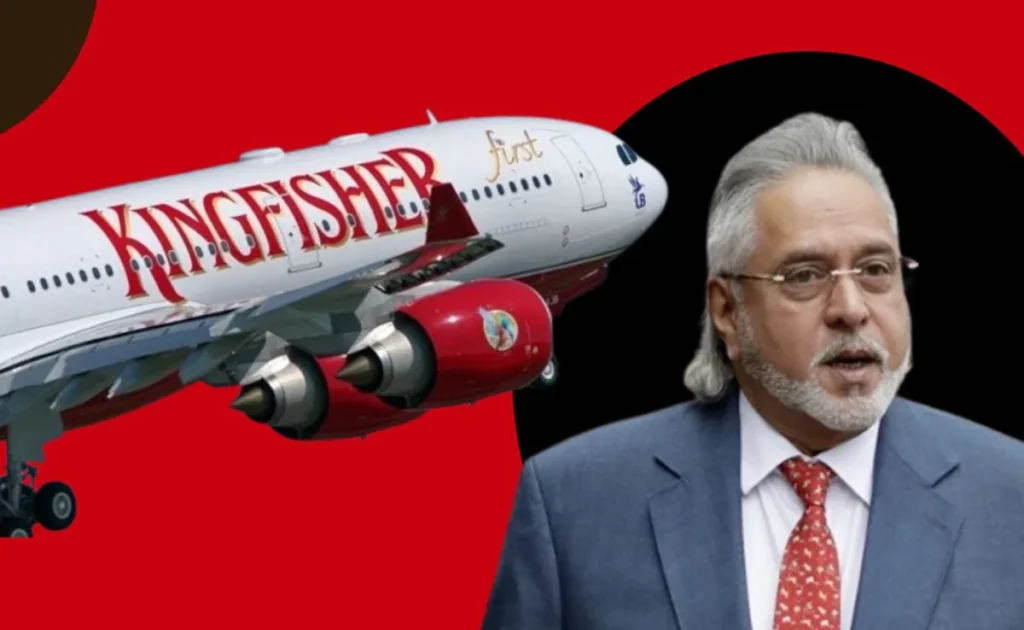
Key details:
Industry: Aviation
Founder: Vijay Mallya
Launched: 2005
Exit: Operations suspended in 2012
Main failure factors: Heavy debt, high operating costs, aggressive expansion, labour issues and weak financial discipline.
Why did Kingfisher Airlines fail?
Kingfisher Airlines built a premium image but struggled to make its economics work. Its acquisition of Air Deccan and subsequent attempt to operate both premium and low-cost propositions added complexity to an already difficult business.
A 2025 academic study found that the airline’s collapse involved strategic missteps, weak corporate governance, mounting labour disputes and financially unsound expansion.
The airline eventually accumulated enormous debt, while aircraft were grounded and employees faced unpaid salaries. Its operating licence was suspended in October 2012.
Business lesson
Brand experience cannot compensate for broken unit economics.
A business can look premium, attract attention and still fail if its revenue cannot cover its operating and financing costs.
2. Subhiksha: Growth became a financial trap

Key details:
Industry: Retail
Founded: 1997
Business model: Discount grocery and retail stores
Peak scale: Around 1,600 outlets
Main failure factors: Rapid expansion, debt dependence, poor supply-chain management and liquidity problems.
Why did Subhiksha fail?
Subhiksha grew from a single Chennai store into a nationwide retailer remarkably quickly. But the expansion required enormous amounts of capital.
By early 2009, the retailer could not replenish inventory or meet employee and vendor payments. Its stores were eventually shut.
A business case study noted that rapid expansion had been funded substantially through debt and that poor supply-chain practices contributed to the financial crisis.
Business lesson
Revenue growth is not the same as financial health.
Opening hundreds of stores may make a company look successful, but growth becomes dangerous when working capital, inventory and financing cannot keep up.
Rapid expansion is one of the biggest challenges for growing businesses. Founders should understand their unit economics and cash requirements before aggressively scaling. For more practical guidance, read our guide to Top 10 Startup Mistakes Every Founder Should Avoid.
3. Chevrolet: A global brand that could not find the right Indian formula

Key details:
Parent company: General Motors
Industry: Automobiles
India entry: 2003
Exit decision: 2017
Main failure factors: Weak returns, intense competition and difficulty building a sustainable position.
Why did Chevrolet fail in India?
Chevrolet entered India with well-known models including the Spark, Beat, Cruze and Tavera. But the company struggled to build sufficient scale in an intensely competitive market.
GM officially announced in May 2017 that Chevrolet would be phased out of India’s domestic market by the end of that year. GM said it wanted to focus capital and resources on opportunities expected to generate stronger returns and would shift its Indian manufacturing operations toward exports.
The broader lesson is not that Chevrolet made poor cars. It is that product quality alone does not guarantee market success.
Business lesson
Local market fit matters as much as global brand strength.
Price, fuel economy, product portfolio, distribution, resale expectations and after-sales support all influence Indian automobile buyers.
4. Tata Nano: When “cheapest” became the wrong positioning
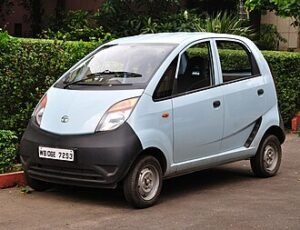
Key details:
Company: Tata Motors
Industry: Automobiles
Launch: 2009
Original positioning: Affordable mass-market car
Production ended: 2018
Main failure factors: Positioning, consumer aspirations, limited demand and production challenges.
Why did Tata Nano fail?
The Nano was one of India’s most ambitious attempts to make car ownership more affordable. But its biggest marketing advantage—being extremely inexpensive—also created a perception problem.
The car became strongly associated with being the “cheapest car”, while many consumers aspired to own a car that represented progress and status.
The model also faced negative publicity around fire incidents, although Tata Motors stated that those incidents were not linked to manufacturing or design defects. Production eventually dwindled to extremely low volumes before ending.
Business lesson
Low price is not automatically a strong value proposition.
Customers buy products for a combination of price, performance, identity, convenience and emotion. Sometimes making a product cheaper can actually weaken its appeal.
5. Nokia: A technology leader that missed the platform shift

Key details:
Company: Nokia
Industry: Mobile phones
India position: Once a dominant handset brand
Major challenge: Smartphone transition
Main failure factors: Strategic missteps, software ecosystem weakness and inability to respond effectively to changing competition.
Why did Nokia lose its position?
Nokia is one of the most famous examples of disruption in technology.
The company had enormous strengths in hardware, manufacturing and brand recognition. But the smartphone market increasingly competed on software, apps and ecosystems, not simply handset quality.
Interestingly, Nokia had already developed digital-camera technology and other innovations long before many competitors. The problem was not an absence of technological capability; it was converting that capability into a competitive smartphone ecosystem.
When Microsoft declared in 2013 that it would buy nearly all of Nokia’s Devices & Services division, the company’s device business ultimately underwent a dramatic transformation.
Business lesson
Being the market leader today does not guarantee leadership tomorrow.
The strongest defence against disruption is not protecting the old business. It is continuously building the capabilities needed for the next one.
6. Kodak: The company that invented the digital camera but lost the digital transition
Key details:
Company: Eastman Kodak
Industry: Photography and imaging
Founded: 1880s
Major disruption: Digital photography
Main failure factors: Difficulty transitioning from the profitable film business to a sustainable digital model.
Why did Kodak fail?
Kodak’s story is more complicated than the popular claim that it simply “ignored digital.”
In fact, Kodak says its researcher Steve Sasson invented the world’s first digital camera in 1975. The company also developed digital imaging products for decades.
The deeper problem was economic transformation. Kodak had built an enormously successful business around film, processing and printing. Digital photography threatened that entire ecosystem.
Kodak eventually restructured and phased out or sold parts of its consumer imaging portfolio during 2012–13.
Business lesson
Innovation is useless if your business model cannot capture its value.
Companies must ask not only, “Can we build the next technology?” but also, “What happens to our existing revenue when customers adopt it?”
7. Bisleri Pop: A famous name is not enough for a new product

Key details:
Brand: Bisleri
Product: Bisleri Pop
Industry: Soft drinks
Market: Carbonated beverages
Outcome: Product withdrawn
Main failure factors: Strong competition, weak differentiation and limited consumer traction.
Why did Bisleri Pop fail?
Bisleri already had enormous brand recognition in bottled water. But that recognition did not automatically transfer to carbonated soft drinks.
Bisleri Pop entered a market dominated by established brands such as Coca-Cola, Pepsi, Thums Up and Sprite. Contemporary business analyses point to weak differentiation and difficulty creating strong consumer recall.
The company eventually withdrew its experimental beverage products.
Business lesson
A strong parent brand does not guarantee product-market fit.
Consumers may trust a company for one category but not automatically accept its products in another.
8. TaxiForSure: Growth without sustainable ride economics

Key details:
Founders: Aprameya Radhakrishna and Raghunandan G
Founded: 2011
Industry: Ride-hailing
Outcome: Acquired by Ola in 2015
Main failure factors: Intense competition, high customer-acquisition spending and difficult unit economics.
Why did TaxiForSure fail?
TaxiForSure was one of India’s early online taxi aggregators. It connected customers with taxi operators and built significant market presence.
But the ride-hailing industry became intensely competitive, with companies spending heavily to acquire drivers and customers.
TaxiForSure was acquired by Ola in 2015. The company had raised substantial capital, but reports at the time highlighted significant cash burn and losses per ride.
Business lesson
Market share without healthy unit economics can become expensive growth.
Founders need to know how much they spend to acquire a customer, how much that customer generates and how quickly the business can recover its acquisition cost.
Customer acquisition can become expensive when startups compete aggressively for market share. Founders should understand where their funding comes from and how investors can support sustainable growth. Our guide to Angel Investors in India explains what early-stage founders should know before raising capital.
9. Bloomberg TV India/BTVi: A small audience can limit even strong content

Key details:
Industry: Business news television
Indian operation: Bloomberg TV India
Later brand: BTVi
Outcome: Broadcasting eventually ended in 2019
Main failure factors: Limited English business-news audience, competition and high operating costs.
Why did Bloomberg TV India fail?
The channel entered India with the strength of the Bloomberg name and specialised financial-news content.
But its addressable television audience was relatively narrow, while established competitors such as CNBC-TV18 and ET Now already had strong positions.
StartupTalky notes that limited viewership and high operating costs made the model difficult to sustain.
Business lesson
A premium product still needs a sufficiently large paying or monetizable market.
Being highly respected by a small audience does not necessarily produce a commercially viable media business.
10. Koinex: When regulation changes the business equation
Key details:
Founders: Rahul Raj and founding team
Founded: 2017
Industry: Cryptocurrency exchange
Outcome: Operations shut in 2019
Main failure factor: Regulatory uncertainty surrounding cryptocurrency trading in India.
Why did Koinex fail?
Koinex became one of India’s early cryptocurrency exchanges and built a significant user base.
But the regulatory environment surrounding cryptocurrency trading created substantial uncertainty. According to Koinex founder Rahul Raj’s account cited by OkCredit, the absence of a clear regulatory framework affected the company’s ability to operate sustainably.
The exchange eventually shut its operations in 2019.
Business lesson
Regulatory risk can become business-model risk.
Founders operating in highly regulated sectors should understand not only today’s rules but also how changes in policy could affect their revenue, customers and ability to operate.
What Are the Biggest Reasons Behind Failed Brands in India?
The cases above reveal that business failure rarely comes from one mistake. It usually happens when several weaknesses reinforce each other.
The most common patterns include:
- Poor cash-flow management
- Over-expansion
- Weak product-market fit
- Poor localization
- Wrong pricing or positioning
- Failure to adapt to technology
- High customer-acquisition costs
- Regulatory uncertainty
- Weak distribution or after-sales service
- Ignoring changing customer preferences
For example, Subhiksha’s rapid expansion created financial pressure, while Kingfisher combined high costs with debt and operational problems.
Nokia and Kodak demonstrate a different problem: technological disruption can destroy an established competitive advantage surprisingly quickly. Kodak’s own history shows that the company had digital technology but still struggled with the transition from film economics.
What can startups learn from failed brands in India?
The most valuable lesson is that failure usually leaves clues before it becomes visible to customers.
Founders should regularly monitor:
- Unit economics — Are individual transactions profitable or moving toward profitability?
- Cash flow — How long can the company operate if revenue misses expectations?
- Customer retention — Are customers returning without increasingly expensive incentives?
- Market fit — Does the product solve a problem customers actually care about?
- Competition — Can competitors copy the proposition or undercut the price?
- Technology shifts — Could a new technology make the existing product less relevant?
- Regulation — Could a policy change materially affect the business?
- Brand perception — Does the way customers describe the product match how the company wants to position it?
- Expansion discipline — Is the company expanding because demand exists or because growth looks impressive on a presentation?
- Operational quality — Can the company consistently deliver what it promises?
The biggest mistake would be to look at these companies and say, “They failed because they made one bad decision.”
Business is rarely that neat. Understanding the market before investing heavily can save a startup from expensive mistakes. If you’re still evaluating your next venture, our guide to 20 Profitable Startup Ideas for India in 2026 offers ideas across different industries and investment levels.
Final Takeaway: What do failed brands in India teach entrepreneurs?
The biggest lesson from failed brands in India is simple: a famous name, large funding round or successful history cannot protect a company from changing economics.
Kingfisher shows the danger of excessive debt and expansion. Subhiksha demonstrates why growth must be backed by working capital. Chevrolet highlights the importance of sustainable market positioning. Tata Nano shows how perception can undermine affordability. Nokia and Kodak demonstrate the cost of failing to navigate major technology shifts.
Meanwhile, smaller cases such as Bisleri Pop, TaxiForSure and Koinex show that even a strong parent brand, large customer base or promising technology cannot guarantee commercial sustainability.
For founders, the goal is not to avoid every mistake. That is impossible.
The goal is to identify warning signs early, measure the right numbers and adapt before a manageable problem becomes an existential one.
At FounderPin, we believe failure stories can be as valuable as success stories. Studying what went wrong can help founders make better decisions about product-market fit, funding, growth, branding and business strategy.
Because sometimes the best business lesson comes from the company that didn’t make it.