
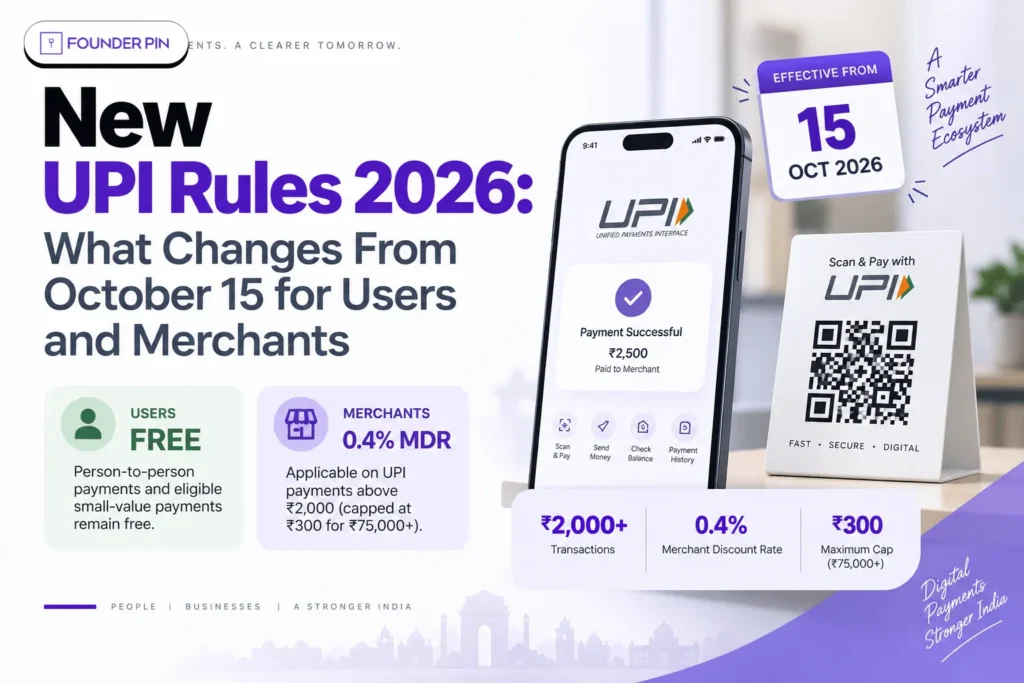
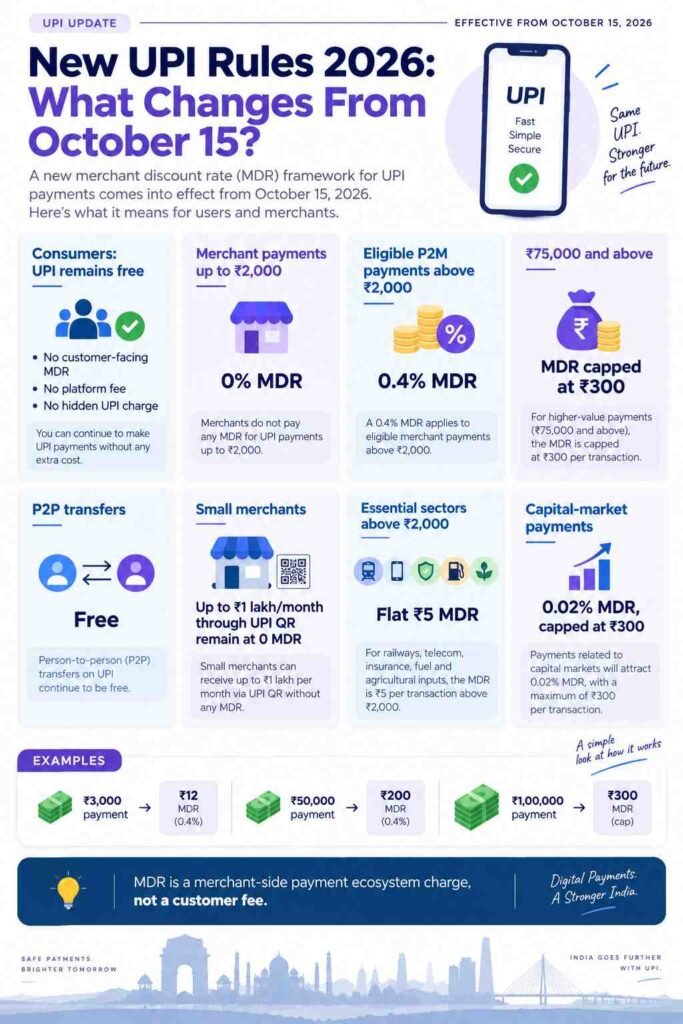
Example: A ₹50,000 eligible merchant payment generates ₹200 in MDR at 0.4%. Once the transaction reaches ₹75,000, the framework caps the MDR at ₹300.
What Changes for Merchants?
Merchants are the group that needs to pay closer attention to the New UPI Rules 2026.
For eligible larger merchant transactions:
- MDR can apply when the payment exceeds ₹2,000.
- The standard rate is 0.4%.
- Transactions of ₹75,000 or more have a ₹300 maximum MDR.
- Eligible small merchants remain protected through the zero-MDR framework.
This creates a difference between a neighbourhood shop processing small QR payments and a large business receiving high-value UPI payments.
For merchants, the practical issue is therefore not simply “UPI charges.” It is how much payment-processing cost their business will absorb after 15 October.
Businesses may need to review their payment reconciliation, margins and payment-provider agreements before the new framework takes effect.
What About Small Merchants?
Small merchants receive specific protection under the new framework.
The important threshold is:
- Up to ₹1 lakh per month received through UPI QR under the eligible small-merchant category can remain at zero MDR.
This is particularly relevant for street vendors, neighbourhood stores and micro-businesses that depend heavily on QR payments.
The policy is intended to avoid putting the same payment cost on a small seller and a large merchant handling substantially larger digital payment volumes.
What About Mutual Funds, Stocks and Capital Markets?
Capital-market transactions have a separate MDR structure.
The framework provides:
- 0.02% MDR for qualifying capital-market transactions
- A maximum of ₹300 per transaction
This category covers payments connected with areas such as mutual funds, securities, stockbrokers and dealers.
The lower rate reflects the different economics of these financial transactions compared with ordinary merchant purchases.
For investors, the key point is that the new UPI framework does not simply apply one universal percentage to every payment type.
How Will the New UPI Rules Affect UPI Apps?
Apps such as Google Pay, PhonePe, Paytm and other UPI applications operate within the wider payment ecosystem.
The new framework creates a revenue mechanism that can be shared among ecosystem participants, including banks, payment service providers and UPI application providers.
The stated objective is to support the continued operation and expansion of UPI infrastructure.
That matters because UPI has reached enormous scale. NPCI data shows that UPI processed about 24.51 billion transactions worth ₹29.82 lakh crore in August 2026.
At that scale, payment infrastructure, fraud prevention, cybersecurity and system capacity are not small expenses.
The change matters for payment platforms because their economics depend on transaction volumes, partnerships and multiple revenue streams, much like the PhonePe business and revenue model
Why Is UPI Introducing MDR Now?
The main policy argument is long-term sustainability.
The framework is intended to help support:
- Payment infrastructure
- Cybersecurity
- Fraud prevention
- Expansion into smaller towns and rural areas
- Wider merchant acceptance
- Continued investment across the UPI ecosystem
The government has also stated that a portion of MDR collections will support a dedicated fund aimed at expanding UPI adoption among small merchants.
In other words, the change is less about charging ordinary users and more about creating a sustainable economic model around an enormous payment network.
For founders and investors, the development is another example of how a large digital platform can evolve its business model as it scales.
New UPI Rules 2026: Users vs Merchants
| Area | From 15 October 2026 |
|---|---|
| P2P UPI transfers | Free |
| Merchant payment up to ₹2,000 | Free |
| Eligible small merchants | Zero MDR |
| Specified P2M payments above ₹2,000 | 0.4% MDR |
| MDR cap for ₹75,000+ transactions | ₹300 |
| Certain essential sectors | Flat ₹5 MDR |
| Capital-market payments | 0.02%, capped at ₹300 |
| Direct MDR charged to customers | No |
What Should Users Do Before October 15?
There is no need for ordinary users to stop using UPI.
Users should simply remember three things:
- P2P payments remain free.
- Merchant payments up to ₹2,000 remain free.
- The new MDR is a merchant-side payment-system charge, not a general UPI fee for consumers.
Users should also be cautious about social-media messages claiming that every UPI payment will suddenly attract a charge.
The safest approach is to check official information from NPCI, the Ministry of Finance and your bank or payment provider.
What Should Merchants Do Before October 15?
Merchants should focus on the economics rather than the headlines.
Before implementation, businesses can:
- Check whether they fall under the eligible small-merchant category.
- Review their expected monthly UPI collections.
- Understand which transactions in their business attract MDR.
- Check their payment-provider settlement statements.
- Review margins on high-value UPI transactions.
- Update accounting and reconciliation processes where necessary.
For businesses with high-value UPI collections, even a small percentage can become meaningful when multiplied across thousands of transactions.
FounderPin Perspective
The New UPI Rules 2026 show an interesting shift in India’s digital-payment story: scale eventually creates an economics problem.
For years, UPI’s growth was supported by a model that kept payments extremely cheap for users and merchants. Now, with billions of transactions moving through the system each month, the ecosystem needs a sustainable way to fund infrastructure and participants.
The October 15 framework tries to do that without putting a blanket charge on consumers or small merchants.
The real test will be how merchants, payment companies and users respond once the framework goes live.
FAQs About New UPI Rules 2026
1. Will UPI become chargeable from October 15, 2026?
No. UPI will not become universally chargeable. P2P transactions remain free, and merchant payments up to ₹2,000 remain free.
2. Will customers pay the new 0.4% UPI charge?
No. The 0.4% MDR is a merchant-side charge within the payment ecosystem. Customers are not supposed to be charged MDR directly.
3. What happens to UPI payments above ₹2,000?
Specified P2M transactions above ₹2,000 can attract MDR. The standard rate is 0.4%, subject to the applicable category rules and caps.
4. Are small merchants exempt from UPI MDR?
Eligible small merchants receiving up to ₹1 lakh per month through UPI QR under the P2PM framework continue to receive zero-MDR treatment.
5. When do the New UPI Rules 2026 take effect?
The revised MDR framework is scheduled to take effect from 15 October 2026.