

The NSE IPO opens for public subscription today, September 17, 2026, marking a major milestone for India’s largest stock exchange. The issue is priced at ₹1,700–₹1,785 per share, with a minimum lot size of 8 shares.
The IPO is entirely an Offer for Sale (OFS), meaning NSE itself will not receive the IPO proceeds. Existing shareholders are selling their shares to the public.
For investors searching for the latest NSE IPO details, here is everything important to know before applying.
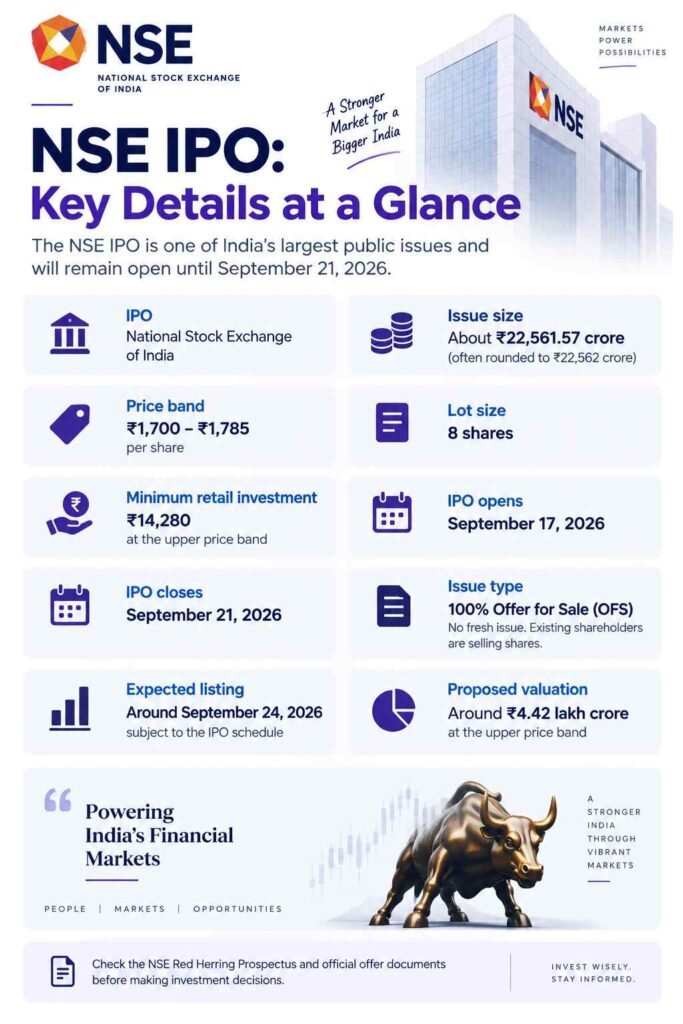
NSE IPO: Key Details at a Glance
The NSE IPO is one of India’s largest public issues and will remain open until September 21, 2026.
- IPO: National Stock Exchange of India
- Issue size: About ₹22,562 crore
- Price band: ₹1,700–₹1,785 per share
- Lot size: 8 shares
- Minimum retail investment: ₹14,280 at the upper price band
- IPO opens: September 17, 2026
- IPO closes: September 21, 2026
- Issue type: 100% Offer for Sale
- Expected listing: Around September 24, subject to the IPO schedule
- Proposed valuation: Around ₹4.42 lakh crore at the upper band
The price band and lot size were disclosed ahead of the issue, while NSE’s official website has published the Red Herring Prospectus and other offer documents for investors to examine.
What Is the NSE IPO?
The NSE IPO is the long-awaited public listing of the National Stock Exchange of India.
The important point is that this is not a fresh issue of shares. Existing shareholders are selling part of their holdings through an OFS.
That means:
- NSE does not receive fresh capital from the IPO.
- The money paid by successful investors goes to the selling shareholders.
- Investors are buying ownership in the exchange from existing holders.
- The IPO provides a route for NSE shares to become publicly traded.
This structure makes the NSE IPO different from a conventional IPO where a company raises new money for expansion, debt repayment or other corporate purposes.
NSE IPO Price Band and Minimum Investment
The NSE IPO price band runs ₹1,700 to ₹1,785 per share, and one lot means 8 shares.
Do the math at the upper end and it works out to:
₹1,785 × 8 shares = ₹14,280
So if you’re a retail investor applying for just one minimum lot, you’d need ₹14,280 in hand — and that’s before any additional charges kick in.
That per-share price is on the higher side, which is why the NSE IPO’s minimum ticket size ends up noticeably steeper than what you’d see with most retail-focused IPOs. Where you actually land, of course, depends on the bid price you choose and how many lots you apply for.
NSE IPO Subscription Dates
The public bidding window runs September 17 to September 21, 2026.
Here’s how the schedule breaks down:
| IPO Event | Date |
|---|---|
| Anchor bidding | September 16, 2026 |
| IPO opens | September 17, 2026 |
| IPO closes | September 21, 2026 |
| Expected listing | Around September 24, 2026 |
Keep in mind these dates aren’t set in stone — the final allotment and listing timeline still depends on how the exchange and regulators finalize things.
NSE IPO GMP: Should Investors Rely on It?
Grey Market Premium, or GMP, is an unofficial market indicator and should not be treated as an assured listing gain.
Several reports have published changing GMP figures around the NSE IPO. However, GMP operates outside the formal exchange mechanism and can move quickly.
The actual listing price can differ significantly from grey-market expectations.
For a fact-based investment decision, investors should give greater weight to the Red Herring Prospectus, financial statements, valuation, risks and business fundamentals than to an unofficial premium.
NSE itself has published its Red Herring Prospectus, financial statements and other offer documents on its investor-relations website.
Why Is the NSE IPO Creating So Much Interest?
The NSE IPO is significant because investors are getting an opportunity to own shares in the operator of one of India’s most important financial-market platforms.
NSE has become deeply connected to India’s equity and derivatives ecosystem.
According to Reuters, NSE has more than 2,000 registered members and over 2,200 listed companies, while its cash-equity market share was around 95% and its equity-derivatives share around 75%, based on NSE disclosures cited in the report.
Another important fact is NSE’s position in derivatives.
Reuters reported that NSE accounted for roughly 89% of global stock-index options volume in 2025, based on World Federation of Exchanges data.
That gives investors a useful perspective: the NSE story is not simply about India’s stock market. Its derivatives business has become a major part of its overall market position.
Also Read | How to Invest in Startups in India: A Complete Guide for Beginners
How Does NSE Make Money?
NSE generates substantial revenue from transaction-related activities, particularly derivatives trading, along with other market-infrastructure and financial services.
Reuters reported that NSE’s revenue more than doubled between April 2019 and April 2026 to around ₹187 billion, while transaction revenue accounted for more than 80% of total income.
However, this concentration also matters.
If trading activity, especially derivatives activity, slows significantly, transaction-linked revenue could come under pressure.
That makes trading volumes an important factor for investors following NSE after its listing.
Understanding how a company generates revenue is equally important when evaluating other businesses. Our guide to [50 startup terms every founder should know] explains key concepts such as revenue, valuation and equity in simple terms.
NSE Financial Performance- 2026
- NSE remains a genuinely profitable business — but FY26 was noticeably softer than FY25 across several key numbers.
- Total income landed at ₹18,713.37 crore in FY26, down slightly from ₹19,176.83 crore in FY25, though still well ahead of FY24’s ₹16,352.06 crore.
- Revenue from operations slipped 3.1% year-on-year, from ₹17,140.67 crore to ₹16,601.31 crore. Profit fell harder, dropping 15.5% for the year.
- EBITDA came in at ₹11,097.9 crore for FY26.
- Zoom out, though, and the longer trend still looks solid — revenue from operations grew at a 5.98% CAGR between FY24 and FY26, which says a lot about the underlying strength of the business.
- The softer year deserves attention, not dismissal. Trading volumes cooled off across cash equities, futures, and options, which dragged down transaction-charge revenue. Futures transaction charges alone fell 14.31% in FY26.
- The bigger takeaway: even a consistently profitable exchange isn’t immune to earnings swings when trading volumes shift or regulations change.
NSE IPO Anchor Investors Raise ₹6,746 Crore
NSE raised around ₹6,746 crore from anchor investors before the public issue opened.
According to moneycontrol reports, NSE allotted approximately 3.77 crore shares to 189 anchor investors at the upper end of the price band.
The anchor book included major domestic and international institutions, including LIC, Fidelity, Abu Dhabi Investment Authority and Norway’s Government Pension Fund Global.
Reuters reported that the anchor allocation was worth about $703 million.
Anchor participation can provide useful information about institutional demand, but it should not be treated as a guarantee of future share-price performance.
What Does 100% OFS Mean for NSE IPO Investors?
A 100% OFS means the IPO proceeds go to existing shareholders rather than NSE.
This is one of the most important points investors should understand.
In a fresh issue, the company creates or issues new shares and receives the proceeds.
In an OFS:
Existing shareholders sell → Investors buy → Selling shareholders receive the proceeds.
NSE therefore does not receive ₹22,000-plus crore to fund new projects simply because its IPO is that large.
For investors, the investment case instead depends on the value of owning shares in NSE’s existing business and its future earnings potential.
NSE IPO Risks Investors Should Watch
The NSE IPO also comes with business, regulatory and valuation risks.
Key factors include:
- High valuation: The upper price band implies a valuation of roughly ₹4.42 lakh crore.
- Derivatives dependence: A large share of transaction revenue comes from derivatives.
- Regulatory risk: Exchanges operate in a heavily regulated financial environment.
- Trading-volume risk: Lower market activity can affect transaction-linked revenue.
- Legal and governance history: NSE’s IPO was delayed for years amid regulatory scrutiny and legal matters.
- Market-cycle risk: Exchange earnings can be influenced by investor participation and market activity.
These factors make the prospectus particularly important rather than relying only on IPO buzz or grey-market indications.
Investors can also explore how funding and valuation shape high-growth businesses in our coverage of [Emergent AI’s $130 million Series C funding].
What Investors Should Check Before Applying
The most useful NSE IPO checklist is simple: understand the valuation, business model, risks and OFS structure before placing a bid.
Investors can check:
- Price band and lot size
- NSE’s profitability and revenue growth
- Dependence on derivatives trading
- Valuation at ₹1,785 per share
- Regulatory and legal disclosures
- Institutional and anchor participation
- Potential post-listing volatility
- The fact that NSE receives no IPO proceeds
The official NSE offer-document page provides access to the RHP, audited financial statements, industry report and other documents.
FounderPin Perspective
The NSE IPO is more than another public issue. It gives public-market investors access to one of the central businesses behind India’s capital-market infrastructure.
But the size and popularity of an IPO do not remove investment risk.
The more useful question is not simply “Is the NSE IPO big?” It clearly is. The better question is whether the ₹1,700–₹1,785 price band adequately reflects NSE’s earnings, market position, growth opportunities and regulatory risks.
For investors, the RHP and financial disclosures are more valuable than IPO excitement alone.
Note: Information in this article is based on publicly available information available on September 17, 2026. IPO investments carry market risk; investors should read the offer documents and consider their own financial circumstances before investing.
Frequently Asked Questions About NSE IPO
1. When does the NSE IPO open and close?
The NSE IPO opens for public subscription on September 17, 2026, and closes on September 21, 2026. Investors can place their bids during this subscription window.
2. What is the NSE IPO price band?
The NSE IPO price band is ₹1,700 to ₹1,785 per share. The IPO has a lot size of 8 shares, making the minimum investment at the upper price band ₹14,280.
3. Is the NSE IPO a fresh issue or an OFS?
The NSE IPO is an Offer for Sale (OFS). Existing shareholders are selling their shares, so NSE itself will not receive the IPO proceeds as fresh capital.
4. How much money is required to apply for the NSE IPO?
At the upper price of ₹1,785 per share and a lot size of 8 shares, investors need ₹14,280 for one lot. The required amount increases with the number of lots applied for.
5. What are the major risks of investing in the NSE IPO?
Key risks include valuation, dependence on trading volumes, derivatives-related revenue concentration, regulatory changes and market volatility. Investors should review NSE’s Red Herring Prospectus and financial disclosures before applying.