
Pixxel Funding: $100 Million Investment and Why India's Space Tech Sector Is Booming
Table of Contents
Toggle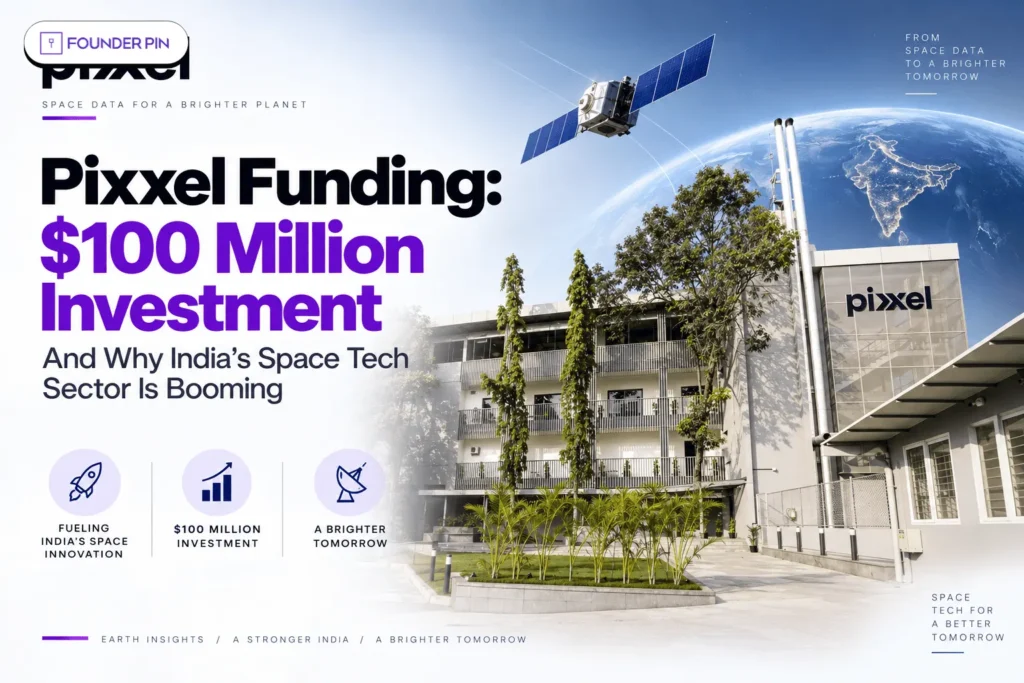
Pixxel funding has reached a major milestone. The Bengaluru-based space-tech company raised $100 million in a Series C round in September 2026. That takes its total capital raised to $195 million.
Temasek and Seraphim co-led the round. Existing investors Radical Ventures and growX Ventures joined in, along with new backers 360 ONE Asset and IMM Investment. Pixxel calls it the largest single funding round any Indian space-tech company has raised.
But the $100 million cheque isn’t really the story here.
Pixxel is pushing beyond satellite imagery now. It’s building a mix of satellites, Earth-intelligence software, sovereign space systems, and satellite manufacturing all at once. Meanwhile, India’s policy reforms are opening doors. A growing startup base and rising institutional funding are creating a stronger market for private space companies too. Read Pixxel’s official announcement for the complete funding details.
Pixxel Funding: What Happened in the $100 Million Round?
The latest Pixxel funding round gives the company capital to expand its satellite constellation, software platform and manufacturing capabilities.
Key points
- Funding: $100 million Series C
- Total funding: $195 million
- Lead investors: Temasek and Seraphim
- New investors: 360 ONE Asset and IMM Investment
- Existing investors: Radical Ventures, growX Ventures and others
- Founder & CEO: Awais Ahmed
- Headquarters: Bengaluru
- Core focus: Earth observation, hyperspectral imaging and Earth intelligence
Pixxel started with a relatively specialised idea: use hyperspectral imaging to capture information about Earth that conventional satellite imagery can miss.
The company has since expanded that proposition into a broader planetary infrastructure business, combining satellite sensors, software and space systems.
That expansion helps explain why the latest funding is considerably larger than Pixxel’s earlier rounds.
A funding round of this size also highlights how capital-intensive technology startups raise money as they move from early development toward commercial scale. Founders can learn more about the process in our guide to raising funds for startups in India.
Where Will Pixxel Use the $100 Million?
Pixxel plans to use the new capital to increase its sensing capabilities, develop its software platform and scale satellite manufacturing.
The company has identified several strategic priorities:
- Develop the next-generation Honeybee hyperspectral constellation
- Add technologies such as synthetic aperture radar (SAR)
- Expand ultra-high-resolution optical imaging
- Develop Aurora, its Earth-intelligence software platform
- Build sovereign Earth-observation systems
- Increase satellite manufacturing capacity in India and the US
Pixxel expects the first Honeybee satellite to launch in 2027.
This is important because the economics of space businesses are changing.
Instead of simply selling raw satellite images, companies can build recurring software and data products around those images. Aurora is designed to sit at that intelligence layer, turning Earth-observation datasets into information that organisations can use for decision-making.
In simple terms: the satellite collects the data; the software tries to make the data useful.
From Hyperspectral Satellites to Earth Intelligence
Pixxel’s business has evolved from building hyperspectral satellites to developing an integrated Earth-intelligence platform.
Its satellites observe Earth across multiple wavelengths of light. This can provide information useful for areas such as agriculture, environmental monitoring, infrastructure and other applications where identifying materials or changes on the ground matters.
Pixxel’s progress is not limited to funding.
According to the company, it has deployed six Firefly satellites over the past two years and launched Aurora as its Earth-observation software platform. It has also secured contracts involving NASA and the US National Reconnaissance Office (NRO) and won multiple iDEX challenges from India’s Ministry of Defence.
Pixxel was also selected to lead the development of India’s first privately led national Earth-observation constellation involving 12 satellites under IN-SPACe.
These milestones matter because investors generally look beyond technology demonstrations. Commercial contracts, deployed satellites and government programmes provide evidence that a space startup is progressing from research toward operational infrastructure.
Why Is India’s Space Tech Sector Booming?
India’s space-tech sector is growing because policy reforms have opened more of the space value chain to private companies and investors.
Several developments have changed the landscape.
1. India opened the sector to private companies
India’s 2020 space-sector reforms created a framework for greater private participation. IN-SPACe was established as a single-window agency to promote, enable and authorise private-sector space activities.
The Indian Space Policy 2023 further established a framework for private participation across the space economy, including satellite development, launch activities and space-based applications.
This is a major structural change. Space is no longer viewed only through the lens of government missions; private companies can increasingly build businesses around space infrastructure and services.
2. Foreign investment rules became more attractive
India liberalised its space-sector FDI rules in 2024.
The government permits up to 100% FDI in several space-related activities, with different automatic-route limits depending on the segment. For example, satellite manufacturing and operations can receive automatic FDI up to 74%, while launch vehicles and spaceports have an automatic-route limit of 49%. Manufacturing of satellite and ground-segment components can receive up to 100% FDI through the automatic route.
That makes it easier for global capital and technology to participate in India’s space ecosystem.
3. Government-backed funding is increasing
India has also created dedicated financial support for the sector.
The government approved a ₹1,000 crore Venture Capital Fund for space startups, while IN-SPACe has also introduced a ₹500 crore Technology Adoption Fund aimed at helping space technologies move toward commercial deployment.
This matters because space startups typically require more capital and longer development cycles than conventional software startups.
4. The startup base is expanding
The growth is visible in startup numbers too.
As of August 2026, the Department of Space said around 440 space-technology startups were registered in India on the DPIIT Start-up India portal. IN-SPACe had also granted 113 authorisations to 52 non-government entities for various space activities.
That represents a much broader ecosystem than the handful of companies that existed when India’s private space market was far less developed.
India’s space-tech sector is expanding rapidly, with startups working across rockets, satellites, Earth observation, propulsion and space-based intelligence. For a broader look at this ecosystem, see our guide to Top 10 Space Startups in India: Leading SpaceTech Companies to Watch in 2026
What Makes Pixxel Important to India’s Space Economy?
Pixxel represents a shift from simply building space hardware toward combining hardware, data and software.
Its model spans several layers:
| Layer | Pixxel’s Focus |
|---|---|
| Space hardware | Hyperspectral and other satellite systems |
| Data | Earth-observation imagery |
| Software | Aurora Earth-intelligence platform |
| Manufacturing | Satellite production and integration |
| Government | Sovereign Earth-observation systems |
| Commercial use | Data and intelligence for organisations |
This vertical integration can potentially give a space company greater control over the technology and data pipeline.
It also reflects a broader trend in the global space economy: satellites are becoming part of larger data and intelligence platforms rather than standalone hardware products.
Why Investors Are Paying Attention to Indian Space Startups
Investors are increasingly looking at Indian space startups because the country’s policy environment, engineering base and expanding commercial applications are creating new opportunities.
The opportunity extends beyond rockets.
Indian startups are working across:
- Satellite manufacturing
- Earth observation
- Space communications
- Launch vehicles
- Satellite propulsion
- Space situational awareness
- Navigation
- Space-based data and analytics
- In-orbit services
The government’s Economic Survey 2025-26 described the emergence of 300+ space startups and highlighted reforms such as IN-SPACe, liberalised FDI, the ₹1,000 crore venture fund and the ₹500 crore Technology Adoption Fund.
The result is a sector where capital is increasingly moving toward companies with commercial products, government partnerships and scalable technology.
What the Pixxel Funding Means for India’s Space-Tech Future
The $100 million Pixxel funding round signals that Indian space startups are attracting larger pools of institutional capital as they move toward full-scale commercial infrastructure.
Pixxel’s next challenge is execution.
The company now needs to convert funding into satellites, manufacturing capacity, software adoption and sustainable commercial revenue. Building space infrastructure is expensive, technically demanding and slower than launching another SaaS dashboard.
But the opportunity is also much bigger.
With the Honeybee constellation, Aurora, sovereign Earth-observation projects and expanded manufacturing plans, Pixxel is attempting to build a business that connects space hardware + data + AI/software + government and commercial applications.
That is arguably the more important story behind this funding round.
For founders and investors trying to understand the terminology behind funding rounds, valuation and ownership, FounderPin’s 50 Startup Terms Every Founder Should Learn provides a useful reference
Frequently Asked Questions About Pixxel Funding
1. How much funding has Pixxel raised?
Pixxel has raised $195 million in total funding after closing a $100 million Series C round in September 2026. The latest round was co-led by Temasek and Seraphim, with participation from new and existing investors.
2. Who invested in Pixxel’s $100 million funding round?
The $100 million Pixxel funding round was co-led by Temasek and Seraphim. New investors included 360 ONE Asset and IMM Investment, while existing investors such as Radical Ventures and growX Ventures also participated.
3. What will Pixxel use its new funding for?
Pixxel plans to use the funding to develop its next-generation Honeybee hyperspectral satellite constellation, add technologies such as synthetic aperture radar and ultra-high-resolution optical imaging, expand its Aurora Earth-intelligence software, develop sovereign Earth-observation systems, and increase satellite manufacturing capacity in India and the US.
4. Why is India’s space-tech sector growing?
India’s private space sector is expanding due to space-sector reforms, greater private participation, government funding support, technology transfers and improved access to ISRO infrastructure. As of August 2026, around 440 space-tech startups were registered on the DPIIT Start-up India portal, while cumulative investment in Indian space startups had reached approximately $618.5 million as of March 31, 2026.
5. What does Pixxel do?
Pixxel develops Earth-observation satellites and Earth-intelligence software. Its technology focuses on hyperspectral imaging, which captures information across many wavelengths of light. The company also develops Aurora, an Earth-intelligence platform, and is expanding into additional sensing technologies and sovereign space systems.
FounderPin Perspective
Pixxel’s $100 million Series C is more than another startup funding headline. It shows how India’s space ecosystem is developing from a government-led model toward a broader commercial ecosystem involving startups, institutional investors, manufacturers and global customers.
The company’s journey also illustrates an important startup lesson: a specialised technology can become a much larger business when the company builds an ecosystem around it.
Pixxel started with hyperspectral imaging. Its current ambition reaches much further — toward an integrated planetary infrastructure platform.
And India’s policy changes are giving companies like Pixxel more room to attempt that leap.
SHARE