
Swish Funding: $24 Million Raised to Challenge India’s Quick Commerce Giants
Table of Contents
Toggle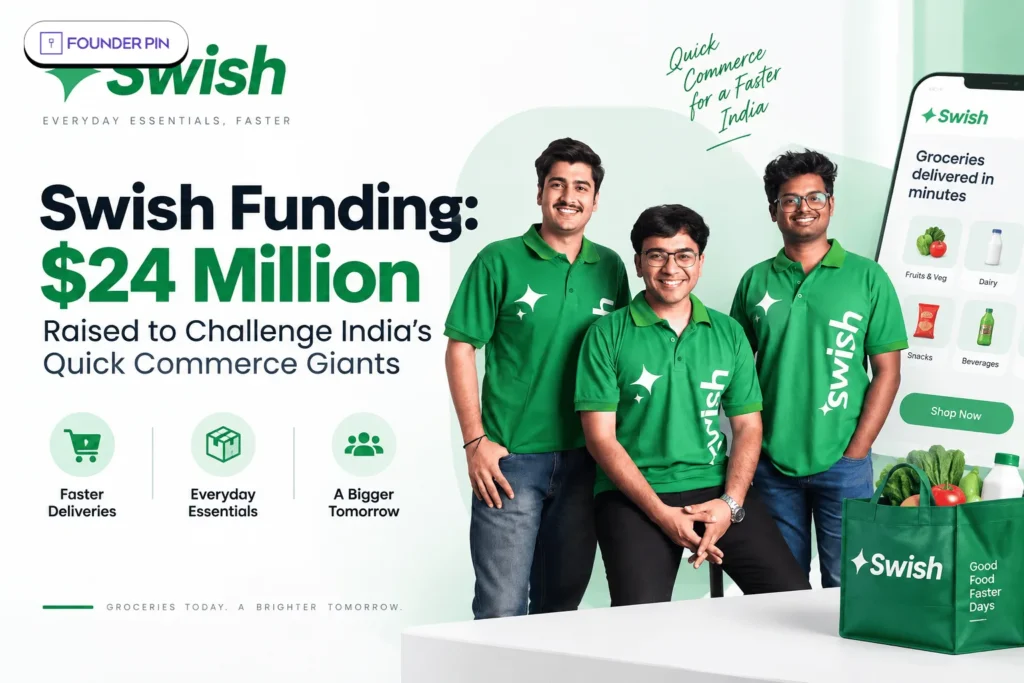
Swish Funding has reached $24 million in its latest fundraise led by Bertelsmann India Investments (BII), with existing investors Accel, Bain Capital Ventures and Hara Global also participating. The Bengaluru-based quick food delivery startup plans to use the fresh capital to expand its neighbourhood kitchen network, strengthen supply-chain infrastructure and enter new cities.
The September 2026 fundraise comes as Swish crosses 1 million monthly orders, putting the startup in a more serious competitive position against fast-food and quick-commerce offerings from companies such as Blinkit, Swiggy and Zepto.
Swish’s latest fundraise is part of a broader trend of Indian startups using venture capital to build and scale technology-led business models. For more context, readers can explore FounderPin’s guide on how to raise funding for startups in India.
Swish Funding: What Happened?
Swish just raised $24 million. Bertelsmann India Investments led the round in September 2026.
Here’s the quick rundown:
- Latest funding: $24 million
- Lead investor: Bertelsmann India Investments
- Existing investors joining in: Accel, Bain Capital Ventures and Hara Global
- Headquarters: Bengaluru
- Founders: Aniket Shah, Ujjwal Sukheja and Saran S.
- Latest reported monthly orders: More than 1 million
- Current footprint: Around 50 pincodes across Delhi-NCR and Bengaluru
- Long-term target: More than 1,000 kitchens over five years
According to BII, Swish has tripled its monthly orders since March 2026. So what’s next? The company wants to go deeper in Delhi-NCR and Bengaluru first, then expand into new cities.
One thing worth clearing up: some reports call this a Series B round, while others say Series C. Nobody has confirmed the official label yet. So for now, it’s safest to simply call it Swish’s latest $24 million fundraise.
How Much Funding Has Swish Raised?
Swish has raised $78 million in total capital across its funding history, according to the company’s latest announcement.
Its funding journey has moved quickly:
| Funding stage | Amount | Key investors / details |
|---|---|---|
| Seed, 2024 | $2 million | Accel and other investors |
| Series A, 2025 | $14 million | Accel and other investors |
| 2026 fundraise | $38 million | Hara Global, Bain Capital Ventures and others |
| Latest fundraise, Sep. 2026 | $24 million | Bertelsmann India Investments and existing investors |
| Total | $78 million | Across four reported rounds |
Swish’s latest announcement puts its total capital raised at $78 million in just two years. Inc42’s funding database also lists four funding events totaling $78 million as of September 2026.
That pace matters because Swish is still a relatively young company. Its ability to repeatedly attract institutional capital shows that investors are willing to back the 10-minute food-delivery model despite the operational challenges involved.
Funding rounds can involve different structures, valuations and investor rights. Founders looking to understand the terminology behind these transactions can refer to FounderPin’s 50 startup terms every founder should know.
Why Is Swish Raising More Money?
The primary goal is expansion—not simply marketing. Swish wants to build more kitchens, increase capacity and create a denser delivery network.
The new capital will support:
- Expansion of neighbourhood kitchens
- Additional capacity in existing markets
- Entry into new cities
- Supply-chain infrastructure
- Technology and operational capacity
- The company’s target of 1,000-plus kitchens over five years
Swish operates a vertically integrated model. Instead of depending entirely on third-party restaurants, it controls the kitchens, technology and last-mile delivery process.
That gives Swish more control over preparation time, menu design and delivery distance—but it also means the company has to invest heavily in physical infrastructure.
How Does Swish Deliver Food in 10 Minutes?
Swish’s model is built around small, high-density neighbourhood kitchens located close to customers.
The company says its kitchens typically operate within roughly a one-kilometre delivery radius. This short distance allows food to be prepared and delivered rapidly.
Its operating model can be simplified into four steps:
- Local kitchen: Food is prepared inside Swish’s own kitchen network.
- Limited radius: Kitchens serve nearby neighbourhoods.
- Fast preparation: The company says average food preparation takes under four minutes.
- Last-mile delivery: Swish handles delivery through its own integrated system.
This is different from the traditional food-delivery marketplace, where a customer orders from a restaurant that may be several kilometres away.
The trade-off is straightforward: fewer kilometres can mean faster delivery, but building enough kitchens to cover a city costs money. That is why Swish’s latest funding is closely tied to network expansion.
Swish vs Blinkit, Swiggy and Zepto
Swish is competing for the same consumer habit—fast food—but its operating model is different from a general quick-commerce marketplace.
Its competitive landscape includes:
- Blinkit Bistro: Quick food delivery through Blinkit’s ecosystem
- Swiggy Bolt: Swiggy’s fast-food delivery proposition
- Zepto Cafe: Zepto’s quick-food offering
- Traditional food delivery: Platforms such as Swiggy and Zomato
- Cloud kitchens: Operators such as Rebel Foods and Curefoods
Swish focuses heavily on its own kitchens and a limited delivery radius. That lets it standardise menus, preparation and fulfilment.
The wider market has also become more challenging. Some rapid-delivery experiments have been scaled back or discontinued, highlighting how difficult it can be to make ultra-fast food delivery work economically at scale.
Swish’s Biggest Growth Signal: Repeat Orders
One of the most important numbers behind Swish’s latest funding is not the $24 million—it is the growth in recurring demand.
Swish says monthly orders have crossed 1 million, after tripling since March 2026. ETtech reported that roughly 70–75% of Swish’s revenue comes from repeat users.
The consumption pattern has also changed.
Initially, quick food delivery could be associated with snacks, coffee or late-night cravings. Swish says lunch and dinner have now become its largest consumption occasions.
That shift could be important for the business model. A service used for everyday meals has the potential to generate more frequent orders than one used only for occasional convenience.
What Does Swish Sell?
Swish has expanded beyond a narrow fast-food menu into a broader everyday-food proposition.
The company currently offers more than 250 SKUs across over 20 food categories, according to reports around the latest funding announcement.
This matters because variety can influence repeat ordering.
If consumers can use the same service for breakfast, lunch, dinner or snacks, Swish has more opportunities to become part of their regular food routine.
But variety also creates operational complexity. More ingredients, recipes and inventory can make forecasting and kitchen management harder. Speed is only useful if the underlying supply chain can keep up.
What Is Next for Swish?
Swish’s next challenge is turning rapid order growth into a sustainable nationwide business.
The company plans to:
- Increase kitchen density in existing markets
- Expand into new cities
- Build more than 1,000 kitchens over five years
- Strengthen supply-chain infrastructure
- Increase capacity to handle rising demand
BII says Swish intends to deepen its kitchen network across Bengaluru and Delhi-NCR while expanding into new markets.
The strategy is ambitious. Building 1,000 kitchens requires substantial investment in real estate, equipment, staff, food supply, technology and delivery operations.
So the real test for Swish is no longer whether consumers will order food in 10 minutes. The bigger question is whether the company can repeat that experience profitably across a much larger network.
Frequently Asked Questions About Swish Funding
1. How much funding has Swish raised?
Swish raised $24 million in its latest funding round in September 2026, led by Bertelsmann India Investments, with existing investors Accel, Bain Capital Ventures and Hara Global also participating. The latest round is reported as a Series B extension.
2. Who invested in Swish’s latest funding round?
Bertelsmann India Investments (BII) led Swish’s $24 million fundraise. Existing investors including Accel, Bain Capital Ventures and Hara Global also participated, continuing their backing of the quick-food delivery startup.
3. How will Swish use the $24 million funding?
Swish plans to use the fresh capital to expand its neighbourhood kitchen network, strengthen supply-chain infrastructure, increase delivery capacity and enter new cities. The company is targeting more than 1,000 kitchens over the next five years.
4. What is Swish’s business model?
Swish operates a vertically integrated 10-minute food-delivery model. It owns its kitchens, technology and last-mile delivery operations, with neighbourhood kitchens typically located within about a one-kilometre radius of customers.
5. How many orders does Swish receive per month?
Swish reported more than 1 million monthly orders as of September 2026, with order volumes having tripled since March 2026. The company currently operates across Bengaluru and parts of Delhi-NCR, including Gurugram, Noida, Delhi and Ghaziabad.
FounderPin Perspective
Swish Funding shows how India’s quick-commerce battle is expanding from groceries into everyday food.
The startup has raised $78 million, crossed 1 million monthly orders, and is targeting a much larger kitchen network.
But capital alone does not guarantee a winning business model.
Swish’s vertically integrated approach gives it greater control over food preparation and delivery, while its neighbourhood-kitchen strategy is designed around speed and density. The next phase will depend on whether those advantages remain attractive as the company expands beyond its current footprint.
For India’s food-tech market, one thing is already clear: the race is no longer just about delivering food. It is about how quickly, how frequently and how efficiently that food can reach the consumer.
For founders and investors following startup funding, Swish is also a useful example of how capital, business models and scale come together. Those interested in the investment side can read FounderPin’s guide on how to invest in startups in India.
Want to Learn More About Startups and Funding?
Swish’s $24 million fundraise is a useful example of how startups raise capital, scale operations and build a competitive advantage in a crowded market. If you want to understand startup funding, business models, growth strategies and the fundamentals every founder should know, explore the FounderPin course.
Learn practical startup and business concepts with FounderPin → Explore the Course
Have a Startup Story or Business Enquiry?
Do you have a startup, funding announcement, founder story or business opportunity you would like to discuss with FounderPin? Get in touch with our team for collaborations, content opportunities, partnerships or general enquiries.
Contact FounderPin → Get in Touch
SHARE