Zepto IPO 2026: Can Quick Commerce Deliver Profits for Investors?
Table of Contents
Toggle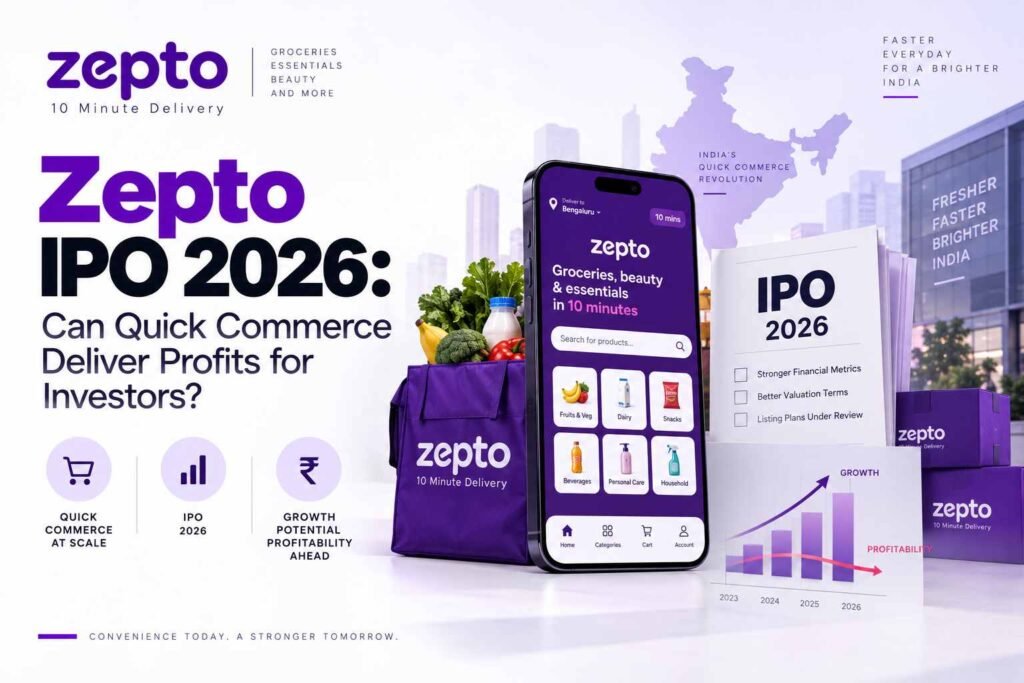
Zepto IPO 2026 has turned into one of the more closely watched startup-market stories in India right now — mostly because it ties together two narratives that don’t usually sit well together: explosive growth and equally explosive losses.
Zepto’s FY26 operating revenue more than doubled to ₹22,623.5 crore, but its net loss for the year widened too, hitting roughly ₹5,905 crore. And the scale is genuinely hard to ignore — around 640 million orders processed, 47.9 million annual transacting users, and 1,139 dark stores running by March 2026.
So here’s the real question: can quick commerce actually make money for the people investing in it? Honestly, the answer has less to do with how fast Zepto grows and more with whether all that growth eventually turns into real margins and cash in the bank.
Zepto IPO 2026: What Is the Current Status?
Zepto has come a long way in the IPO process — but the road hasn’t been entirely smooth, and the listing timeline has hit a pause along the way.
Here’s where things stand:
- Zepto filed confidential draft IPO papers back in December 2025
- Regulators gave their approval sometime in 2026
- The updated DRHP put a ₹8,010 crore fresh issue on the table, plus an offer-for-sale component
- All told, the proposed issue size was reported at roughly ₹9,000–₹10,000 crore
- Then in July 2026, Zepto reportedly hit pause on the IPO altogether, choosing instead to explore a pre-IPO fundraise of over ₹1,000 crore after valuation talks with investors didn’t quite land where expected
That pause matters more than it might seem. It’s a reminder that the IPO story was never just about getting to the listing bell — valuation expectations and how much appetite the public markets actually have both play a real role too.
Zepto Financial Performance: Growth Is Strong, But Losses Remain
Zepto’s biggest IPO challenge is the gap between revenue growth and profitability.
| Metric | FY25 | FY26 |
|---|---|---|
| Revenue from operations | ₹11,109.9 crore | ₹22,623.5 crore |
| Net loss | ₹4,699.7 crore | ₹5,905.1 crore |
| Annual transacting users | 3.84 crore | 4.79 crore |
| Dark stores | 1,029 | 1,139 |
| Orders | — | ~640 million |
Sources: Zepto’s updated DRHP reporting and financial coverage.
The positive side is obvious: revenue more than doubled in FY26.
The catch is equally obvious: losses increased too. For public-market investors, that creates a critical question—how much additional growth is required before the business becomes consistently profitable?
Why Zepto’s Unit Economics Matter More Than Revenue
Zepto needs each order and store to become economically stronger as the business scales.
Its Q4 FY26 adjusted EBITDA loss was about ₹1,248 crore, but the adjusted EBITDA loss per order improved to approximately ₹59.4, compared with ₹142.7 a year earlier. Its adjusted EBITDA margin also improved from -37.5% to -15.3%.
That is an important improvement.
In simple terms, Zepto appears to be getting more efficient as order volumes increase. But improving losses are not the same as making profits.
The company still needs to demonstrate that improvements can continue without relying excessively on discounts, new-store investment or external capital. This is why understanding how startups raise and deploy capital is important. FounderPin’s coverage of Swish Funding News: Inside the $38M Series B offers another example of how growth-stage startups use funding to expand their businesses
For founders and investors trying to understand whether rapid growth actually creates value, FounderPin’s guide to Unit Economics: IPL 2026 Startup CAC Analysis explains why CAC, margins and customer economics matter beyond headline growth.
The Quick-Commerce Profitability Problem
Quick commerce has attractive demand, but the operating model is expensive.
The model requires:
- Dense dark-store networks
- Warehousing and inventory management
- Delivery partners
- Technology infrastructure
- Customer acquisition
- Promotions and discounts
- High order availability
The economics become more attractive when a store handles more orders because fixed costs can be spread across a larger volume.
Zepto’s orders per store per day increased to around 2,140 in Q4 FY26 from 1,425 a year earlier, according to Moneycontrol’s analysis of the company’s filing.
That is one of the more important operating indicators to watch.
Zepto vs Blinkit vs Instamart: Competition Is Still Intense
Zepto is competing in a market where scale, store density and profitability are all becoming important. This competitive environment is also visible in how brands use major sporting events to drive customer acquisition, as explored in FounderPin’s analysis of Moment Marketing: Zepto vs Blinkit During Matches.
Its major listed rivals include:
- Blinkit, operated by Eternal
- Instamart, operated by Swiggy
- Zepto as the standalone quick-commerce player
Q4 FY26 comparisons reported by Moneycontrol showed Blinkit with higher revenue and positive adjusted EBITDA, while Zepto remained loss-making on an adjusted EBITDA basis.
This makes profitability a particularly important issue for Zepto.
Public investors may increasingly compare not just how many orders a company delivers, but how much economic value it creates from those orders.
How Zepto Could Become Profitable
Zepto has several potential routes to profitability, but execution will determine whether they work.
1. Higher orders per dark store
More orders from existing stores can improve fixed-cost absorption.
Zepto’s rising orders per store suggest that its network is becoming more productive.
2. Advertising revenue
Advertising is becoming an increasingly important monetisation channel.
TechCrunch reported that Zepto’s advertising revenue grew more than 151% year over year to ₹1,640 crore in FY26, faster than its overall operating revenue growth.
This matters because advertising can potentially carry attractive margins compared with physical delivery operations.
3. Better contribution margins
Reducing discounts, improving delivery efficiency and increasing basket sizes can help improve economics per order.
The goal is simple: earn more from each customer interaction than it costs to serve it.
4. Scale without uncontrolled expansion
Opening stores can increase reach, but every new store requires investment.
Zepto therefore needs to balance market expansion with store-level profitability rather than treating store count as the only growth metric.
What Could Go Wrong for Zepto IPO Investors?
Honestly, the risk list here isn’t short: valuation, cash burn, brutal competition, and the basic question of whether this growth rate can actually hold.
Here’s what’s worth watching:
- The losses haven’t stopped: FY26 net loss came in around ₹5,905 crore, and that’s not a small number to explain away.
- Valuation is a sore spot: Reports from July suggest valuation disagreements were a big part of why the IPO got paused in the first place.
- The competition isn’t backing off: Blinkit and Instamart are both still pouring money into quick commerce, and neither shows signs of slowing down.
- Growth could get pricier: If discounts stay necessary to keep customers coming back, acquisition costs could eat into margins fast.
- Store economics need time: Expanding quickly tends to pile on fixed costs before individual stores actually mature into profitability.
- Public markets won’t be as patient: Once Zepto lists, investors are likely to demand real proof of sustainable cash generation, not just growth numbers.
There’s also a bigger shift happening around it. The 2026 startup IPO environment, in general, seems far more focused on profitability, cash discipline, and predictable unit economics than it is on growth for growth’s sake.
Can Zepto Deliver Profits for Investors?
Zepto has demonstrated strong operating growth, but profitability is not yet established at the company level.
The bullish argument is straightforward:
- Revenue is growing rapidly.
- Order volumes are scaling.
- User numbers are increasing.
- Store productivity is improving.
- Advertising provides an additional revenue stream.
- Per-order adjusted EBITDA losses have narrowed.
The cautious argument is equally important:
- Full-year net losses are still very large.
- The company continues to consume significant capital.
- Competition remains intense.
- Valuation expectations may affect IPO timing and investor demand.
Therefore, the Zepto IPO 2026 story should be viewed as a transition from growth at scale toward profitable scale.
What Investors Should Watch Before the Zepto IPO
Five numbers can tell investors more than a flashy IPO headline.
- Adjusted EBITDA loss per order — Is it consistently falling?
- Orders per dark store — Are existing stores becoming more productive?
- Contribution margin — Can Zepto earn more after direct fulfilment costs?
- Advertising revenue — Is high-margin monetisation becoming meaningful?
- Cash burn — How much additional capital does growth require?
These metrics can help distinguish genuine operating leverage from growth that simply requires more spending.
FounderPin Perspective
Zepto has already proved that Indian consumers will embrace ultra-fast grocery delivery at enormous scale.
The harder test is now financial.
A successful Zepto IPO 2026 would require the company to convince public investors that today’s huge order volumes can eventually translate into durable profits and cash flows.
The interesting part is that Zepto does not necessarily need to stop growing. It needs to show that every layer of growth is becoming more efficient.
In quick commerce, speed wins customers. Unit economics win investors.
Key Takeaways
- Zepto’s FY26 revenue reached about ₹22,624 crore.
- FY26 net loss increased to approximately ₹5,905 crore.
- The company processed roughly 640 million orders in FY26.
- Annual transacting users reached about 47.9 million.
- Orders per store improved materially in Q4 FY26.
- Advertising revenue is emerging as a potentially important monetisation channel.
- Zepto’s IPO plans were reportedly paused in July 2026 amid valuation discussions.
- Profitability and cash efficiency remain central issues for the public-market case.
Frequently Asked Questions About Zepto IPO 2026
1. What is the Zepto IPO 2026?
The Zepto IPO 2026 refers to the company’s planned public listing in India. Zepto has filed IPO documents and proposed a combination of fresh shares and an offer for sale. The timing and final issue structure may change based on market conditions and the company’s plans.
2. Is Zepto profitable in 2026?
No. Zepto reported a net loss of approximately ₹5,905 crore in FY26 despite revenue of around ₹22,624 crore. However, some operating metrics, including adjusted EBITDA loss per order, improved during the year.
3. What is Zepto’s valuation for the 2026 IPO?
Zepto’s IPO valuation has been subject to changing market expectations and funding discussions. Reports in 2026 indicated that valuation expectations were one factor behind the company’s decision to pause its IPO plans and explore additional pre-IPO funding. The final IPO valuation will depend on the eventual issue terms and market conditions.
4. Can Zepto become profitable?
Zepto could potentially improve profitability through higher orders per dark store, better contribution margins, advertising revenue, larger baskets and greater operating efficiency. However, the company still needs to demonstrate that these improvements can translate into sustained company-wide profitability and positive cash flow.
5. What should investors check before the Zepto IPO?
Investors should examine Zepto’s revenue growth, adjusted EBITDA loss per order, contribution margin, cash burn, orders per dark store, customer growth and advertising revenue. These indicators can provide a clearer picture of whether Zepto’s rapid growth is translating into stronger business economics.
SHARE