
SUGAR Cosmetics Valuation Drop: What Happened to India’s D2C Boom?
Table of Contents
ToggleSUGAR Cosmetics valuation drop explained: funding, losses, store cuts and what it reveals about the changing D2C boom in India.
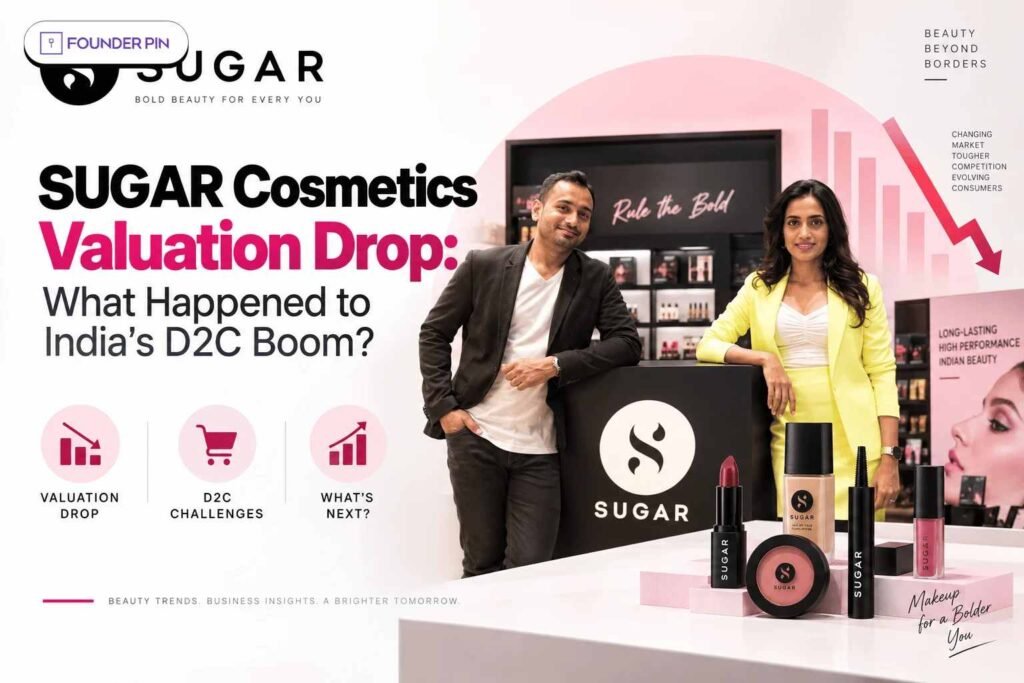
India’s D2C beauty story was once built around a simple formula: build a strong brand online, attract young consumers, raise venture capital, and expand rapidly into offline retail.
SUGAR Cosmetics became one of the most visible examples of that playbook. But its latest funding round tells a very different story.
In September 2026, SUGAR raised about ₹144.5 crore from existing investor A91 Partners, while its implied valuation fell sharply compared with its previous highs. Recent reports put the post-money valuation around ₹550–600 crore to ₹755 crore, depending on the transaction calculation and reporting methodology. That compares with a peak valuation of roughly ₹3,000 crore or more during its earlier funding period.
So, what happened to SUGAR Cosmetics—and does its valuation drop signal a broader problem for India’s D2C boom?
SUGAR Cosmetics Valuation Drop: What Changed?
The biggest change is that investors are now placing greater weight on profitability, repeat demand and operational efficiency rather than rapid expansion.
Key points:
- SUGAR raised approximately ₹144.5 crore from A91 Partners in September 2026.
- Its valuation is substantially below its earlier peak.
- FY25 operating revenue fell to around ₹404 crore from ₹505 crore.
- FY25 net loss increased to roughly ₹135 crore from ₹68 crore.
- The company is now cutting stores and SKUs as part of a turnaround strategy.
The valuation correction therefore cannot be viewed simply as an investor losing interest in beauty.
It reflects a change in how investors value consumer startups: growth alone is no longer enough when that growth requires heavy spending and produces widening losses.
From a ₹3,000 Crore Story to a Much Lower Valuation
SUGAR’s rise shows how dramatically investor expectations changed during India’s D2C funding boom.
In May 2022, SUGAR announced a $50 million Series D round led by L Catterton, with existing investors including A91 Partners, Elevation Capital and India Quotient participating. Contemporary reports placed the company’s valuation at around the $500 million mark, although reported rupee equivalents varied with exchange rates.
That funding supported an aggressive expansion strategy.
SUGAR expanded its physical distribution while continuing to build its digital brand. By 2024, the company said it had more than 200 exclusive brand outlets and a presence across 45,000+ retail outlets in 550+ cities.
The problem was not expansion itself.
The problem was that distribution does not automatically create consumer demand.
The valuation correction also shows why founders and investors need to understand how valuation, dilution, burn rate and unit economics interact. FounderPin’s 50 Startup Terms to Know provides a useful primer on these concepts
Moneycontrol’s September 2026 reporting says SUGAR’s broader retail footprint eventually crossed 2,400 stores, while the company has since begun shrinking its network and targeting roughly 1,000–1,100 stores.
That is a major strategic reset.
Why Did SUGAR Cosmetics Struggle?
The central issue was the gap between aggressive scale and sustainable unit economics.
Several factors came together:
- Rapid offline expansion increased fixed costs.
- Consumer demand did not grow evenly across geographies.
- Inventory problems affected product availability.
- Competition intensified across beauty and cosmetics.
- Revenue declined while losses increased.
- Investors became more selective about D2C growth.
SUGAR’s FY25 numbers make the pressure visible. Operating revenue dropped approximately 20% from FY24, while the net loss almost doubled to ₹135 crore.
The company’s earlier strategy had also relied heavily on expanding its offline footprint.
In 2024, SUGAR said around 80% of its stores had reached break-even and that it expected the remaining stores to move toward profitability.
But subsequent performance showed that store-level economics remained difficult enough to require a much deeper restructuring.
The Offline Expansion Problem
SUGAR’s experience highlights an important D2C lesson: moving offline changes the economics of the business.
An online-first brand can experiment with products and audiences relatively quickly.
Physical retail introduces:
- Store costs
- Distributor margins
- Inventory requirements
- Working capital pressure
- Geographic differences in demand
- Higher operational complexity
According to Moneycontrol’s September 2026 report, SUGAR is now reducing its retail footprint, cutting its SKU count and moving toward a roughly 50:50 online-offline mix, compared with a more offline-heavy model during its expansion phase.
The company reportedly once had around 850 SKUs and is moving toward a much narrower portfolio.
That sounds less glamorous than opening hundreds of stores—but sometimes boring operational discipline is exactly what a consumer startup needs.
What Happened to India’s D2C Boom?
SUGAR’s valuation correction reflects a broader shift in India’s D2C ecosystem, but it does not mean the D2C model is dead.
India’s D2C startups raised about $757 million in 2024, down 18% from $930 million in 2023 and less than half the $1.6 billion raised in 2022, according to Tracxn data reported by The Economic Times.
The reasons included:
- Higher customer acquisition costs
- Market saturation
- Investor caution
- Greater focus on unit economics
- Fewer opportunities for rapid, low-cost scaling
The funding environment has not completely disappeared.
In January 2026, Financial Express reported renewed VC interest in D2C beauty, but investors were increasingly looking for repeat demand, tighter costs and clearer paths to profitability.
That distinction matters.
The D2C boom is evolving from “grow at any cost” to “prove that the growth works.”
SUGAR’s experience also fits into the broader shift in India’s startup funding environment. For a wider look at how investor expectations are changing, see FounderPin’s guide to Top Startup Trends in India in 2026.
Beauty Is Still a Big Opportunity
SUGAR’s valuation decline should not be interpreted as evidence that India’s beauty market has stopped growing.
India’s beauty and personal-care category continues to attract entrepreneurs, investors and large consumer companies.
Beauty startups also continued attracting funding in 2025. The Economic Times reported that 20 leading homegrown D2C beauty brands raised $63.1 million between January and September 2025.
The difference is that investors increasingly want brands to demonstrate:
- Repeat purchases
- Strong product-market fit
- Healthy contribution margins
- Efficient customer acquisition
- Inventory discipline
- Sustainable offline economics
In other words, the opportunity remains, but the rules have changed.
What SUGAR’s Valuation Drop Teaches Founders
The biggest lesson is that revenue growth and business quality are not the same thing.
A startup can increase sales while simultaneously becoming harder to operate.
Founders should therefore track more than GMV or topline growth.
Important metrics include:
- Customer acquisition cost
- Repeat purchase rate
- Contribution margin
- Inventory turns
- Store-level profitability
- Cash burn
- Working-capital requirements
- Revenue per retail location
SUGAR’s experience also shows why physical expansion should follow proven demand rather than create the expectation of demand.
More stores can create more visibility—but they can also create more fixed costs.
A falling valuation also highlights why founders should understand the mechanics of fundraising before accepting capital. FounderPin’s guide to raising funding for startups in India covers funding stages, investor expectations and common fundraising mistakes
FounderPin Perspective
SUGAR Cosmetics remains an important case study in India’s consumer startup ecosystem because its story contains both sides of the D2C opportunity.
The company successfully built a recognisable Indian beauty brand, attracted major institutional investors and expanded from digital commerce into a large offline network.
But its later financial performance shows the difficulty of converting brand recognition and distribution into sustainable profitability.
The SUGAR Cosmetics valuation drop is therefore less about the end of India’s D2C boom and more about its next phase.
The market’s focus is moving beyond “How rapidly can you expand?” to “Can you scale profitably and repeatably?”
For founders, that may be a tougher question—but it is also a healthier one.
FAQs
1. Is SUGAR Cosmetics struggling?
SUGAR Cosmetics has faced financial and operational pressure in recent years, including declining revenue and higher losses. The company has responded by reducing its store footprint, cutting SKUs and focusing more closely on profitable growth. However, these challenges do not mean the brand has exited the market or that its long-term prospects are determined.
2. Which is better, SUGAR Cosmetics or Nykaa?
SUGAR Cosmetics and Nykaa operate with different business models, so there is no universal answer. SUGAR is primarily a beauty brand focused on its own products, while Nykaa operates a broader beauty and fashion retail platform and also has private-label brands. The better option depends on whether a consumer values a specific SUGAR product or prefers Nykaa’s wider product selection and retail ecosystem.
3. Is SUGAR Cosmetics in profit or loss?
SUGAR Cosmetics reported a net loss in FY25. Its loss reportedly increased to around ₹135 crore, while operating revenue declined to approximately ₹404 crore. The company has been taking steps to improve its cost structure and move toward more sustainable economics.
4. What is Vineeta Singh’s net worth?
Vineeta Singh is the co-founder and CEO of SUGAR Cosmetics. Estimates of her personal net worth vary significantly across online sources because private-company holdings, investments and other assets are not fully disclosed publicly. Therefore, unverified internet estimates should not be treated as an official figure.
5. Why did SUGAR Cosmetics’ valuation fall?
SUGAR Cosmetics’ valuation fell amid weaker financial performance, including declining revenue and increased losses. The company has also shifted from aggressive expansion toward reducing stores, SKUs and operating costs. The valuation correction reflects investors placing greater emphasis on profitability, cash efficiency and sustainable growth.
SHARE