D2C Growth in India: Why Indian D2C Startups Are Growing Faster in 2026
Table of Contents
Toggle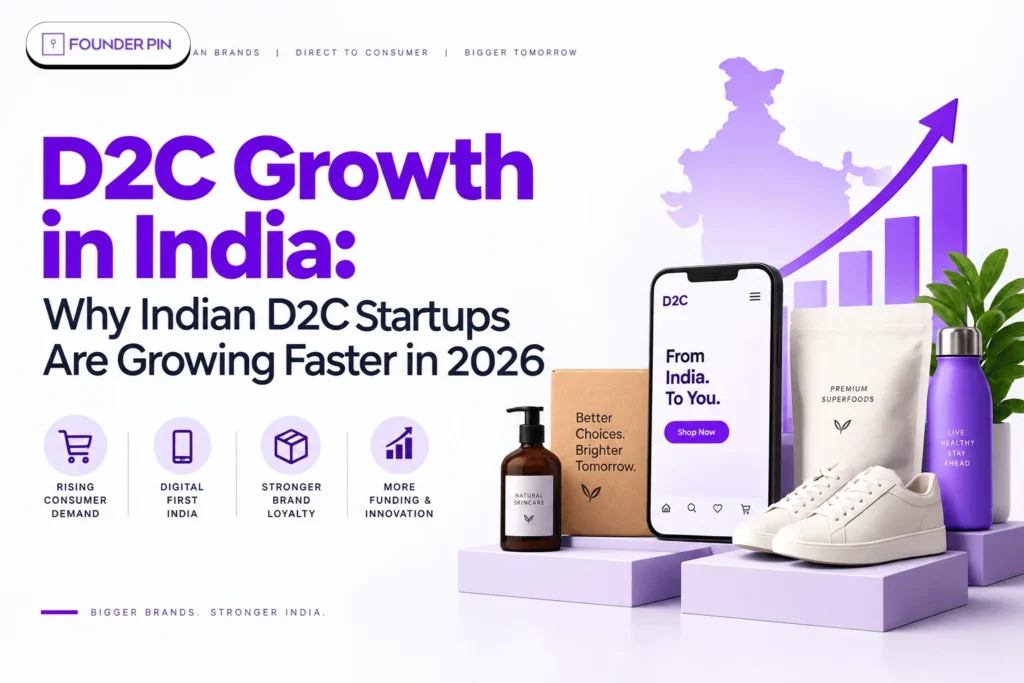
India’s direct-to-consumer (D2C) market is moving beyond the “Instagram brand” phase. In 2026, successful D2C startups are combining digital discovery, quick commerce, marketplaces, offline stores, better logistics, and stronger repeat purchasing.
Redseer estimates India’s online retail market will cross $90 billion in 2026, growing about 22–24% year over year. Its H1 2026 data also shows online retail grew roughly 25% YoY, making 2026 one of the strongest growth years in recent history.
So, what is driving D2C growth in India?
Why Is D2C Growth in India Accelerating in 2026?
The biggest drivers are digital consumer adoption, Tier-2 and Tier-3 demand, social discovery, quick commerce, omnichannel expansion, and easier access to digital commerce infrastructure.
- More consumers are comfortable buying directly online.
- Smaller cities are becoming important demand centres.
- Quick commerce has created another digital shelf for brands.
- D2C companies can test products faster than traditional consumer businesses.
- Brands are increasingly combining online and offline distribution.
India’s D2C opportunity is therefore not just about having a website. It is about building a brand that can meet consumers wherever they shop.
IMA’s 2026 research highlights the same shift: D2C is becoming a brand-building route, while offline expansion, quick commerce and marketplaces increasingly support scale.
1. Tier-2 and Tier-3 Cities Are Becoming Growth Engines
A major reason for D2C growth in India is that demand is spreading beyond large metros.
- Consumers in smaller cities have greater access to digital commerce.
- Regional consumers can discover niche brands without visiting physical stores.
- Logistics networks now reach more locations.
- Social media reduces the geographic advantage once enjoyed by traditional retailers.
Redseer says Tier-2+ cities have moved from being relatively slower markets to important growth contributors, particularly in categories such as fashion and beauty.
This changes the D2C playbook. A startup no longer needs thousands of stores before it can reach customers across India.
2. Social Media Has Turned Product Discovery Into Entertainment
D2C brands can build awareness through content before consumers even search for the product.
- Instagram and YouTube help brands demonstrate products.
- Influencers provide social proof.
- Short-form video makes product education easier.
- User-generated content can strengthen trust.
This is particularly useful in beauty, personal care, fashion, food and lifestyle categories.
The interesting part is that consumers may discover a product because of a creator, understand it through content, and finally purchase it through a marketplace, brand website or quick-commerce app.
That means the customer journey is becoming less linear.
3. Quick Commerce Is Creating a New D2C Distribution Channel
Quick commerce is increasingly becoming more than a grocery-delivery model; it is becoming another discovery and distribution channel for consumer brands.
- Brands can reach customers within minutes in supported locations.
- Consumers can purchase products during moments of immediate need.
- Beauty, personal care, food and household categories can benefit from faster fulfilment.
- Quick-commerce platforms provide brands with another route beyond their own websites.
Bain and Flipkart data reported by Reuters showed that quick commerce accounted for more than two-thirds of India’s e-grocery orders in 2024, while the sector’s market had expanded sharply from 2022 levels.
By 2026, the larger lesson for D2C founders is simple: distribution speed can influence brand growth almost as much as advertising.
4. D2C Brands Are Moving Offline
The modern D2C model is increasingly omnichannel rather than purely digital.
CBRE reported that D2C brands accounted for approximately 28% of India’s retail leasing activity in H1 2026, compared with about 23% in H1 2025.
Why are digital-first companies opening physical stores?
- Physical stores increase visibility.
- Customers can experience products before buying.
- Offline presence can strengthen credibility.
- Stores can support local fulfilment and omnichannel sales.
This is especially important for categories where customers want to touch, test, taste or try products.
The irony is amusing: D2C started by bypassing traditional retail, and many successful brands are now discovering that retail still matters.
5. ONDC Is Lowering Digital Commerce Barriers
Open commerce infrastructure is giving smaller brands another way to reach online consumers.
The Government of India says ONDC is designed to reduce dependence on individual platforms by allowing sellers on one participating application to become discoverable across other participating buyer applications.
As of December 9, 2025, the government reported more than 1.16 lakh retail sellers live on ONDC across 630+ cities and towns.
ONDC itself highlights D2C benefits including:
- Wider digital visibility
- Connected logistics
- Lower channel commissions
- Access to multiple buyer applications
- Growth support for participating brands
For emerging D2C businesses, more distribution options can mean less dependence on a single marketplace.
6. Consumers Want Better Products, Not Just Cheaper Products
Indian consumers are becoming more willing to pay for differentiated products when the brand communicates clear value. This trend is creating opportunities across beauty, food, technology and other consumer categories. For founders exploring new opportunities, our guide to 20 Technology Startup Ideas for 2026 offers additional ideas for building scalable businesses.
This is visible in categories such as:
- Beauty and skincare
- Health and wellness
- Premium food
- Personal care
- Fashion
- Pet care
- Home and lifestyle products
For example, India’s beauty and personal-care market is projected to expand significantly through 2030, with digital channels becoming increasingly important.
This creates room for focused D2C brands that solve specific customer problems instead of trying to sell everything to everyone.
7. Data Gives D2C Startups Faster Feedback
D2C businesses can learn directly from customer behaviour and adjust products, pricing and marketing faster.
Understanding key startup concepts such as customer acquisition cost, unit economics and valuation can help founders make better growth decisions. Our 50 Startup Terms Every Founder Should Know guide explains these concepts in simple language.
A traditional consumer company may need multiple distribution layers before it gets meaningful feedback.
A D2C startup can track:
- Conversion rate
- Repeat purchases
- Customer acquisition cost
- Average order value
- Product reviews
- Cart abandonment
- Subscription behaviour
- Customer lifetime value
This does not automatically make every D2C startup profitable. But it can shorten the feedback loop between product → customer → data → improvement.
That learning advantage can become a meaningful competitive asset.
D2C Growth in India: What Comes Next?
The next phase of D2C growth will likely focus less on acquiring customers at any cost and more on profitable, repeatable growth.
The market is becoming more competitive. Online retail is expanding rapidly, but customer acquisition, discounts, logistics and advertising still cost money.
The stronger D2C businesses are therefore building several growth engines:
| Growth Engine | Why It Matters |
|---|---|
| Brand website | Customer relationship and first-party data |
| Marketplaces | Wider consumer reach |
| Quick commerce | Speed and impulse purchases |
| Offline stores | Trust and product experience |
| Social media | Discovery and community |
| ONDC | Additional digital distribution |
| Repeat purchases | Better customer economics |
McKinsey’s 2026 analysis similarly describes India’s D2C opportunity as part of a broader shift toward flexible, direct and lower-cost ways for smaller businesses to reach consumers.
The Bottom Line
D2C growth in India is accelerating because the entire commerce ecosystem is becoming easier to access.
Consumers have more digital purchasing options. Smaller cities are becoming important demand centres. Quick commerce is expanding distribution possibilities. Physical retail is returning to the growth equation, while ONDC is creating additional digital infrastructure.
The winners in 2026 will not necessarily be the brands with the loudest advertising.
They will be the ones that combine strong products, trusted branding, efficient distribution, repeat customers and healthy unit economics.
For Indian founders, that is the real D2C opportunity: build a brand first, then build the distribution system around it.
FAQs
1. Is D2C profitable in India?
Yes, D2C can be profitable in India, but profitability depends on product margins, customer acquisition costs, repeat purchases, pricing and distribution. Redseer reports that several new-age Indian consumer brands have reached ₹100–500 crore revenue while growing profitably. However, rapid sales growth alone does not guarantee sustainable profits.
2. What is the future of D2C brands in India?
The future of D2C brands in India is increasingly omnichannel. Brands are combining their own websites with marketplaces, quick commerce, social media and physical stores. McKinsey estimates India’s D2C e-commerce channel could grow from around $10–12 billion currently to approximately $60 billion by 2030.
3. What is the size of the D2C market in India?
India’s D2C market size varies depending on how researchers define D2C. McKinsey estimates the D2C e-commerce channel at around $10–12 billion currently, with potential to reach $60 billion by 2030. Other research firms report substantially larger figures because they use broader market definitions, so methodology matters.
4. What are the top 5 D2C companies in India?
There is no official ranking of India’s top D2C companies because brands can be compared by revenue, valuation, profitability or market reach. Prominent D2C-origin brands include boAt, Lenskart, Mamaearth, Wakefit and SUGAR Cosmetics, covering categories such as electronics, eyewear, beauty, home products and personal care.
5. How many D2C brands fail in India?
There is no reliable India-wide statistic showing exactly how many D2C brands fail. Claims that “90% of D2C brands fail” are widely repeated but lack strong supporting evidence. Redseer data shows that relatively few new-age consumer brands scale from ₹100 crore to ₹500 crore, but that does not necessarily mean the others failed.
SHARE