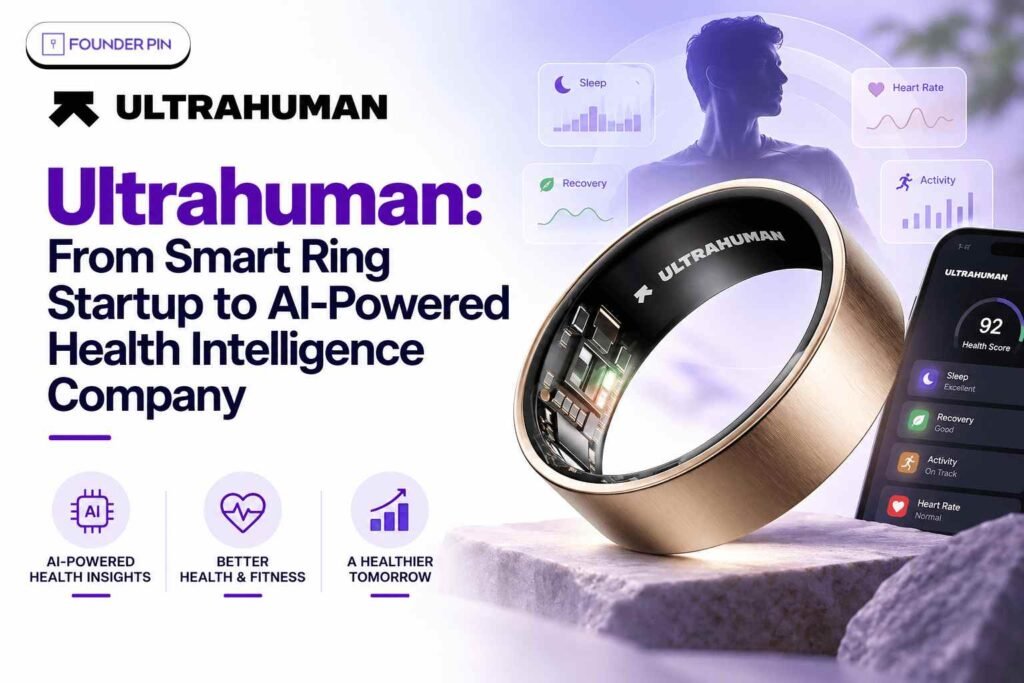
Founded in India, Ultrahuman first gained attention through metabolic health tracking and later expanded into smart rings. By September 2026, its ambitions had grown considerably: the company raised $70 million, launched new AI and data initiatives, and began positioning the human body itself as a new interface between people and technology.
Ultrahuman’s story is interesting because it did not start by trying to become an AI company. It built hardware, collected physiological data, developed software around that data, and gradually expanded the number of signals it could interpret.
The Ultrahuman Ring Turned Hardware Into a Data Platform
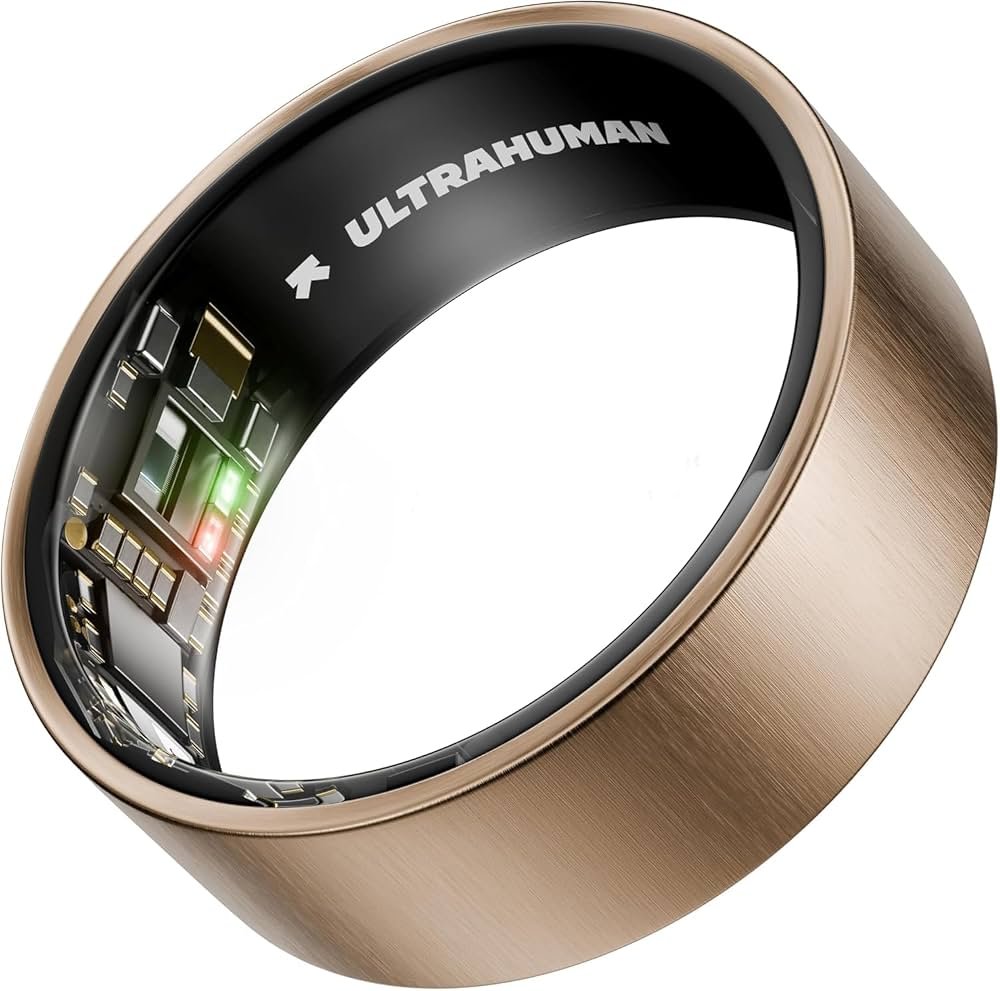
The Ultrahuman Ring AIR helped move the company into the increasingly competitive smart-ring market.
The device focuses on areas such as:
- Sleep
- Recovery
- Movement
- Heart-rate measurements
- Heart-rate variability
- Skin temperature
- Women’s health
- Metabolic insights
Ring AIR weighs about 2.4 grams and offers roughly 4–6 days of battery life, according to Ultrahuman.
The company also introduced Ring PRO in 2026, with a redesigned architecture and up to 15 days of battery life.
That longer battery life is more than a specification-sheet flex. Continuous monitoring becomes much more useful when users do not have to remove the device every couple of days to charge it.
Ultrahuman’s Business Model Is Expanding Beyond Hardware
Ultrahuman’s business is increasingly built around a hardware-plus-software ecosystem.
Its PowerPlugs allow users to add specialized experiences to the Ultrahuman platform. These cover areas such as cardiovascular insights, women’s health and other wellness applications.
The company’s FY2025 financial disclosures reported $64 million in operating revenue, compared with $12 million in FY2024, along with $8.2 million in net profit.
Smart rings still accounted for the majority of that revenue. However, the growing software layer gives Ultrahuman another potential source of recurring revenue.
This is an important strategic shift: the ring gets the product into the user’s life, while software can keep adding value after the hardware purchase.
Ultrahuman’s profitable growth is a useful contrast to the equity-heavy playbook. Many founders start with bootstrapped startup funding and government grants before ever approaching venture investors.
Blood Vision Expands Ultrahuman Beyond Wearables
Ultrahuman’s next major move was to connect wearable information with blood biomarkers.
Its Blood Vision service analyzes more than 100 biomarkers covering areas such as cardiovascular, metabolic, hormonal and inflammatory health.
The underlying idea is straightforward:
A wearable can show what is happening continuously, while laboratory testing can provide a deeper biochemical snapshot.
Combining the two can potentially create a richer picture than relying on either source alone.
Ultrahuman launched Vision Cloud in 2025, allowing users to upload medical test reports and receive interpreted insights alongside their wearable information.
The company is therefore moving from a “smart ring” proposition toward a broader personal health data platform.
Jade AI Is the Next Step
In February 2026, Ultrahuman introduced Jade, which the company describes as a real-time biointelligence AI platform.
Jade is designed to interpret information from multiple parts of the Ultrahuman ecosystem, including Ring data, Blood Vision and other health inputs.
The distinction is important.
Traditional wearable software mostly answers questions such as:
How did I sleep?
An AI-powered health intelligence layer aims to answer a more useful question:
What does my recent health data mean, and what pattern should I pay attention to?
That transition—from measurement to interpretation—is where much of the future value of health technology could sit.
Ultrahuman Is Building a Larger Health Data Ecosystem
The company’s 2026 product roadmap shows how broad its ambitions have become.
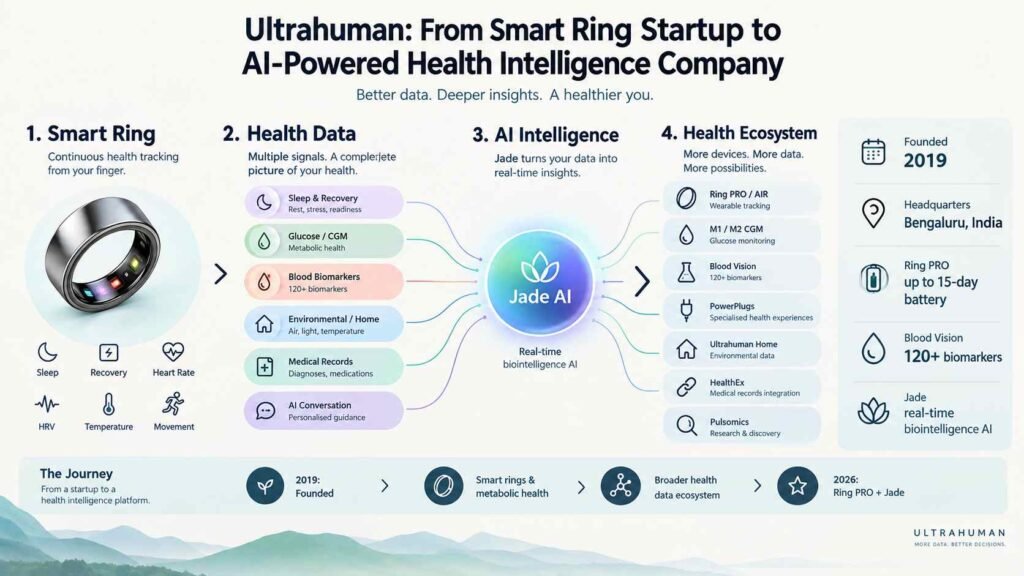
Its ecosystem now includes:
- Ring AIR and Ring PRO for continuous wearable data
- M1/M2 CGM offerings for glucose monitoring
- Blood Vision for laboratory biomarkers
- PowerPlugs for specialized health experiences
- Ultrahuman Home for environmental data
- Jade for AI-powered interpretation
- Pulsomics for opt-in physiological research
- HealthEx integration for connecting medical records
In September 2026, Ultrahuman launched the HealthEx PowerPlug, which connects consented medical records with continuous Ring measurements.
The company says the system can place information such as diagnoses, medications and procedures alongside wearable signals including resting heart rate, HRV, skin temperature and sleep.
That represents a major change in the company’s original proposition.
Ultrahuman is no longer just collecting data from a ring. It is attempting to connect different layers of a person’s health information.
The $70 Million Funding Round Signals a Bigger Ambition
In September 2026, Ultrahuman announced a $70 million financing roundinvolving investors including Qualcomm Ventures, Labcorp, Alpha Wave, Blume, Nexus and Alteria Capital.
TechCrunch reported that the round valued the company at approximately $365 million, compared with a reported $120 million valuation in 2023.
The funding comes at an important point in Ultrahuman’s evolution.
The company is now competing not only in smart rings but also across health data, diagnostics, AI and human-computer interfaces.
Qualcomm’s participation is particularly relevant to Ultrahuman’s hardware ambitions because the company is exploring ways for smart rings to become more capable computing interfaces.
Funding at this scale is far from the norm for early-stage companies. Founders who want to understand how capital is actually raised at each stage can read FounderPin’s full guide to raising funding for startups in India.
Why Ultrahuman’s Strategy Is Different
Ultrahuman’s core strategy can be summarized in four steps:
Hardware → Data → Intelligence → Ecosystem
First, the company puts sensors close to the body.
Second, those sensors generate continuous physiological data.
Third, software and AI attempt to interpret the signals.
Finally, additional products and integrations expand the amount of health information available to the platform.
That creates a potential flywheel: more devices can generate more data, more data can improve insights, and better insights can make the broader ecosystem more useful.
But health intelligence is not simply another software category. Accuracy, privacy, clinical validation and responsible communication matter enormously.
Ultrahuman itself states that its PowerPlugs are generally wellness products and should not be treated as substitutes for professional medical care.
What Comes Next for Ultrahuman?
The next phase of Ultrahuman will likely be less about selling a ring and more about building a continuous personal health intelligence layer.
Its recent moves point toward three major priorities:
- Connecting more health data sources
- Using AI to interpret complex physiological patterns
- Turning wearable hardware into a broader computing interface
The company still faces intense competition in smart rings and health technology. It also needs to prove that increasingly sophisticated health insights are accurate, useful and trusted at scale.
For Ultrahuman, the bigger opportunity is therefore not simply to sell more rings.
It is to make the ring the entry point to a much larger health intelligence ecosystem.
FounderPin Perspective
Ultrahuman’s evolution offers an interesting startup lesson: the strongest product opportunity may sit beyond the original product category.
The company started with metabolic health, expanded into wearables, added biomarkers, introduced software experiences, and is now connecting health records with AI.
That progression shows how a hardware startup can attempt to build a deeper technology moat around data, software and ecosystem integration.
The real test, however, will be whether Ultrahuman can turn all those signals into insights people genuinely trust and use—without confusing wellness technology with medical care.
For founders, the takeaway is simple: sometimes the device is not the destination. It is the doorway.
FAQs
1. Why did Ultrahuman get banned?
Ultrahuman was not broadly “banned.” In 2025, the U.S. International Trade Commission ruled in Oura’s favor in a patent dispute, restricting Ultrahuman from importing new Ring AIR inventory into the U.S. Existing stock could still be sold. Ultrahuman later redesigned Ring PRO for the market.
2. Which is better, Oura or Ultrahuman?
Oura and Ultrahuman offer different strengths, so the choice depends on what you value. Oura has a strong focus on sleep, readiness and its established health ecosystem. Ultrahuman emphasizes recovery, metabolic health, continuous tracking and increasingly AI-powered insights through products such as Ring PRO and Jade.
3. Is Ultrahuman worth the money?
Whether Ultrahuman is worth the money depends on how actively you use its health-tracking features. Ring PRO currently starts at ₹44,999 in India and offers up to 15 days of battery life. Users interested in sleep, recovery, metabolic data and AI insights may find its broader ecosystem valuable.
4. Who is the CEO of Ultrahuman?
Mohit Kumar is the founder and CEO of Ultrahuman. He co-founded the company in 2019 and has led its expansion from metabolic health technology into smart rings, health intelligence, AI and connected health data. Kumar continues to serve as the company’s founder and chief executive in 2026.
5. Is Ultrahuman from India?
Yes. Ultrahuman is an Indian health-technology company headquartered in Bengaluru, India. The company was founded in 2019 and has expanded internationally, with markets including the United States, United Kingdom, Canada, Australia and India. Its recent strategy focuses on building a global health-intelligence platform around wearable and biological data.