Bootstrapped Startup Funding: Can Startups Get Government Funding?
Table of Contents
Toggle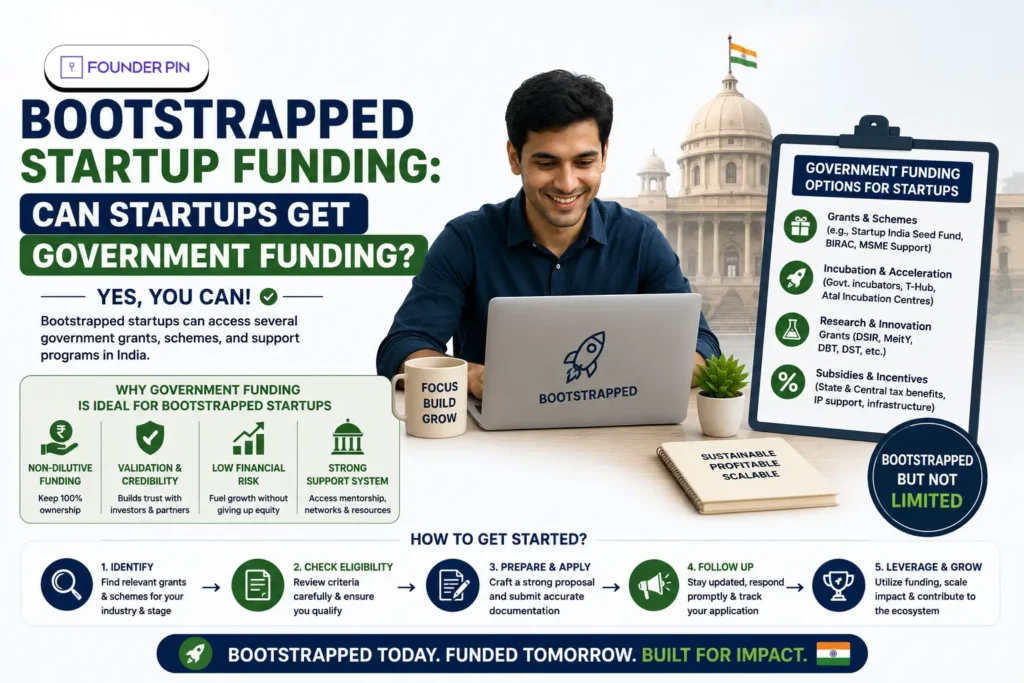
Key Takeaways
- Bootstrapped Startup Funding allows founders to grow their businesses while retaining full ownership and control.
- Government grants and schemes such as SISFS, BIG, and NIDHI PRAYAS provide non-dilutive funding for eligible startups.
- Most government funding programs prioritize innovation, scalability, and market impact rather than a startup’s funding history.
- Government grants can help bootstrapped startups accelerate product development, expand operations, and reduce financial constraints.
- Securing government funding can strengthen a startup’s credibility and improve its chances of attracting future investors and strategic partners.
Introduction
Many successful startups begin their journey without external investors. Founders often rely on personal savings, early revenue, and careful financial management to build their businesses from the ground up. This approach, known as bootstrapping, allows entrepreneurs to retain full ownership and maintain complete control over decision-making.
However, growth often requires capital. Product development, hiring, technology investments, marketing, and expansion can quickly strain limited resources. This raises an important question for founders: Can bootstrapped startups access government funding without taking investment from venture capitalists or angel investors?
The answer is yes. India has developed a strong startup support ecosystem that includes grants, seed funding programs, incubation support, innovation schemes, and sector-specific incentives. At FounderPin, we help entrepreneurs identify and secure these opportunities. This guide explains how Bootstrapped Startup Funding can be strengthened through government grants and startup schemes.
What is Bootstrapping?
Bootstrapping refers to building and growing a business using the founder’s own funds and the revenue generated by the company, rather than relying on external financing such as loans, venture capital, or angel investments.
The term originates from the expression “pull yourself up by your bootstraps,” which reflects the idea of achieving success through self-reliance, resourcefulness, and careful financial management.
In a bootstrapped startup, founders focus on controlling costs, spending wisely, and reinvesting profits back into the business. Although this approach can be challenging due to limited resources, it allows entrepreneurs to maintain full ownership and decision-making control without giving up equity to outside investors.
Why Government Funding Is Ideal for Bootstrapped Startups
Many bootstrapped founders avoid external investors because they want to retain ownership and flexibility.
Government funding offers several advantages:
- Non-dilutive capital
- Lower financial risk
- Access to incubators
- Mentorship opportunities
- Product development support
- Market validation assistance
Unlike venture capital, most grants do not require founders to give up shares in their company.
Government Funding Options for Bootstrapped Startups in India
Bootstrapped startups in India can access a wide range of government grants, collateral-free loans, and founder-friendly funding programs without giving up equity. These initiatives are designed to help startups validate ideas, build products, and scale operations while allowing founders to retain ownership.
Before applying for most government schemes, startups should obtain DPIIT Recognition, as it serves as a key eligibility requirement for many central and state-level programs.
1. Apply for Early-Stage Grants
Government grants are particularly attractive for bootstrapped founders because they provide non-dilutive funding for product development and innovation.
Startup India Seed Fund Scheme (SISFS)
Funding Support
Up to ₹20 lakh for proof-of-concept development, prototype creation, and product trials.
Available to startups that are generally less than 2 years old and working on innovative or technology-driven solutions.
NIDHI-PRAYAS
Funding Support
Up to ₹10 lakh for hardware-focused and DeepTech startups.
Helps founders transform innovative concepts into working prototypes.
Biotechnology Ignition Grant (BIG)
Funding Support
Up to ₹50 lakh for biotechnology, healthcare, and agritech startups.
Funding duration of up to 18 months for concept validation and technology development.
iDEX (Innovations for Defence Excellence)
Funding Support
Grants ranging from ₹1.5 crore to ₹10 crore.
Supports startups developing defence, aerospace, and dual-use technologies.
2. Explore Startup Acceleration and Growth Programs
Once a startup has developed a prototype or gained initial market traction, several government-backed programs can support further growth.
MeitY SAMRIDH Scheme
Funding Support
Provides matching investment support or funding of up to ₹40 lakh.
Designed for software, SaaS, and technology product startups.
TIDE 2.0
Funding Support
Supports startups working in emerging technologies such as AI, IoT, Blockchain, and Robotics.
Funding is provided through approved innovation centers and incubation partners based on Technology Readiness Levels (TRLs).
3. Access Collateral-Free Government Loans
Startups with growing revenue but limited assets can benefit from government-backed credit programs.
Credit Guarantee Scheme for Startups (CGSS)
Funding Support
Credit guarantee cover of up to ₹10 crore for eligible DPIIT-recognized startups.
Enables banks, NBFCs, and venture debt providers to offer financing without demanding collateral.
CGTMSE
Funding Support
Collateral-free loans ranging from ₹2 crore to ₹5 crore.
Government guarantees cover approximately 75% to 85% of the loan amount.
Pradhan Mantri MUDRA Yojana (PMMY)
Funding Support
Tarun and Tarun Plus categories offer collateral-free loans ranging from ₹5 lakh to ₹20 lakh.
Suitable for micro-enterprises, small businesses, and local technology ventures.
4. Take Advantage of State Startup Policies
Several state governments operate dedicated startup grant programs that provide localized support and funding.
Karnataka ELEVATE
Funding Support
Equity-free grants of up to ₹50 lakh.
Includes specialized initiatives such as ELEVATE Shakti for women-led startups.
Tamil Nadu Startup Seed Grant Fund (TANSEED)
Funding Support
Up to ₹15 lakh in milestone-based seed funding.
Supports startups working in green technology, rural innovation, and social impact sectors.
Kerala Startup Mission (KSUM)
Funding Support
Grants ranging from ₹3 lakh to ₹10 lakh.
Available for startups at the idea stage, product development stage, and early commercialization stage.
Step-by-Step Application Checklist
Register Your Business
Incorporate your startup as one of the following:
Private Limited Company
Limited Liability Partnership (LLP)
Registered Partnership Firm
Obtain DPIIT Recognition
Apply through the Startup India platform to unlock eligibility for grants, tax benefits, and startup support programs.
Connect with an Approved Incubator
Many schemes, including SISFS, require startups to apply through recognized incubators. Founders can typically select up to three incubators to review their application and pitch deck.
Verify Shareholding Requirements
Ensure Indian promoters hold at least 51% ownership of the company, as many government schemes require majority Indian ownership for eligibility.
By combining grants, government-backed loans, accelerator programs, and state startup policies, bootstrapped founders can secure substantial funding while maintaining control over their businesses.
Advantages of Government Funding Over Angel Investment
No Equity Dilution
- One of the biggest advantages of government grants is that founders retain ownership.
- Bootstrapped entrepreneurs can secure funding while maintaining complete control over the company’s future.
Long-Term Strategic Freedom
- Government funding allows startups to pursue long-term innovation goals without investor pressure for rapid returns.
- This is particularly valuable for startups with longer product development cycles.
Improved Investor Credibility
- Interestingly, government-funded startups often become more attractive to investors later.
- Grant approval acts as third-party validation, increasing confidence among future investors and partners.
Common Challenges for Bootstrapped Founders
Limited Cash Flow
- Without external funding, founders often face resource constraints.
- Government grants help reduce financial pressure during critical growth stages.
Slower Product Development
- Limited budgets can delay innovation and market entry.
- Funding support enables startups to accelerate development timelines.
Scaling Constraints
- Hiring talent, expanding operations, and entering new markets require capital.
- Government programs provide resources that help founders scale sustainably.
How to Improve Grant Approval Chances
Build a Strong Business Case
Funding agencies want to see:
- A clear problem statement
- Innovative solutions
- Market demand
- Revenue potential
A compelling business case improves competitiveness.
Demonstrate Traction
Bootstrapped startups often have an advantage because they can show real customer demand and revenue generation.
Evidence of traction strengthens applications significantly.
Prepare Comprehensive Documentation
Accurate financials, business plans, and compliance documents are essential for successful applications.
Professional preparation increases approval rates.
The Future of Bootstrapped Startup Funding in India
India’s startup ecosystem is increasingly focused on innovation-led growth. Government agencies are expanding support for startups across technology, manufacturing, agriculture, sustainability, healthcare, and deeptech sectors.
As more founders choose bootstrapping over immediate fundraising, government grants will continue to play a crucial role in supporting innovation while preserving founder ownership.
Conclusion
The idea that startups must raise venture capital to succeed is becoming outdated. Today, Bootstrapped Startup Funding can be significantly strengthened through government grants, startup schemes, incubation support, and innovation programs.
By leveraging these opportunities, founders can access capital, accelerate growth, and retain control of their businesses. For many entrepreneurs, government funding offers the ideal balance between financial support and ownership preservation.
Contact FounderPin for Expert Funding Guidance
Finding the right grant or startup scheme can be challenging without expert support. At FounderPin, we help founders identify funding opportunities, prepare strong applications, and maximize their chances of approval.
Contact us for a consultation today and discover how government funding can help your bootstrapped startup grow faster without giving up equity.
Frequently Asked Questions (FAQs)
1. Can bootstrapped startups get government funding in India?
Yes, bootstrapped startups can access various government funding programs in India, including the Startup India Seed Fund Scheme (SISFS), BIG, and NIDHI PRAYAS. Most schemes focus on innovation, scalability, and business potential rather than whether a startup has raised private investment.
2. What are the best government grants for bootstrapped startups?
Some of the most popular funding options include the Startup India Seed Fund Scheme, Biotechnology Ignition Grant (BIG), NIDHI PRAYAS, and state government startup grants. These programs provide non-dilutive funding to help startups develop products, validate markets, and scale operations.
3. Do founders have to give up equity to receive government grants?
No, most government grants are non-dilutive, meaning founders do not have to give up ownership or equity in their startup. This makes government funding an attractive option for bootstrapped entrepreneurs who want to maintain full control of their business.
4. What documents are required to apply for startup grants?
Startups usually need a business strategy, financial projections, evidence of innovation, DPIIT recognition (if available), business registration paperwork, and a pitch deck. However, requirements vary by scheme. The likelihood of grant approval is increased by precise and comprehensive paperwork.
5. Is government funding better than angel investment for bootstrapped startups?
Government funding and angel investment serve different purposes. Grants provide capital without equity dilution, while angel investors may offer mentorship and industry connections. Many successful startups use government grants in the early stages before raising private investment to accelerate growth.
SHARE