
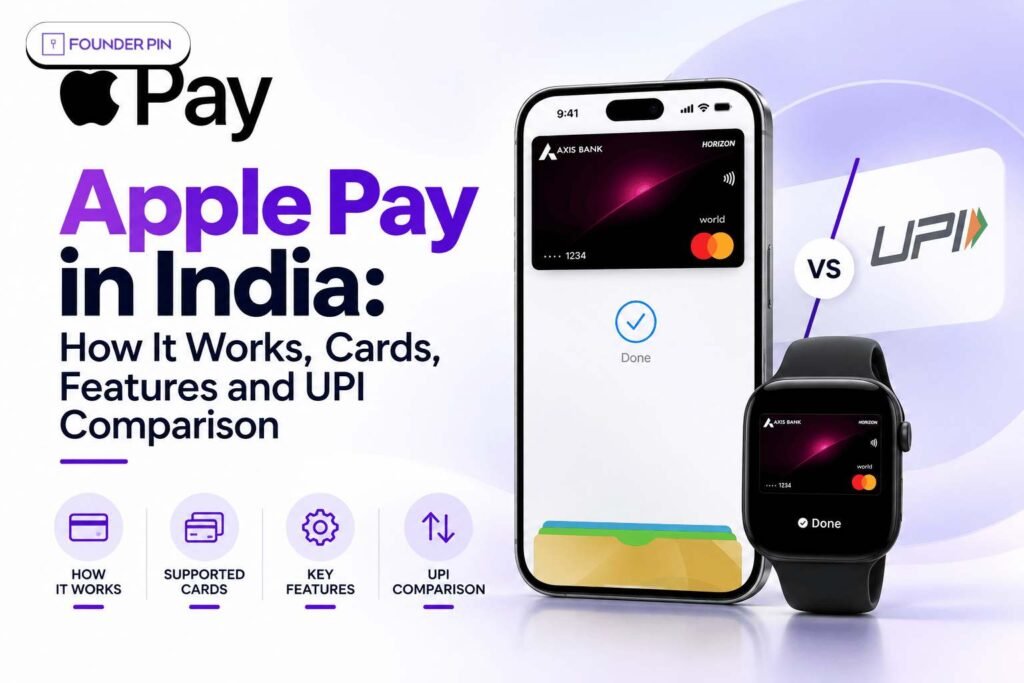
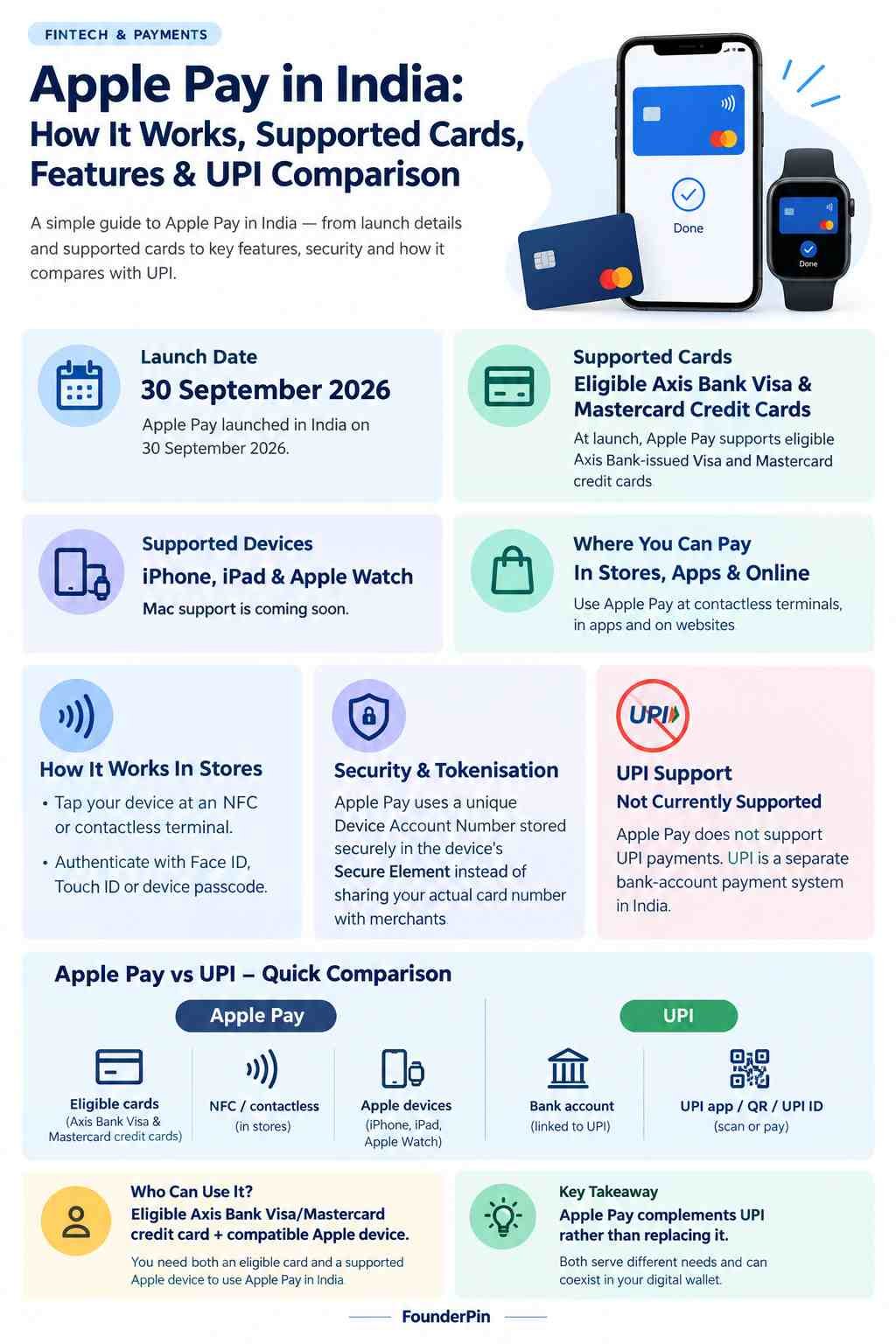
Apple Pay is now available in India, giving iPhone, iPad and Apple Watch users a new way to pay with eligible cards. The company launched the service in India on 30 September 2026, initially supporting eligible Axis Bank Visa and Mastercard credit cards.
The bigger question is where Apple Pay fits into a country where UPI is already part of everyday life. The answer is simple: Apple Pay is primarily a card-based contactless payment service, while UPI moves money directly through bank accounts.
That difference makes Apple Pay less of a UPI replacement and more of another payment option for Indian consumers.
Key Takeaways
- Apple Pay officially launched in India on 30 September 2026.
- Initial card support covers eligible Axis Bank Visa and Mastercard credit cards.
- iPhone, iPad and Apple Watch support is available at launch; Mac support is coming.
- Apple Pay uses device-specific tokenisation rather than exposing the actual card number to merchants.
- Users can authenticate payments with Face ID, Touch ID or a device passcode.
- Apple Pay works at compatible contactless terminals and supported online/in-app checkouts.
- UPI and Apple Pay use different payment models.
- UPI remains a bank-account-based payment infrastructure, while Apple Pay primarily digitises eligible cards.
- NPCI recorded more than 24.5 billion UPI transactions in August 2026.
- Additional Apple Pay bank partnerships may expand India’s Apple Pay ecosystem over time.
What Is Apple Pay in India?
Apple Pay is Apple’s digital payment service that lets users add eligible cards to Apple Wallet and pay using compatible Apple devices.
- Available in India from 30 September 2026
- Works on iPhone, iPad and Apple Watch at launch
- Mac support is coming
- Launch support is for eligible Axis Bank Visa and Mastercard credit cards
- Payments can work in stores, apps and online
- Apple Pay uses contactless NFC for compatible in-store transactions
Apple Pay essentially puts a supported credit card inside the Apple ecosystem. Instead of pulling out a physical card, users can authenticate on their device and tap it at a compatible payment terminal.
Apple says the service is accepted at millions of merchants in India, including brands such as Blinkit, Croma, Zomato, Tata 1mg, Reliance brands and others.
How Does Apple Pay Work in India?
Apple Pay works by replacing the physical card number used during a transaction with a device-specific payment credential.
The process is straightforward:
- Add an eligible card to Apple Wallet.
- The card is verified by the issuing bank.
- Apple Pay creates a device-specific payment credential.
- At a contactless terminal, authenticate with Face ID, Touch ID or a passcode.
- Hold the iPhone or Apple Watch near the payment terminal.
- The transaction is processed through the card network and issuing bank.
The important part is what happens behind the scenes.
Apple says the actual card number isn’t stored on Apple’s servers or shared with merchants. Instead, a unique Device Account Number is encrypted and stored in the device’s Secure Element.
This is also consistent with India’s broader card-tokenisation framework, under which actual card details are replaced by tokens for supported transactions.
Which Cards Support Apple Pay in India?
At launch, Apple Pay in India supports eligible Axis Bank-issued Visa and Mastercard credit cards.
| Apple Pay India card support | Current status |
|---|---|
| Axis Bank Visa credit cards | Supported, subject to eligibility |
| Axis Bank Mastercard credit cards | Supported, subject to eligibility |
| Axis Bank debit cards | Not listed by Apple at launch |
| HDFC Bank cards | Not currently listed |
| ICICI Bank cards | Not currently listed |
| SBI cards | Not currently listed |
| RuPay cards | Not currently listed for Apple Pay India |
| Other banks | May be added later |
The distinction between Visa/Mastercard credit cards and other card types matters. Having a card from a supported bank does not automatically mean every card issued by that bank will work.
Apple’s current India bank list specifically identifies Axis Bank’s Visa and Mastercard credit cards. The company also says the list will be updated as additional banks are added.
So, before planning to use Apple Pay, check the exact card and issuer eligibility rather than assuming that every Axis card qualifies.
How to Set Up Apple Pay in India
Eligible users can add their supported card through Apple Wallet or the Axis Bank app.
The basic process is:
- Open the Wallet app on your iPhone.
- Tap the + button.
- Select the option to add a payment card.
- Scan or enter the card details.
- Complete the verification process requested by the bank.
- Once approved, the card becomes available in Apple Pay.
Apple also says eligible cards can be added through the latest version of the Axis Bank app.
Once the card is active, users don’t need a separate payment application just to make an Apple Pay transaction.
How to Pay Using Apple Pay
In a store, Apple Pay turns a compatible iPhone or Apple Watch into a contactless payment device. So how exactly does it work?
On an iPhone with Face ID:
- First, double-click the side button.
- Then authenticate using Face ID or the device passcode.
- Next, hold the top of the iPhone near the contactless reader.
- Finally, wait for the confirmation.
On Apple Watch:
- First, double-click the side button.
- Then select the required card, if necessary.
- Next, hold the display near the contactless terminal.
- Finally, wait for the confirmation.
So what really sets this apart from traditional card payments? Simply put, you never need to hand over the physical card or type the card number into the checkout terminal.
What Are the Main Apple Pay Features in India?
Apple Pay’s main advantage is combining contactless card payments with Apple’s hardware, authentication and tokenisation.
1. Contactless payments
Users can tap their iPhone or Apple Watch at compatible NFC terminals.
2. Face ID and Touch ID authentication
Transactions can be authenticated through Apple’s biometric security or device passcode.
3. Online and in-app payments
Apple Pay can also appear as a checkout option in supported apps and websites, reducing the need to repeatedly enter card details.
4. Device-specific tokenisation
The merchant doesn’t receive the user’s actual card number during an Apple Pay transaction.
5. Existing card rewards continue
Apple says users continue to receive the rewards and benefits associated with their eligible cards.
6. Lost-device protection
If an iPhone is lost, users can use Find My and Lost Mode to suspend Apple Pay on the device.
7. No separate Apple Pay fee
Apple says it doesn’t charge users a fee for making Apple Pay purchases. Normal card issuer charges or terms can still apply.
Apple Pay vs UPI in India
Apple Pay and UPI solve different payment problems, even though both can make digital payments feel nearly instant.