
Seed Funding vs Angel Funding vs VC Funding Explained for Indian Startups
Table of Contents
ToggleSeed Funding vs Angel Funding vs VC Funding: Know the Difference, Raise with Confidence
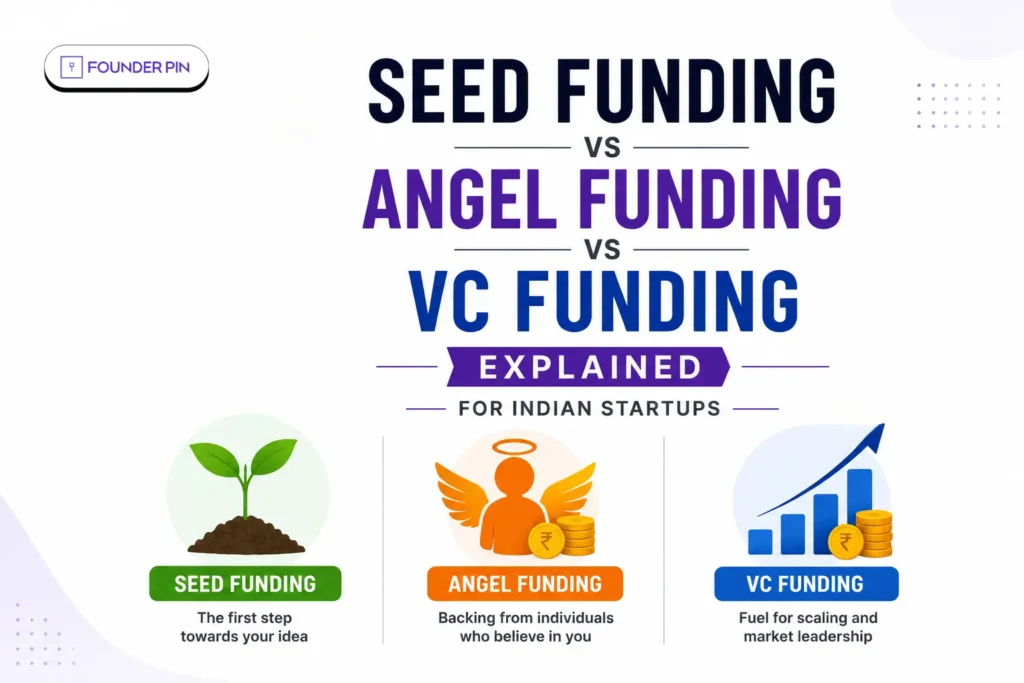
Key Takeaways
- Seed funding helps startups validate ideas, build products, and gain initial market traction.
- Angel funding provides both capital and mentorship, making it ideal for startups entering the early growth stage.
- VC funding is best suited for startups with proven traction that need significant investment to scale rapidly.
- Understanding Seed Funding vs Angel Funding vs VC Funding helps founders choose the right funding source at the right stage of growth.
- Successful fundraising depends on strong execution, market validation, and selecting investors who bring strategic value beyond money.
At FounderPin, one of the most common questions we hear from entrepreneurs is: Which type of funding is right for my startup? As India’s startup ecosystem continues to mature, founders have more financing options than ever before. However, understanding the differences between seed funding, angel funding, and venture capital funding remains a challenge for many early-stage entrepreneurs.
Choosing the wrong funding source can impact your startup’s growth, ownership structure, and long-term vision. That’s why understanding Seed Funding vs Angel Funding vs VC Funding is crucial before approaching investors.
This guide breaks down each funding stage, explains how they work, and helps Indian founders determine which option best fits their startup journey.
Why Startup Funding Matters
Funding provides the resources needed to build products, hire talent, acquire customers, and scale operations. While bootstrapping works for some businesses, many startups require external capital to accelerate growth and compete effectively.
The key is not just raising money but raising the right type of money at the right stage.
Seed Funding vs Angel Funding vs VC Funding
Startup funding generally follows a progression as businesses grow. Seed fundraising, angel funding, and venture capital (VC) investment are the three most popular funding phases. Each stage serves a different purpose and involves different types of investors, investment amounts, and growth expectations.
Important Distinctions Between Seed Funding, Angel Funding, and VC Funding
| Feature | Seed Funding | Angel Funding | Venture Capital (VC) Funding |
|---|---|---|---|
| Startup Stage | Idea validation or early product development | Early-stage startup with initial traction | Established startup ready for rapid growth |
| Investor Type | Incubators, accelerators, startup funds, friends, and family | High-net-worth individuals and experienced entrepreneurs | Professional venture capital firms |
| Investment Size | ₹20 Lakhs to ₹2 Crores | ₹10 Lakhs to ₹3 Crores | ₹10 Crores to ₹100+ Crores |
| Primary Objective | Build and validate the product | Achieve market traction and business growth | Scale operations and expand market presence |
Seed Funding
The First Stage of Startup Financing
Seed funding is often the first formal investment that helps founders transform an idea into a working business. It is typically used to develop a product, test market demand, and validate the business concept.
Purpose of Seed Funding
The main objective of seed funding is to help startups establish product-market fit. Founders use this capital to build prototypes, launch minimum viable products (MVPs), and gather feedback from early users.
Seed Funding in India
India’s startup ecosystem offers several funding opportunities for early-stage businesses. Many founders leverage government initiatives, startup incubators, and seed funds to secure initial capital. Government-backed programs also support startups during the product validation stage.
Equity Considerations
In exchange for seed capital, founders typically offer a portion of company ownership. The exact equity percentage depends on factors such as valuation, growth potential, and investor interest.
Angel Funding
Funding From Individual Investors
Angel funding comes from individual investors who use their personal capital to support promising startups. These investors often have entrepreneurial or industry experience and actively guide founders during the early stages of growth.
Purpose of Angel Funding
Angel investors generally focus on startups that have already validated their ideas and demonstrated some market potential. Along with capital, they often provide mentorship, industry expertise, and business connections.
Angel Investment in India
India has a growing network of angel investors and startup communities that actively invest in early-stage businesses. Angel funding has become increasingly accessible through investment platforms, startup networks, and syndicates across major cities.
Equity and Founder Control
Angel investors usually acquire a smaller ownership stake compared to institutional investors. As a result, founders often retain greater operational flexibility and decision-making control.
Venture Capital (VC) Funding
Funding for Rapid Business Growth
Venture capital funding is designed for startups that have already achieved product-market fit and are preparing for large-scale expansion. VC firms invest pooled capital from institutions and professional investors.
Purpose of Venture Capital Funding
The primary goal of venture capital is to accelerate growth. Startups use VC funding to expand teams, enter new markets, improve products, increase customer acquisition, and strengthen market position.
Venture Capital in India
India has a well-developed venture capital ecosystem with numerous firms investing in technology, fintech, SaaS, e-commerce, healthcare, and consumer-focused startups. VC firms typically conduct detailed due diligence before making investment decisions.
Equity and Governance
Because venture capital firms invest substantial amounts of money, they usually require a significant ownership stake. They often seek board representation and actively participate in strategic business decisions.
How to Choose the Right Funding Option
When to Consider Seed Funding
Seed funding is ideal for founders who are building a product, validating an idea, or preparing to launch an MVP. It helps startups establish a foundation before pursuing larger funding rounds.
When to Consider Angel Funding
Angel funding is suitable for startups that have developed a product and generated initial customer interest. Founders can benefit from both financial support and experienced mentorship.
When to Consider Venture Capital Funding
VC funding becomes relevant when a startup has achieved product-market fit and needs significant capital to accelerate growth. It is often the preferred choice for businesses pursuing aggressive expansion and market leadership.
Choosing the Best Path
The right funding option depends on your startup’s stage, traction, growth goals, and capital requirements. Many successful startups begin with seed funding, progress to angel investment, and eventually raise venture capital as they scale their operations.
Common Fundraising Mistakes Founders Make
Raising Too Early
Many founders seek funding before validating their product.
Investors prefer evidence of demand and customer interest.
Choosing Money Over Value
Not all investors contribute equally.
The right investor can provide:
- Strategic advice
- Industry knowledge
- Business connections
- Growth opportunities
Giving Away Too Much Equity
Founders should carefully evaluate dilution at every stage.
Preserving ownership can be important for future funding rounds and long-term control.
The Evolution of Startup Funding in India
Over the last ten years, India’s startup scene has developed considerably. Founders now have access to:
- Angel networks
- Seed funds
- Venture capital firms
- Startup accelerators
- Government initiatives
- Corporate innovation programs
This growing ecosystem makes fundraising more accessible than ever for ambitious entrepreneurs.
Also Read | How to Fundraise for a Startup in India Without Investor Connections
Conclusion
Understanding Seed Funding vs Angel Funding vs VC Funding is essential for every startup founder. Each funding type serves a unique purpose and aligns with different stages of business growth.
Seed funding helps transform ideas into products. Angel investment offers mentorship and encourages early development. Venture capital funding enables startups to scale rapidly and capture larger markets.
The best funding choice depends on your startup’s current stage, growth objectives, and long-term vision. Rather than chasing capital, focus on building a strong business that naturally attracts the right investors.
Ready to Position Your Startup for Investment?
At FounderPin, we help founders build investor-ready brands, create compelling growth strategies, and improve startup visibility.
Contact us for a consultation and discover how to prepare your startup for successful fundraising and sustainable growth.
Frequently Asked Questions (FAQs)
1. What is the difference between Seed Funding, Angel Funding, and VC Funding?
The main difference lies in the startup stage and investor type. Seed funding helps validate an idea, angel funding supports early growth through individual investors, and VC funding provides larger investments for startups with proven traction and scalability.
2. When should a startup raise seed funding?
A startup should consider seed funding when it needs capital to build an MVP, validate product-market fit, conduct market research, or acquire its first customers before generating significant revenue.
3. Are angel investors better than venture capital firms for early-stage startups?
Angel investors can be a better choice for early-stage startups because they often provide mentorship, industry expertise, and flexible terms. Venture capital firms typically invest in businesses that have already demonstrated growth and scalability.
4. How much equity do startups usually give away in Seed Funding, Angel Funding, and VC Funding rounds?
The amount varies depending on valuation and growth stage. Seed rounds generally involve smaller equity dilution, while angel and VC rounds may require founders to give up larger ownership stakes in exchange for higher capital investments.
5. Which funding option is best for Indian startups?
There is no one-size-fits-all answer. Seed funding is ideal for idea-stage startups, angel funding works well for businesses with early traction, and VC funding is best suited for startups looking to scale rapidly and capture large market opportunities.