
What Investors Actually Look for Before Funding a Startup
Table of Contents
Toggle“Successful fundraising often starts with understanding exactly what investors look for before funding a startup.”
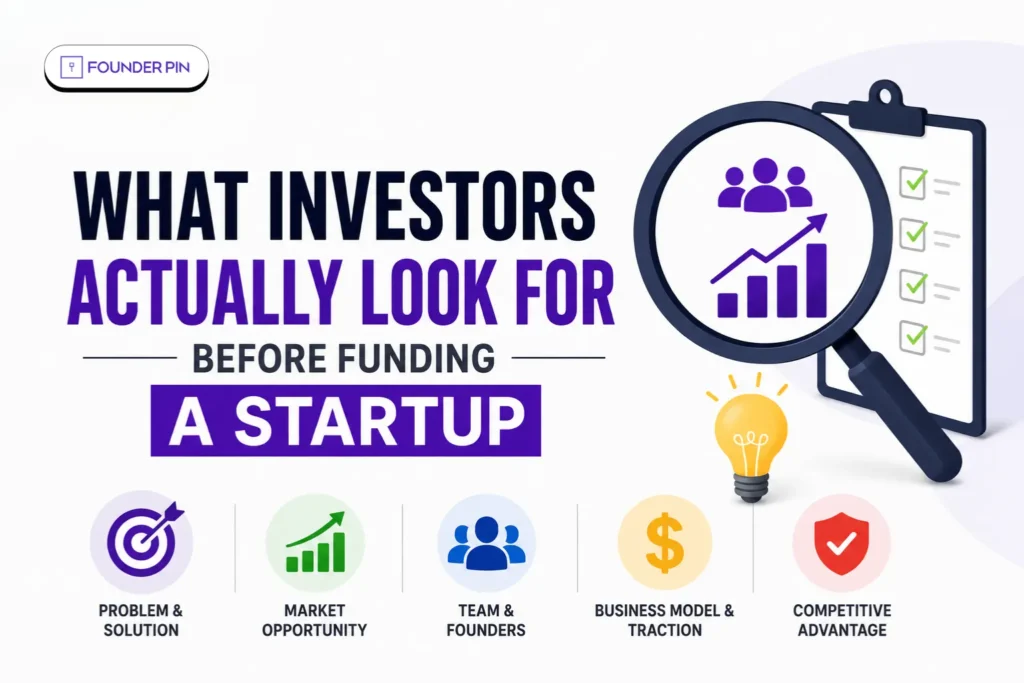
Key Takeaways
Before investing in a startup, investors look beyond the idea and focus on the founder’s ability to execute, the size of the market opportunity, and the business’s potential for sustainable growth. Understanding these investment criteria can help founders build stronger businesses and improve their chances of securing funding.
- Investors prioritize strong founders with leadership skills, industry expertise, and a clear vision for growth.
- Demonstrating product-market fit and customer traction is often more important than having an innovative idea alone.
- Startups targeting large, scalable markets are generally more attractive to investors.
- Healthy unit economics, revenue growth, and financial transparency play a crucial role in investment decisions.
- A clear competitive advantage and consistent business momentum can significantly increase fundraising success.
At FounderPin, we often hear founders ask the same question: “What do investors really look for before they decide to invest?” The truth is much more complex, despite the belief held by many entrepreneurs that a brilliant idea is sufficient to obtain startup funding.
Investors evaluate hundreds of startups every year, but only a small percentage receive funding. The difference often comes down to execution, market opportunity, founder quality, and business fundamentals. Understanding what investors look for before funding a startup can significantly improve your chances of raising capital and building long-term investor confidence.
In this guide, we’ll break down how investors evaluate startups and practical startup fundraising tips every founder should know.
Why Investors Don’t Invest in Ideas Alone
A groundbreaking idea can capture attention, but investors fund businesses—not concepts.
Every successful startup operates at the intersection of:
- A real market problem
- A scalable solution
- Strong execution
- Sustainable growth potential
Investors understand that ideas can change over time. What matters more is whether the founders can adapt, execute, and build a profitable company.
Also Read | Seed Funding vs Angel Funding vs VC Funding Explained for Indian Startups
1. Product-Market Fit: Customer Validation
- Paying customers: Revenue is one of the strongest indicators that people find value in your product. Investors view paying customers as proof that the startup is solving a real problem.
- User growth: Consistent growth in users demonstrates increasing market demand. A growing customer base signals that the startup has the potential to scale successfully.
- Customer retention: Acquiring customers is important, but retaining them is even more valuable. High retention rates demonstrate that consumers still value and have faith in the product.
- Positive feedback: Customer testimonials and reviews provide valuable validation. Investors often see positive feedback as evidence of strong product-market fit and customer satisfaction.
2. Market Opportunity and Scalability
- How large is the opportunity? Investors prefer startups targeting large and growing markets. A bigger market creates more room for growth and higher potential returns on investment.
- Can the business expand nationally or globally? Startups with expansion potential are generally more attractive to investors. A business that can scale beyond a local market offers greater revenue opportunities.
- Is the market growing? Fast-growing industries often create favorable conditions for startups. Investors look for sectors where demand is increasing and future opportunities are abundant.
Scalability Potential
- Expand efficiently: Investors want businesses that can grow without dramatically increasing operational costs. Efficient expansion improves profitability and long-term sustainability.
- Reach new markets: The ability to enter new regions or customer segments increases growth potential. Investors see market expansion as a sign of scalability.
- Serve more customers: A scalable startup should be capable of handling increased demand without major disruptions. This demonstrates operational strength and growth readiness.
- Improve margins over time: As startups grow, investors expect profitability to improve. Stronger financial success and increased corporate efficiency are indicated by higher margins.
3. Business Model and Unit Economics
- Who pays? Investors need a clear understanding of the target customer. Knowing exactly who purchases the product helps validate the business model.
- How much do they pay? Pricing plays a critical role in revenue generation and profitability. Investors analyze whether the pricing strategy is competitive and sustainable.
- How often do they pay? Recurring revenue models are often preferred because they provide predictable income. Subscription-based businesses, for example, are attractive due to their revenue stability.
Healthy Unit Economics
- Gross margins: Gross margins indicate how much profit remains after direct costs. Higher margins often signal a stronger and more scalable business model.
- Customer Acquisition Cost (CAC): CAC calculates the cost of acquiring a new client. Startups that can effectively and profitably recruit clients are preferred by investors.
- Lifetime Value (LTV): LTV estimates the total revenue a customer generates over time. A high LTV compared to CAC demonstrates a healthy and sustainable business.
- Burn rate: Burn rate reflects how quickly a startup spends its cash reserves. Investors monitor this metric closely to evaluate financial discipline and runway.
4. Competitive Advantage
- What differentiates your product? Investors want to understand why customers would choose your solution over alternatives. A clear differentiator strengthens market positioning.
- Why can’t competitors easily copy you? A unique advantage protects the startup from market competition. Strong defensibility increases investor confidence in long-term success.
- What is your unique value proposition? Your value proposition explains the specific benefit customers receive. Investors look for clear and compelling reasons why the market needs your product.
Barriers to Entry
- Proprietary technology: Unique technology can create a strong competitive moat. It makes it harder for competitors to replicate your solution.
- Strong brand recognition: A recognizable brand builds customer trust and loyalty. Investors value startups that have already established a strong market presence.
- Network effects: Businesses become more valuable when each new user increases value for others. This creates a powerful competitive advantage and supports rapid growth.
- Exclusive partnerships: Strategic partnerships can provide access to customers, distribution channels, or technology. These relationships often strengthen the startup’s market position.
5. Financial Preparedness
- Revenue: Investors want founders to have a clear understanding of revenue trends and performance. Consistent revenue growth signals a healthy business.
- Expenses: Managing expenses effectively demonstrates financial discipline. Investors prefer startups that optimize costs while pursuing growth.
- Cash runway: Runway shows how long a startup can operate before needing additional funding. A longer runway reduces risk and provides flexibility.
- Profit margins: Robust profit margins are a sign of effective operations. Strong margins are frequently seen by investors as an indication of long-term viability.
- Growth projections: Investors can better grasp future opportunities by using realistic forecasts. Projections with solid evidence increase confidence and credibility.
Common Reasons Investors Reject Startups
Lack of Market Demand
Even innovative products fail when customers don’t need them.
Weak Founding Team
A great idea cannot compensate for poor execution.
Unrealistic Valuations
Founders who overvalue their startups often struggle to attract serious investors.
Poor Financial Understanding
Investors hesitate when founders cannot explain their business economics.
Also Read | How to Fundraise for a Startup in India Without Investor Connections
Startup Fundraising Tips for Founders
- Validate your business idea before fundraising by proving there is real customer demand for your product or service.
- Know your key financial metrics such as revenue, profit margins, CAC, burn rate, and growth projections.
- Create a strong pitch deck that clearly explains your problem, solution, market opportunity, and business model.
- Focus on traction and measurable growth since investors prefer evidence of progress over ambitious projections.
- Build relationships with investors early through networking, LinkedIn, startup events, and industry communities.
- Set a realistic startup valuation based on current traction, revenue, and market benchmarks.
- Highlight your competitive advantage and clearly explain why your startup stands out from competitors.
- Choose strategic investors who add value through mentorship, industry expertise, and business connections, not just capital.
Conclusion
Understanding what investors look for before funding a startup is one of the most valuable lessons a founder can learn. Investors evaluate far more than just ideas. They assess founder quality, market opportunity, traction, scalability, financial health, and competitive advantage.
The strongest startups combine visionary leadership with measurable business progress. By focusing on customer validation, strong unit economics, and sustainable growth, founders can dramatically improve their fundraising success.
Remember: investors are not simply investing in products—they are investing in people, execution, and future potential.
Ready to Make Your Startup Investor-Ready?
At FounderPin, we help founders build strong brands, improve visibility, and position their startups for successful fundraising.
Contact us for a consultation and discover how to make your startup more attractive to investors and growth opportunities.
Frequently Asked Questions (FAQs)
1. What do investors look for before funding a startup?
Investors typically evaluate the founding team, market opportunity, product-market fit, traction, scalability, unit economics, and competitive advantage before deciding to invest in a startup.
2. How do investors evaluate startups during fundraising?
Investors assess factors such as revenue growth, customer acquisition, retention rates, market size, business model sustainability, and the founders’ ability to execute their vision effectively.
3. What are the most important startup funding requirements?
Key startup funding requirements include a clear business model, validated market demand, strong financial metrics, a scalable growth strategy, and a compelling pitch deck that communicates the startup’s potential.
4. What are the best startup fundraising tips for first-time founders?
First-time founders should focus on validating their product, building traction, knowing their financial metrics, creating a strong pitch deck, networking with investors, and targeting the right funding partners for their startup stage.