How to Make a Winning Startup Pitch Deck in 2026
Table of Contents
Toggle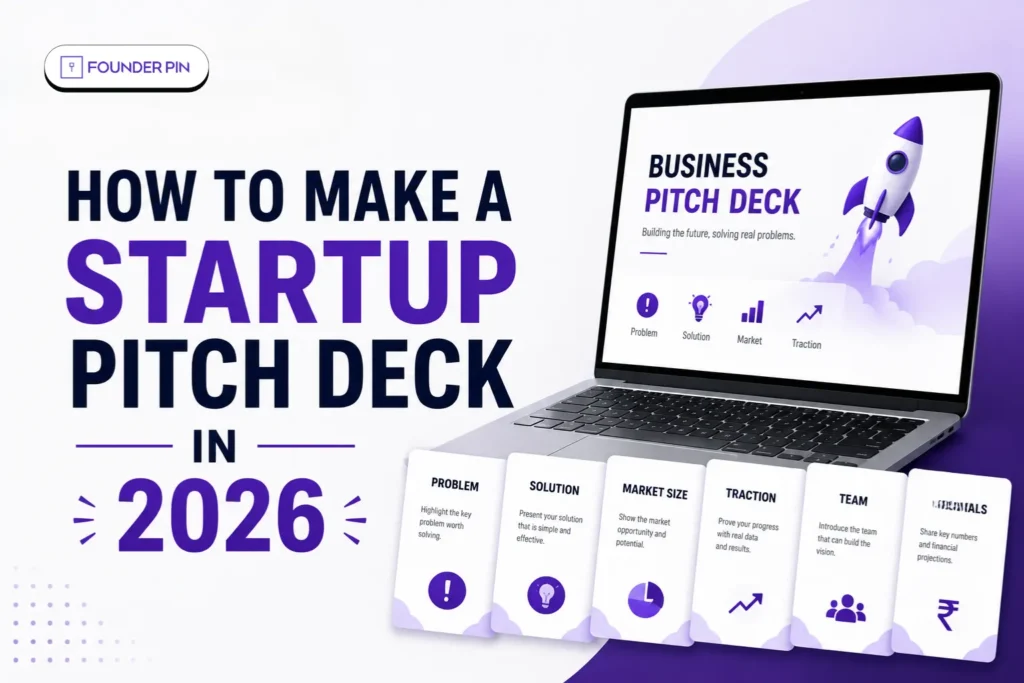
Key Takeaways
Creating a winning startup pitch deck is about more than great design—it’s about clearly communicating your business potential to investors. A strong deck combines storytelling, traction, market opportunity, and a clear funding strategy.
- Clearly state the market opportunity, the problem, and the solution.
- Showcase traction and real customer validation whenever possible.
- Keep your startup pitch deck concise, visually appealing, and easy to understand.
- Highlight your competitive advantage and team strengths.
- To gain the trust of investors, include a growth plan and a reasonable financial request
SHARE
At FounderPin, we’ve seen countless startups with promising ideas struggle to secure funding—not because their business lacked potential, but because their pitch deck failed to tell a compelling story. In today’s highly competitive startup ecosystem, investors receive hundreds of pitch decks every month. The founders who stand out are those who can clearly communicate their vision, traction, and growth potential in just a few slides.
Understanding how to make a startup pitch deck is one of the most important fundraising skills an entrepreneur can develop. A winning pitch deck is more than a presentation; it is a strategic document that helps investors understand why your startup deserves their attention and capital.
In this guide, we’ll break down everything you need to know about creating a powerful startup pitch deck in 2026.
What is a Pitch Deck?
A pitch deck is a short presentation that introduces your startup to potential investors. It highlights your business idea, vision, market opportunity, product, business model, team, and growth plans. Most pitch decks contain around 10 to 15 slides that provide investors with a clear understanding of the company and its potential.
A pitch deck might be compared to an investor introduction for your startup. Since investors often review numerous opportunities, your presentation needs to communicate the value of your business quickly and effectively. In many cases, a pitch deck serves as the first interaction investors have with your startup, making it a critical part of the fundraising process.
Also Read | What Investors Actually Look for Before Funding a Startup
Why Do Startups Need a Pitch Deck?
As the startup ecosystem continues to expand, competition for investor attention has become more intense. A compelling pitch deck can help founders stand out and increase their chances of securing investor meetings and funding opportunities.
Creates a Strong First Impression
Investors review countless startup proposals every year. A professional and well-structured pitch deck can capture their attention and encourage them to learn more about your business.
Communicates Your Business Story
A strong pitch deck clearly explains the problem your startup is solving, the solution you offer, and the opportunity available in the market. It helps investors understand your vision and why your business deserves attention.
Builds Investor Confidence
Investors want to see that founders have a clear strategy and a deep understanding of their business. A well-prepared pitch deck demonstrates planning, market knowledge, and readiness for growth, helping build credibility and trust.
The Essential 10-Slide Pitch Deck Structure
A well-structured pitch deck helps investors quickly understand your business, market potential, and growth strategy. To improve your chances of securing funding, ensure that your presentation answers the key questions investors typically ask.
1. Cover Slide
Start with your company name, logo, tagline, and contact details. This slide should immediately communicate what your startup does and leave a strong first impression.
2. The Problem
Clearly define the problem your target customers face. Focus on a real and meaningful challenge that creates measurable pain points rather than describing broad or generic issues.
3. The Solution
Present your product or service and explain how it solves the identified problem. Keep the explanation simple, practical, and easy for investors to understand.
4. Market Opportunity
Show the size of the opportunity by breaking down your market into Total Addressable Market (TAM), Serviceable Available Market (SAM), and Serviceable Obtainable Market (SOM). Use realistic data and calculations to support your projections.
5. Product Demonstration
Use screenshots, product visuals, mockups, or workflow illustrations to demonstrate how your solution works. Visual presentations are often more effective than text-heavy explanations.
6. Business Model
Explain how your startup generates revenue. Include details about your pricing structure, revenue streams, customer payment model, and expected profit margins.
7. Traction and Validation
Highlight evidence that proves customer demand and business momentum. This may include revenue growth, active users, customer testimonials, partnerships, pilot programs, or waitlist numbers.
8. Competitive Analysis
Identify your key competitors and explain how your startup stands out in the market. Showcase your competitive advantages, unique value proposition, and market positioning.
9. Go-to-Market Strategy
Outline your plan for acquiring customers and expanding your business. Explain your marketing channels, sales approach, customer acquisition strategy, and growth roadmap.
10. Financial Projections and Funding Requirement
Provide reasonable financial projections for the ensuing three to five years. Clearly state how much funding you are seeking and explain how the investment will be used to achieve specific business milestones.
Pitch Deck Design and Presentation Best Practices
A strong pitch deck is not just about the information you present. In order to properly communicate your idea and pique investor interest, your presentation’s design, structure, and delivery are crucial.
Keep the Design Clean and Visual
Investors often review multiple pitch decks in a short period. To make your presentation easier to understand, focus on visuals rather than large blocks of text.
Use elements such as:
- Bullet points
- Icons
- Graphs and charts
- Product screenshots
- High-quality mockups
Keep each slide simple and uncluttered. Sufficient white space improves readability and helps investors focus on the most important information.
Build a Compelling Story
An effective pitch deck should lead investors via a coherent and captivating story. Instead of presenting isolated facts, explain the journey behind your startup and the problem you are solving.
Your story should clearly connect:
- The market problem
- Your solution
- Customer demand
- Business opportunity
- Growth potential
A strong narrative helps investors understand your vision and creates a stronger emotional connection with your business.
Use Templates and AI Tools Strategically
Creating a pitch deck from scratch can be time-consuming. Many founders begin with proven pitch deck templates and then customize them to match their brand and business model.
AI tools can also assist with:
- Structuring slide content
- Generating presentation outlines
- Simplifying complex language
- Improving content clarity
However, all information, projections, and claims should accurately reflect your startup’s unique situation. Investors value authenticity, accuracy, and business-specific insights more than generic content.
Common Pitch Deck Mistakes to Avoid
Even a promising startup can struggle to attract investors if its pitch deck contains avoidable mistakes. Understanding these common errors can help founders create a more compelling and investor-friendly presentation.
Including Excessive Technical Information
Many founders spend too much time explaining product features and technical details. While the technology is important, investors are often more interested in the market opportunity, business potential, and growth prospects.
Keep technical explanations simple and focus on how your solution creates value for customers and generates returns for investors.
Overlooking the Competition
Some startups claim they have no competitors, which can raise concerns among investors. Every business competes for customer attention in some form, whether directly or indirectly.
A strong pitch deck acknowledges the competitive landscape and clearly explains what makes the startup different and why customers would choose it over existing alternatives.
Presenting Overly Optimistic Financial Forecasts
Investors appreciate ambitious goals, but unrealistic revenue projections can reduce credibility. Financial forecasts should be supported by market data, business assumptions, and achievable growth targets.
Instead of making exaggerated claims, focus on presenting practical and well-researched financial plans that demonstrate a clear path to growth.
Startup Pitch Deck Trends in 2026
AI-Powered Investor Research
Founders increasingly use AI tools to identify suitable investors and personalize outreach.
Data-Driven Storytelling
- Investors now expect stronger data support for growth claims.
- Successful decks combine narrative and metrics effectively.
Shorter Decks Perform Better
- The most effective pitch decks typically contain 10–15 slides.
- Concise presentations often generate more investor engagement.
Final Checklist Before Sending Your Pitch Deck
Before approaching investors, ensure your deck:
- Clearly explains the problem
- Presents a compelling solution
- Shows market opportunity
- Demonstrates traction
- Highlights team strengths
- Includes realistic projections
- States the funding ask clearly
A polished deck reflects a disciplined founder.
Helpful Pitch Deck Resources
- Inspiration & Breakdowns: Analyze successful teardowns from funding rounds on TechCrunch Pitch Deck Teardown.
- Design Platforms: Create polished, professional, and consistent slides using design tools like Visme or Prezent AI.
Conclusion
Learning how to make a startup pitch deck is one of the most valuable skills for entrepreneurs seeking funding in 2026. Investors are looking for clarity, traction, scalability, and strong leadership—not just innovative ideas.
A winning startup pitch deck combines compelling storytelling, strong business fundamentals, and data-driven insights. By focusing on the right slides, avoiding common mistakes, and presenting your startup with confidence, you can dramatically improve your chances of securing investor meetings and raising capital.
Ready to Build an Investor-Ready Startup?
At FounderPin, we help founders create powerful investor narratives, improve startup visibility, and prepare for successful fundraising.
Contact us for a consultation and discover how to position your startup for funding, growth, and long-term success.
Frequently Asked Questions (FAQs)
1. What is a startup pitch deck?
A startup pitch deck is a short presentation that explains your business idea, market opportunity, business model, traction, team, and funding requirements to potential investors.
2. How many slides ought to be included in a pitch deck for a startup?
Most successful startup pitch decks contain between 10 and 15 slides. The goal is to provide enough information to generate investor interest without overwhelming them with unnecessary details.
3. Which Slides Are Most Important in a Pitch Deck?
The most important slides include the problem, solution, market opportunity, business model, traction, competitive advantage, team, financial projections, and funding ask.
4. How is a business pitch deck assessed by investors?
Investors typically assess the size of the market opportunity, product-market fit, founder credibility, traction, scalability, financial potential, and the startup’s competitive advantage.
5. What are the biggest startup pitch deck mistakes to avoid?
Common mistakes include overcrowded slides, unrealistic valuations, weak market research, lack of traction data, poor storytelling, and failing to clearly explain how the business will generate revenue.