Best Government Grants Available for Startups in India 2026
Table of Contents
Toggle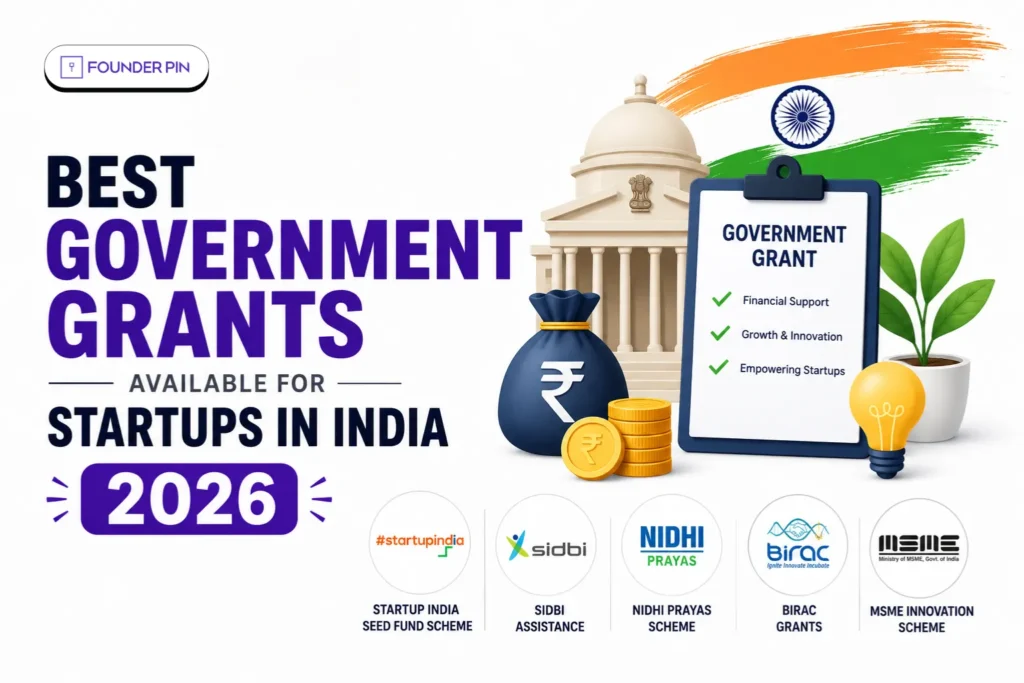
Key Takeaways
For Indian businesses, government subsidies can be a potent source of non-dilutive finance that enables founders to expand without sacrificing equity. By understanding available schemes and preparing strong applications, startups can access valuable financial and mentorship support.
- In India, government subsidies for businesses offer capital without dilution of stock.
- Programs like Startup India Seed Fund, BIRAC, AIM, and NIDHI support innovation and early-stage growth.
- State-level startup schemes offer additional funding opportunities for founders.
- Strong documentation, innovation, and a clear business plan improve grant approval chances.
- Startups may scale operations, validate ideas, and draw in new investors with the aid of government support.
Raising capital remains one of the biggest challenges for startup founders. Many entrepreneurs focus on venture capital and angel investors. However, they often overlook another valuable funding source: government grants.
Unlike traditional funding, grants do not require founders to give up equity. In addition, startups do not need to take on debt. As a result, government grants have become an attractive option for early-stage businesses looking to grow with less financial pressure.
At FounderPin, we have seen many Indian startups use government-backed programs to validate ideas, build products, and scale faster. Additionally, policymakers continue to strongly encourage India’s startup environment. Because of this, government grants for startups in India are becoming increasingly important for entrepreneurs seeking growth capital.
In this guide, you’ll discover the best startup grants India offers in 2026. We’ll also cover commom mistakes, application tips, and the most popular Startup India schemes available today. Finally, you’ll learn how to improve your chances of securing government funding and accelerating your startup’s growth.
Why Government Grants Matter for Indian Startups
Government grants play a crucial role in supporting innovation and entrepreneurship. Unlike venture capital funding, grants provide financial assistance without requiring founders to surrender ownership in their companies.
Key benefits include:
- Non-dilutive funding
- Reduced financial risk
- Support for research and innovation
- Improved startup credibility
- Easier access to future investors
For startups operating in sectors such as technology, healthcare, agritech, sustainability, and manufacturing, government funding can significantly accelerate growth.
Top Government Grants for Indian Startups (2026)
| Grant Program | Managing Organization | Funding Support | Best For |
|---|---|---|---|
| Startup India Seed Fund Scheme (SISFS) | DPIIT, Startup India | Up to ₹50 Lakhs | Early-stage startups |
| GENESIS EIR Program | MeitY | ₹10 Lakhs Grant + ₹40 Lakhs Pilot Support | Tech startups in Tier-2 & Tier-3 cities |
| SAMRIDH Program | MeitY | Up to ₹40 Lakhs Matching Investment | Technology startups |
| Fund of Funds for Startups (FFS) | SIDBI | Indirect Funding via VC Funds | Startups across various stages |
| Credit Guarantee Scheme for Startups (CGSS) | Government of India | Collateral-Free Loans up to ₹5 Crore | Growth-stage startups |
| Biotechnology Ignition Grant (BIG) | BIRAC | Up to ₹50 Lakhs | Biotech & life sciences startups |
| Atal Innovation Mission (AIM) | NITI Aayog | Funding Varies by Program | Innovation-focused startups |
| State Startup Grants & Incentives | Various State Governments | Varies by State | Regional startups & entrepreneurs |
1. Startup India Seed Fund Scheme (SISFS)
The Startup India Seed Fund Scheme (SISFS) is a flagship initiative introduced by DPIIT under the Startup India program. The scheme helps early-stage startups secure funding for product development, proof-of-concept validation, pilot testing, market entry, and commercialization activities.
Key Highlights
- Supports startups facing initial funding challenges.
- Funding is provided through approved incubators.
- Available to DPIIT-recognized startups with innovative business ideas.
- Can be used for prototype creation, product testing, and customer validation.
SISFS provides beneficial non-dilutive finance to entrepreneurs in the idea or product development stage, which helps lower financial risk while creating a solution that is ready for the market.
2. GENESIS EIR Program
The GENESIS Entrepreneur-in-Residence (EIR) program, launched by MeitY, focuses on supporting technology-driven entrepreneurs, especially those operating in Tier-2 and Tier-3 cities. The program combines financial assistance with mentorship and infrastructure support.
Program Benefits
- Grant assistance of up to ₹10 lakh for product development and validation.
- Up to ₹40 lakh in additional pilot support for commercialisation initiatives.
- Access to expert mentorship and collaborative workspaces.
This initiative is well-suited for founders who have already developed a proof of concept and are preparing to scale their innovation.
3. SAMRIDH Program
SAMRIDH (Startup Accelerator of MeitY for Product Innovation, Development, and Growth) supports technology startups by offering financial assistance and guided mentorship to help accelerate business growth.
Key Advantages
- Matching investment support of up to ₹40 lakh through partner accelerators.
- Assistance for software, electronics, and product-focused startups.
- Exposure to investors, mentors, and international opportunities.
The program combines financial support with acceleration services, making it attractive for startups aiming for rapid expansion.
4. Fund of Funds for Startups (FFS)
Managed by SIDBI, the Fund of Funds for Startups (FFS) was established under the Startup India Action Plan. Rather than investing directly in startups, the fund invests in SEBI-registered venture capital funds that support promising businesses.
Why It Matters
- Backed by a corpus of ₹10,000 crore.
- Increases capital availability through venture capital firms.
- Supports startups across both early and growth stages.
Although founders cannot apply directly for grants through FFS, the program significantly improves funding opportunities across the startup ecosystem.
5. Credit Guarantee Scheme for Startups (CGSS)
Easier Access to Business Loans
The Credit Guarantee Scheme for Startups helps eligible businesses secure loans without providing collateral. The government guarantees a portion of the loan, reducing risk for financial institutions.
Key Benefits
- Collateral-free funding up to ₹5 crore.
- Government-backed guarantee support.
- Suitable for working capital and expansion requirements.
The scheme is particularly useful for startups that need growth capital but do not have substantial assets to pledge as security.
6. Biotechnology Ignition Grant (BIG)
Funding for Biotech Innovation
The Biotechnology Ignition Grant, administered by BIRAC, supports startups working in biotechnology and life sciences. The program helps innovators convert research-based ideas into commercially viable solutions.
Funding Features
- Grant assistance of up to ₹50 lakh.
- Support period of up to 18 months.
- Ideal for health-tech, agri-tech, biomedical, and environmental innovations.
BIG plays a crucial role in helping scientific startups validate their technologies and advance product development.
7. Atal Innovation Mission (AIM)
Building a Strong Innovation Ecosystem
The Atal Innovation Mission promotes entrepreneurship and innovation throughout India. While AIM is not primarily a funding scheme, it provides valuable support through incubation networks and innovation programs.
Key Contributions
- Establishes Atal Tinkering Labs and Atal Incubation Centres.
- Offers mentorship and startup ecosystem support.
- Encourages collaboration between startups, industry, and government.
AIM-affiliated startups frequently have easier access to future funding possibilities, networking opportunities, and mentorship.
8. State-Level Startup Grants and Incentives
Additional Funding Opportunities Across States
Many state governments have launched startup-friendly policies and grant programs to encourage innovation and entrepreneurship. These initiatives often complement central government schemes.
Benefits of State Startup Programs
- Localized support tailored to regional industries.
- Funding assistance for prototype development and validation.
- Sector-focused incentives in areas such as deep tech, manufacturing, healthcare, and agriculture.
Programs like Karnataka’s ELEVATE initiative demonstrate how state governments are helping startups access additional funding and growth opportunities.
Also Read | How to Make a Winning Startup Pitch Deck in 2026
Common Mistakes Startups Make When Applying for Grants
Applying Without Eligibility Verification
Always review eligibility criteria before applying.
Weak Documentation
Incomplete or poorly prepared applications often result in rejection.
Lack of Innovation
Programs designed for innovation-focused startups may reject businesses without clear differentiation.
Ignoring Follow-Up Requirements
Grant applications often involve interviews, presentations, or additional documentation requests.
Tips to Maximize Government Grants for Your Startup
To increase your chances of securing government grants in 2026, founders should focus on preparation, compliance, and strategic planning. The following procedures can raise application success rates and grant eligibility.
Obtain DPIIT Recognition
Many government funding programs require startups to be recognized under the Startup India initiative. Securing DPIIT recognition early can unlock access to several grants, incentives, and support schemes.
Develop a Strong Business Plan
A well-structured business plan with a clear value proposition, proof of concept, and growth roadmap can significantly strengthen your funding application. Government agencies often prioritize startups with scalable and well-defined business models.
Apply Through Official Government Platforms
Always submit applications through authorized government portals such as Startup India and MyScheme. These platforms provide accurate information, application tracking, and access to multiple funding opportunities.
Collaborate With Recognized Incubators
Working with approved incubators can improve access to programs such as SISFS and SAMRIDH. Incubators also provide mentorship, networking opportunities, and guidance throughout the application process.
Maintain Financial Transparency
Keeping accurate financial records and ensuring regulatory compliance can simplify due diligence procedures. Transparent financial reporting increases credibility and improves your chances of securing government funding.
Conclusion
Government grants for startups in India offer one of the most founder-friendly funding opportunities available in 2026. From Startup India schemes and BIRAC programs to NIDHI initiatives and state-level grants, entrepreneurs have access to numerous funding pathways without sacrificing equity.
The key to success lies in understanding eligibility requirements, preparing strong applications, and demonstrating innovation, scalability, and impact. For startups seeking sustainable growth, government grants can provide the financial foundation needed to build and scale successfully.
Ready to Secure Funding for Your Startup?
At FounderPin, we help entrepreneurs improve visibility, strengthen investor readiness, and navigate funding opportunities more effectively.
Contact us for a consultation and discover how to position your startup for grants, investment, and long-term growth.
SHARE
Frequently Asked Questions (FAQs)
1. What are the best government grants available for startups in India in 2026?
Some of the top government grant programs for Indian startups in 2026 include the Startup India Seed Fund Scheme (SISFS), GENESIS EIR Program, SAMRIDH Program, Biotechnology Ignition Grant (BIG), and various state-level startup funding initiatives.
2. Who is eligible for government startup grants in India?
Eligibility varies by scheme, but most programs require startups to be registered in India. Many grants also require DPIIT recognition, a scalable business model, and an innovative product or service.
3. Do government startup grants require founders to give up equity?
No. Most government grants are non-dilutive, meaning founders can access funding without giving up ownership or equity in their startup.
4. How can startups apply for government grants in India?
Startups can apply through official portals such as Startup India, MyScheme, MeitY programs, and state government startup websites. Some schemes also require applications through approved incubators and accelerators.
5. What documents are required to apply for startup grants?
Commonly required documents include DPIIT recognition certificates, business registration documents, a business plan, financial projections, pitch decks, and proof of concept or prototype details, depending on the grant program.