Top Government Grants for EV Startups in India
Table of Contents
Toggle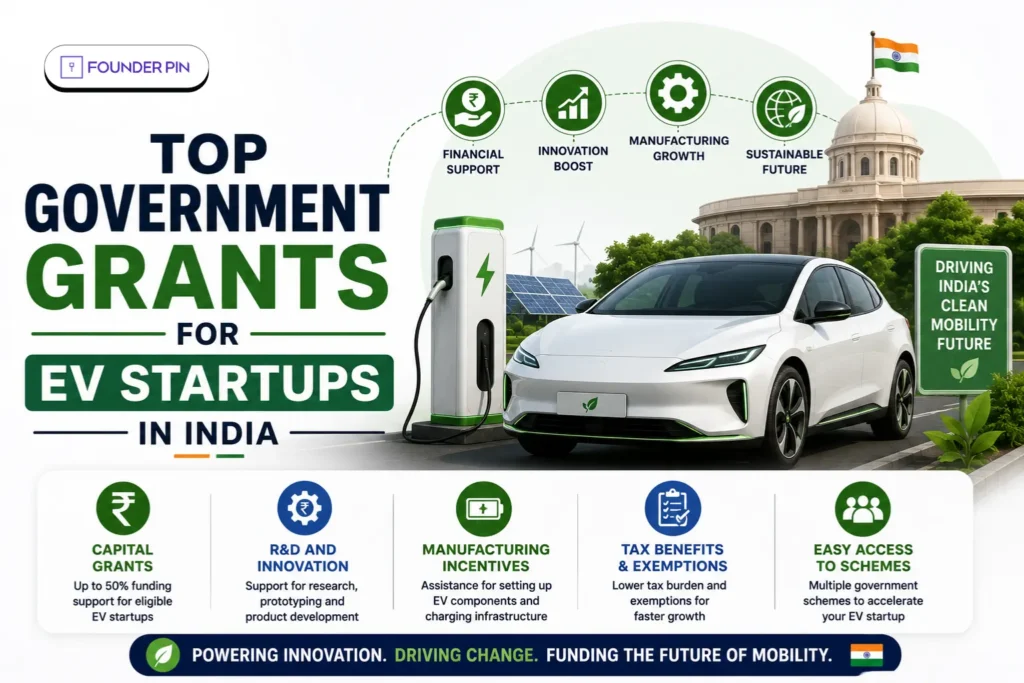
Key Takeaways
- Government Grants for EV Startups help founders access non-dilutive funding to develop electric mobility solutions without sacrificing equity.
- Programs such as the Startup India Seed Fund Scheme, MeitY GENESIS, NIDHI PRAYAS, and Technology Development Board support EV innovation and commercialization.
- EV startups working in battery technology, charging infrastructure, energy storage, and fleet electrification can benefit from specialized funding opportunities.
- State EV policies and government-backed initiatives provide additional incentives, subsidies, and startup support across India.
- Strong applications should highlight technological innovation, scalability, intellectual property, and a clear commercialization roadmap.
- Government funding can help EV startups overcome high development costs, accelerate market entry, and attract private investors.
- Leveraging EV startup funding India schemes can provide a competitive advantage in India’s rapidly growing electric mobility sector.
Introduction
India’s electric vehicle (EV) industry is experiencing rapid growth, driven by government policies, sustainability goals, rising fuel costs, and increasing consumer demand for clean transportation. From electric two-wheelers and battery technology to charging infrastructure and fleet electrification, startups are playing a crucial role in shaping the future of mobility.
However, research, product development, production, testing, and commercialisation frequently demand large sums of money to launch an EV firm. This is where government support becomes invaluable. Several grants, subsidies, and funding programs have been introduced to accelerate innovation and strengthen India’s electric mobility ecosystem.
At FounderPin, we help startups identify funding opportunities and navigate complex government schemes. In this guide, we’ll explore the top Government Grants for EV Startups in India, eligibility requirements, and strategies to improve your chances of securing funding.
“Government grants are not just a funding source for EV startups—they are a catalyst for innovation, helping founders transform ambitious mobility ideas into scalable businesses.”
Why Government Funding Matters for EV Startups
Unlike many digital startups, EV businesses often face high upfront costs associated with hardware development, battery technology, manufacturing facilities, charging infrastructure, and regulatory compliance.
Government support helps startups:
- Reduce development costs
- Accelerate innovation
- Improve commercialization efforts
- Access research infrastructure
- Build competitive advantages
- Attract future investors
For many founders, grants provide critical non-dilutive funding that preserves ownership while supporting growth.
Top Government Grants and Funding Schemes for EV Startups in India
Electric Vehicle (EV) startups in India can access several government-backed grants, subsidies, and funding programs designed to support innovation, manufacturing, charging infrastructure, and commercialization. Major initiatives include Project EVolutionS, PM E-DRIVE, Startup India Seed Fund Scheme (SISFS), and state-level EV policies in regions such as Tamil Nadu and Karnataka.
One of the biggest advantages of these programs is that many provide funding without requiring founders to give up equity, making them highly attractive for early-stage EV ventures.
Core Central Government Grants
Project EVolutionS (DST)
Funding: Up to ₹50 lakh, including ₹30 lakh through equity-linked instruments.
Focus: Supports EV startups that have achieved Technology Readiness Level (TRL) 3–4 and are working toward commercialization at TRL 6–8. The program focuses on EV components, battery technologies, and public charging infrastructure.
How to Apply: Applications can be submitted through the Department of Science and Technology (DST).
Startup India Seed Fund Scheme (SISFS)
Funding: Up to ₹20 lakh as an equity-free grant for Proof of Concept (PoC), prototype development, and product testing. Eligible startups can also receive up to ₹50 lakh through convertible debentures for commercialization and market expansion.
Focus: Early-stage startups developing innovative EV products and technologies.
How to Apply: Apply through approved incubators on the Startup India platform.
NIDHI-PRAYAS
Funding: Up to ₹10 lakh.
Focus: Designed for hardware-based startups seeking support to transform innovative EV concepts into working prototypes.
Why It Matters: Ideal for founders building physical EV products before approaching investors or larger funding programs.
MeitY GENESIS
Funding: Provides a ₹10 lakh prototype grant along with an additional ₹40 lakh pilot funding grant.
Focus: Supports deep-tech and hardware startups working on product validation, pilot deployment, and commercialization.
Why It Matters: Helps EV startups bridge the gap between prototype development and market adoption.
Also Read | How DeepTech Startups Can Access Government Funding in India
EV Subsidies and Infrastructure Incentives
| Scheme / Initiative | Financial Support | Primary Focus |
|---|---|---|
| PM E-DRIVE | ₹10,900 crore total outlay | Public transportation electrification, component manufacturing, and EV charging infrastructure |
| EV Mitra Scheme | 20% to 25% capital subsidy | Public EV charging station setup |
| PLI for Advanced Chemistry Cell (ACC) | Performance-linked incentives | Domestic manufacturing of EV battery cells and power electronics |
Why These Programs Matter
These initiatives accelerate EV adoption while strengthening India’s domestic manufacturing ecosystem. They also help startups lower infrastructure costs, access government incentives, and scale their operations more efficiently.
Leading State Government EV Grants
Tamil Nadu EV Policy
Funding: Grants ranging from ₹25 lakh to ₹1 crore.
Focus: EV manufacturing, battery technology, charging infrastructure, and clean mobility solutions.
Administered By: StartupTN and related state agencies.
Why It Matters: Tamil Nadu has emerged as one of India’s strongest EV manufacturing hubs, offering substantial support for startups operating in the sector.
Startup Karnataka (ELEVATE)
Funding: Equity-free grants of up to ₹50 lakh.
Additional Benefit: Provides a 25% capital subsidy for setting up commercial EV charging stations.
Focus: Deep-tech, sustainability, clean energy, and EV innovation.
Why It Matters: Supports early-stage startups working on next-generation mobility and energy technologies.
Essential Eligibility Requirements
DPIIT Recognition
Most EV-focused funding programs require startups to obtain official recognition from the Department for Promotion of Industry and Internal Trade (DPIIT) before applying.
Startup Age and Previous Funding Limits
For schemes such as SISFS, the startup should generally be less than 2 years old and should not have received more than ₹10 lakh in prior government grant funding.
Preference for Indigenous Technology
Many programs prioritize startups developing local intellectual property and domestic technology solutions, particularly in areas such as:
- Electric motors
- Battery Management Systems (BMS)
- Controllers and power electronics
- Charging technologies
- Energy storage systems
This focus supports India’s efforts to reduce import dependency and strengthen the domestic EV ecosystem.
Government Funding for EV Startups in Emerging Segments
Battery Technology and Energy Storage
Battery innovation remains one of the most critical areas of electric mobility.
Funding opportunities exist for startups developing:
- Advanced battery systems
- Battery recycling solutions
- Energy storage technologies
- Battery management software
EV Charging Infrastructure
As EV adoption grows, charging infrastructure becomes increasingly important.
Government support often prioritizes startups working on:
- Charging stations
- Smart charging networks
- Charging management software
- Energy optimization solutions
Fleet Electrification Platforms
Startups enabling commercial fleet electrification and mobility-as-a-service solutions can also benefit from innovation-focused funding programs.
How EV Startups Can Improve Funding Approval Chances
Demonstrate Innovation
Funding agencies prefer startups developing unique technologies rather than simply replicating existing solutions.
Founders should clearly highlight:
- Technological differentiation
- Intellectual property
- Market advantages
- Industry impact
Show Scalability
- Government programs prioritize startups capable of generating large-scale economic and environmental benefits.
- Scalable business models and growth projections strengthen applications significantly.
Present a Clear Commercialization Plan
- Innovation alone is not enough.
- Successful applications demonstrate how the technology will reach customers, generate revenue, and contribute to India’s electric mobility goals.
Common Challenges EV Founders Face
High Capital Requirements
- Hardware development, manufacturing, and testing can be expensive.
- Government grants help reduce financial barriers during critical growth stages.
Long Product Development Cycles
- EV technologies often require extensive testing and regulatory approvals before commercialization.
- Funding support enables founders to continue product development without excessive dilution.
Infrastructure Constraints
Charging infrastructure and supply chain limitations remain industry-wide challenges, making government support increasingly important.
The Future of Electric Mobility Startup Funding
India has ambitious goals for electric mobility adoption and clean energy transition. As a result, policymakers are expected to continue expanding support for EV innovation, battery manufacturing, charging infrastructure, and sustainable transportation solutions.
Founders who actively leverage electric mobility startup funding opportunities today will be better positioned to lead the next phase of India’s mobility revolution.
Conclusion
The growing availability of Government Grants for EV Startups presents significant opportunities for entrepreneurs building the future of transportation. From prototype funding and innovation grants to incubation support and commercialization assistance, government programs can help founders accelerate growth while preserving equity.
By understanding available schemes and preparing strong applications, EV startups can access the resources needed to compete in one of India’s fastest-growing industries.
Contact FounderPin for Expert Funding Guidance
Navigating government grants, EV startup schemes, and funding programs can be complex. At FounderPin, we help founders identify the right opportunities, prepare winning applications, and build funding strategies aligned with long-term growth.
Contact us for a consultation today and discover the best funding opportunities available for your EV startup.
Frequently Asked Questions (FAQs)
1. What are the best government grants for EV startups in India?
Some of the top Government Grants for EV Startups include the Startup India Seed Fund Scheme (SISFS), MeitY GENESIS, NIDHI PRAYAS, Project EVolutionS (DST), and state-level EV incentive programs. These initiatives support innovation, product development, and commercialization.
2. Can electric vehicle startups get government funding without giving up equity?
Yes. Most government grants and subsidies are non-dilutive, allowing EV startups to access funding without surrendering ownership or equity in their business.
3. Who is eligible for EV startup funding in India?
Eligibility varies by scheme, but most programs support registered startups, MSMEs, and innovation-driven businesses working in electric mobility, battery technology, charging infrastructure, clean energy, and sustainable transportation.
4. Are there government grants available for EV charging infrastructure startups?
Indeed. Startups creating charge stations, charging networks, smart charging solutions, and other electric mobility infrastructure are supported by a number of government programs and state EV regulations.
5. How can EV startups improve their chances of securing government grants?
Startups should focus on demonstrating innovation, scalability, market demand, environmental impact, and a clear commercialization strategy. Strong documentation and a detailed business plan also improve approval chances.
SHARE